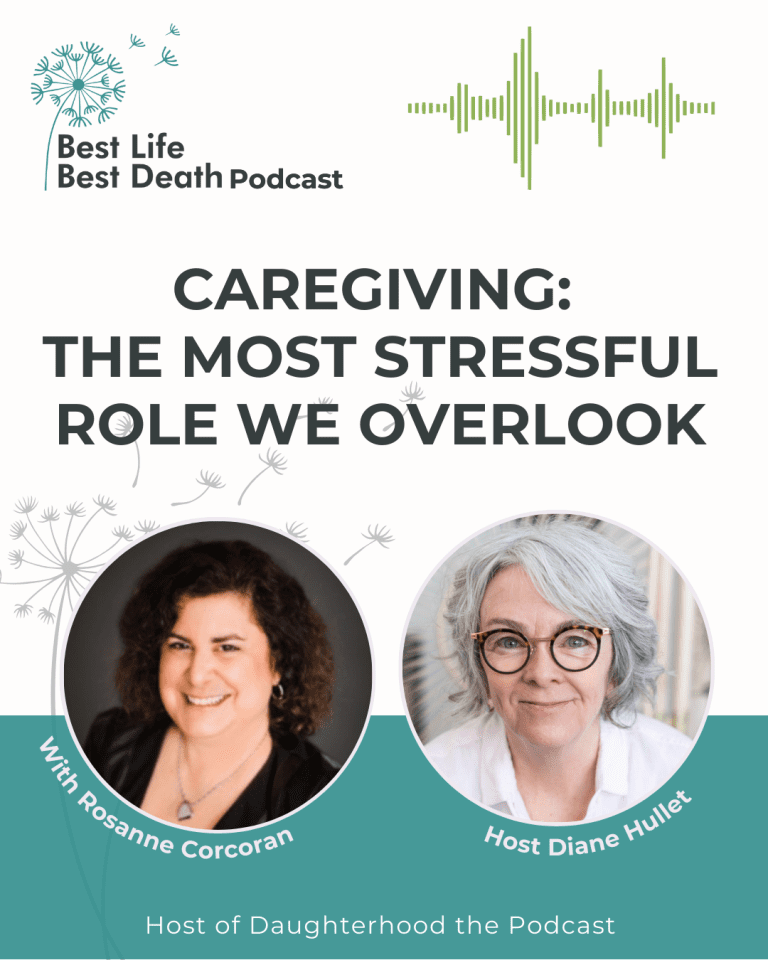
Rosanne Corcoran knows caregiving from the inside. When her mother moved in with vascular dementia, Rosanne became her primary caregiver for years, navigating the daily realities, emotional toll, and quiet endurance that so often go unseen. Today, she channels that lived experience into advocacy as a support-circle leader and podcast host with Daughterhood, a community built to reduce isolation and provide support to caregivers. With an estimated 63 million caregivers in the U.S., and 44% of them providing high levels of care, this conversation matters more than most of us realize.
As Rosanne puts it: “Caregivers at the core are isolated, overwhelmed, carrying guilt, and living with grief, and almost no one recognizes any of that.” If you are a caregiver – or know someone who is – listen in, share this episode, and help make the invisible labor of caregiving visible. daughterhood.org
For more information on Best Life Best Death please visit our website at www.bestlifebestdeath.com
Follow us on our social channels to receive pertinent and helpful resources on death, grieving, and more at:
Facebook: www.facebook.com/bestlifebestdeath
Instagram: www.instagram.com/bestlifebestdeath
Transcript:
Diane Hullet: [00:00:00] Hi, I am Diane Hullet, and you’re listening to the Best Life Best Death podcast. Today I’ve got another podcaster joining me among other many talents. Welcome to Roseanne Corcoran.
Rosanne Corcoran: Hi. Thank you. Thanks for having me.
Diane Hullet: I’m so glad you’re here. We, um, just in our little bit of 10 minutes of riffing before we hit record, we started to go off on all these things we need to talk about.
So I’m excited for listeners to hear what you have to say because what you’re talking about is really caregiving at the biggest level and the most micro level of what it means to be a daughter who’s caregiving and. Gosh, that’s so many people. So, okay, I’m diving right in. Tell us about you, Roseanne, how you got into what you do and what it is that you do.
Rosanne Corcoran: Uh, sure. So I, um, I was caring for my mom who had vascular dementia, so she had vascular dementia for 12 years. [00:01:00] Um. She lived independently. I did my best to support her independently, trying to keep her independent, and when it became apparent that she couldn’t live by herself anymore, she moved in with me and, and my family.
And she lived with us for six years until she died. You know, I, I adored my mother. I would do anything for her. I did do anything for her, and it was the hardest thing I ever did in my life. And it, you know, it, it just, the stress, the anxiety, the overwhelm, the worry, all of it. And I often wondered about people that didn’t like who they were caring for, because not everybody cares for the person that they, that they’re caring for.
I mean, that’s the reality. It’s not a nice thing to say, but that’s the reality. So. Um, while I was caring for her and I had two kids at home and I had a husband that traveled and, you know, it was, it was bedlam a lot. I had heard Tepa snow say, um, caregivers should have four to five hours to themselves every day.
Diane Hullet: Ha ha ha, [00:02:00] let’s add a little chuckle, four to five hours. I mean, wouldn’t that be incredible? But I know, I know caregivers who don’t have four to five minutes.
Rosanne Corcoran: Agreed. Agreed. And
Diane Hullet: we should add, who’s Tepa Snow
Rosanne Corcoran: Tepa, snow Dementia Expert, uh, dementia Wizard, Tepa Snow, um, who’s just fantastic. The, the strategies that she has, the approach that she has is, is life changing for somebody who’s dealing with dementia.
But when she said that, I thought, oh my God, how am I, what am I? How do you do this? And, um. But I, I heard her and I heard her in the midst of my life going, I don’t know how I’m gonna continue this pace. Because the thing that caregivers also forget is that it will end, your caregiving will end, and what you’re doing within this time is gonna affect that time as well.
And so [00:03:00] I was lucky enough to find someone to come in for a few hours a day, and I thought if I, and I had in my, in my searching for, oh my God, what do I do as a caregiver? How am I supposed to do all of this? I came upon an tomlinson’s blog on daughter daughter.org website, and when I read it, I thought, is this woman here?
Can she see me? Because I feel like. She was looking through my window and saying, you know, you’re okay. This is normal. Of course you feel this way. And I saw that they had, uh, support groups. They, we call them circles. And this was back in the time when we were in person. So I thought if I could ever get out of my house, I was gonna start a support group because I knew there were more people like me that were around.
But how do you find each other? Right? So I had somebody come in, I started this, a local support group, and each month. We would get together and we would be saying the same thing. You know, I’m so stressed I’m, I don’t know [00:04:00] how, I don’t know how to deal with these feelings. I feel so heavy, and I thought. I want to like talk about this.
Why isn’t anybody talking about this? So, I, my background is English communications. I have a BA in English Communications. So I knew that I could do, I could put something together. And I started this podcast. I went to Anne and I said, listen, I would love to create this podcast, make it part of daughter so I can talk to people.
Great. So I start recording in my PO in my closet. So my mother would be in the other room and I’d be in the closet surrounded by my clothes talking to experts. And, and that’s, that’s how that’s all started. You know, I’ve been fortunate to be able to speak with experts and not only to be able to ask the questions, but to ask the follow up question.
You know, like, okay, that’s a great answer. What happens when that doesn’t work? What do I do now? So it was, it was really great and I’ve had, I’ve been so fortunate to have. You know, I’ve had tip of snow on twice. I’ve had, uh, Judy Cornish on. I’ve had Lisa Gibbons, whose mother and [00:05:00] grandmother had Alzheimer’s and started her own nonprofit, Lisa’s Care connection.
You know, I’ve been able to talk to Barbara Carns. I mean, in what world can I speak to? Barbara Carns and I had Barbara Carns on speaking about hospice, you know, siblings and caregiving, compassion fatigue, caring for an estranged parent, all these things that come up because caregivers at the core. Are isolated, they’re overwhelmed.
They have lots of guilt, and there’s grief and no one recognizes any of that. I mean, I’ve had, I’ve had, um, professionals, I’ve had doctors, I’ve had social workers say to me, when I had to take care of my mother or my father, I was so overwhelmed and felt so out of the loop. I didn’t know what to do. And these are professionals.
Do you know, and we’re asking caregivers to go, okay, here you go. Go get it in the system. That’s not built for you.
Diane Hullet: Yeah,
Rosanne Corcoran: go talk in in a language that you don’t know [00:06:00] and, and it’s overwhelming.
Diane Hullet: It’s overwhelming and they don’t have even, you know, they are the frog in the hot water often, right? So you start doing a little, then you start doing a little more.
The water gets hotter and hotter, your time gets less and less, and pretty soon you’ve got a full-time job, maybe a kid or two, maybe a partner and an ailing parent that maybe you’re taking care of long distance and flying back and forth, and maybe you’re nearby. But whatever the location, the distance, the diagnosis.
The prognosis, it’s so overwhelming, and you don’t even really have the time to take the time to figure out what the resources are that would help you.
Rosanne Corcoran: You don’t, you don’t, and even when you find them and you’re reading them and you’re like, I’m re, I’m reading the same sentence four times.
Diane Hullet: Yes.
Rosanne Corcoran: Because I know what you’re saying to me, but I don’t know what you’re saying to me because you’re so stressed and everything’s, you’re, you’re on high alert all the time and those types of things.
It’s really hard to get through that. [00:07:00]
Diane Hullet: It’s really hard to get through that. And I love hearing that on your podcast, one of the things you love to do is the follow-up question, right? So when you talk to Tepa Snow and Tepa Snow says Caregivers should have four to five hours to themselves a day. What’s the follow-up question for that?
Rosanne Corcoran: How?
Diane Hullet: Mm-hmm.
Rosanne Corcoran: How? How do we do that? And the answer is you have to, which is a really hard answer and it’s a really hard thing to hear. But that leads us into. The expectations, right? What are the expectations that we have for ourselves and that we’re doing for other people?
Diane Hullet: Yeah. So the expectations we have of ourselves that maybe our family has of us, maybe that the person has of us.
Talk a little more about that.
Rosanne Corcoran: Well, it’s, you know, it’s, it’s so hard because we’re holding ourselves to a different standard. And we’re running around trying to do these things and we’re, everything’s out, right? We’re putting [00:08:00] all of our energy out. And then inevitably, you can’t be everything to everybody.
You just can’t. You can try, but you can’t. Something’s gonna get lost in the shuffle. And when, when we look at it like, okay, I am one person here. And I’m doing the best that I can. And with all of the caregivers that I speak to, I always say to them, you are doing the best that you can in an impossible situation, right, with the information that you have.
So you’re dealing and it’s, it’s very easy to go from expectations to guilt. Because then you say, gosh, I, I should have known that. Why? Why should you have known that? Were you trained in this? Did you have a course in this? Do you have a, do you have a degree in wound care? I don’t think you do, but yet you’re doing wound care and you know, there’s a thousand different things.
When I was caring for my mom, when I was with my kids, I was thinking about what I had to do for my mom. And when I was with my mom, I was thinking about what [00:09:00] my kids weren’t getting. So it’s that constant, that’s the expectation guilt thing, right? Because we’re trying to do all of these things and we have to really look at it and look at the reality of it and say, this is what I can do today, and if I don’t get there, it doesn’t mean you’re a bad person.
It doesn’t mean that you failed. It doesn’t mean any of that. But that’s how we feel. Then you compound that every day. Because again, we’re putting everything out, right? We’re giving everything outward, and we’re not giving anything to ourselves because we’re the last person on our list because it’s easier.
I’m doing this, I’m doing this, I’m running here, I’m running there. What you want me to, what do you want me to do? You want me to go for a walk? How am I gonna go for a walk?
Diane Hullet: Right? How’s that exactly gonna fit
Rosanne Corcoran: in? How does that work? But those are the things when you look at your schedule and you look at what you’re doing, it’s like, okay.
How can I, how can I put a little bit in here [00:10:00] for me, if you can’t look at it and say, I’m gonna go take five hours off, okay, I’m not gonna look at that. But how about if I take five minutes off in the morning? How about if I do something for me? And then you build on that, and then you build a little bit more, and then those five minutes become 15 minutes, even if you have to split them up.
But it’s just something to feed your soul. Because you matter in this whole world of it, right? A caregiving care. Being a caregiving caregiver is part of a duo. You can’t have a caregiver without a care partner, so that’s part of the equation. You are part of the equation even though nobody treats you that way, even though nobody thinks you’re doing a whole lot.
I once had somebody say to me, how hard is it to take care of your mom? You’re just sitting there with her. Yeah, that’s, that’s what I’m doing. I’m just sitting here with her. Yeah. Yep,
Diane Hullet: yep. Pretty much like that.
Rosanne Corcoran: Pretty much, pretty much. I mean, you know, [00:11:00] you do have your fair share of, you know, the price is right and all, you know, young and the restless, which is great, but there’s other, you know, fires come up all day long and that’s stress and that expectation of what am I supposed to be doing?
Diane Hullet: Talk a little too about the, so the internal expectation is. Often based on what,
Rosanne Corcoran: um, our families, um, our ideas of who we’re s what we’re supposed to do, what we should be doing, how we should be doing it, all of those types of things. Um, you know, and it doesn’t help when people say, well, of course, of course they’re your parents.
Of course you’re gonna take care of them. They took care of you. Not helpful. It’s not helpful, and. It’s those types of exterior shoulds that get in the way. And I always say, you have to have a ectomy. Don’t we don’t need shoulds. [00:12:00] You know, we don’t need shoulds. We don’t need people that say, at least we don’t need the uh, yeah, but I’ve never heard somebody say at least, and then there’s been something positive after it.
Never. So. We have to cut ourselves a break, and it’s self-compassion. It’s self love. It’s all of those self things that when you’re used to putting everything out, you don’t bring it back in. That’s part of the really hard stuff, which goes then to, of course, boundaries, which is a whole nother, you know, a whole nother That’s
Diane Hullet: that’s a whole other podcast.
Yeah. Yeah. It’s huge. Exactly. It’s huge. Not to mention finances, which is huge, huge, huge. But Roseanne pop out for a little, ’cause we were talking about how just in the last month some statistics have come out. Yeah, yeah. What, what can you tell us about women daughters caregiving the world?
Rosanne Corcoran: So we know from the National Alliance for Caregiving are one of [00:13:00] our favorite groups and a A A and A A RP.
They came out with a report that said 63. There are 63 million family caregivers in the United States. 63 million, 61% of them are women, 38% are men. Of those 63 million, 44% provide a high level of care.
Diane Hullet: Wow. Take that in. Listeners. 44% provide a high level of care.
Rosanne Corcoran: Yes.
Diane Hullet: Not just sort of casual and
Rosanne Corcoran: No, not
Diane Hullet: just sitting
Rosanne Corcoran: there
Diane Hullet: watching.
The price is
Rosanne Corcoran: right. Just
Diane Hullet: sitting there. Yeah. Not, not the price is right level. Yes.
Rosanne Corcoran: Yes. Yeah. So that, and not to mention the billions of dollars that family caregivers save the healthcare industry for doing what they do. And how, how many times, you know, remember back in the day when you would have surgery, they’d keep you overnight or they’d keep you for three days, and then you n no.
Mm-hmm. It’s like, okay, here’s your hat. What’s your [00:14:00] hurry? Gotta go. Just had surgery. You’ll be fine. Here’s your, here’s your page of instructions. Good luck to you. And what happens? That becomes the caregiver’s job, not the job. They, not the job they trained for, not the job they signed up for. Probably
Diane Hullet: not the job that they’re holding down and trying to get to.
Rosanne Corcoran: Correct? Correct. I mean, how many we know and we know that women suffer because they leave the workforce because you really can’t do it all. It’s, it’s, it’s impossible. So what happens? They leave the workforce, they leave their job, they leave their social security, they leave their 4 0 1 Ks, they leave them.
And what, and then what?
Diane Hullet: Then they need caregiving down the road is then what? Like I’m struck by what a societal per perpetuating cycle this becomes, right?
Rosanne Corcoran: Yes, yes. From the very beginning. Yes.
Diane Hullet: So not only are we saving [00:15:00] the healthcare system billions of dollars in the caregiving, we’re also so not putting in billions of dollars into the economic engine.
Right. By stepping back.
Rosanne Corcoran: Right, right. Yep.
Diane Hullet: I’m so struck by how it, this is, to me, this is such a fascinating conversation because it’s like the micro individual, me or a friend of mine who’s a daughter who’s caregiving, and it’s the macro, like it’s also this much, much bigger. Issue problem that I have no idea how to face head on, but it always bounces back to the micro.
It bounces back to the one person who’s had a surgery of some kind and the daughter needs to fly home and support, or the son needs to fly home and support or, yeah. They need to drive across town and make arrangements. Like there’s just so much that has to happen and people are living longer. So I don’t think this is getting any simpler.
I just read a report that said by, you know, some year we’re, that life expectancy is [00:16:00] 85.
Rosanne Corcoran: Mm-hmm.
Diane Hullet: This is big to live into 85. And to me it’s never the numbers, it’s the, you know, it’s not the number in terms of a number for longevity. It’s the how do you live that healthfully, and I don’t know that we’re living it healthfully.
So the last X number of years of that require caregiving.
Rosanne Corcoran: That’s exactly right. That’s exactly right. And we don’t talk about the quality of life, which is very different. And we know caregiving happens in, in many day different ways. It either happens slowly over time, right? It happens with a diagnosis or it happens with an accident or a stroke, like a stroke, a fall, something, and you’re going along your day and you get the phone call, right?
The phone call, and off you go and everything has changed and you’re not prepared for it, and you have to figure out how to make it work and what happens when you have a job that you can’t leave? You are working and you’re still trying to provide [00:17:00] and you’re trying to split yourself in two, it’s, it’s, um, it is the most stressful thing that is overlooked.
It just is.
Diane Hullet: Oh, that’s so well said. It’s the most stressful thing that’s overlooked because we talk about what a, what a health crisis stress and how difficult it is, but this is a stressor that’s often not seen.
Rosanne Corcoran: Mm-hmm.
Diane Hullet: Why do you think that is? Roseanne? Do you think it’s because it’s 60% women?
Rosanne Corcoran: I do. You said
Diane Hullet: conspiratorially?
Mm-hmm.
Rosanne Corcoran: Yes, indeed. Yes, indeed. And yes. And that’s also part of the problem because women will just pick up. No, she’ll take care of it. Yep. She’ll, she’ll, she’ll take care of the kids and the, and the, and the parents and everything else, and her house and her, oh, and by by the way, go get a manicure. Yes. That it’s all of that.
And it’s like, [00:18:00] no, no, it’s really hard.
Diane Hullet: It’s so big. What? What do people. Well, let’s talk a little about, you know, solution. Ha ha. There’s, there’s no simple solution, but what, what, what resources are there? What do people need? What, if anything, is helpful?
Rosanne Corcoran: So support, you know, I will always hold the flag for support because you can’t, you, you can do it alone, but you can’t do it alone.
You need something and you need that. You need somebody to be able to say, I see you. I hear you. You’re doing it more than just, you know, I don’t know how you do it. Okay. Thank you. Doesn’t help me. You know, in daughter, we hear over and over. Um, I feel so much better that I’ve got that. I found you. I feel so much better now than I did when I [00:19:00] signed on because it’s.
It’s that feeling of, oh my goodness, you too. You feel like this too. I thought it was just me. And it’s not just you, but you can’t say this if you say it to a non-safe person, and I’m by non-safe. I mean somebody that goes, whoa, what’s a big deal? It’s, it’s like grief, really. People wanna tell you how you feel.
People wanna say, well, you know. You should be again, right? You should be feeling this way or, or that way. But they don’t let you speak. They don’t because sometimes what comes out of your mouth is not nice as a caregiver, you know, when it’s like, I don’t know how much longer I can do this. I don’t know how much longer I wanna do this.
Diane Hullet: I don’t like this person.
Rosanne Corcoran: I don’t like this person,
Diane Hullet: or this person has been difficult my whole life.
Rosanne Corcoran: Correct, correct. I, she was, they were never there for me. Now I’m supposed to do this. And we’re [00:20:00] talking. I mean, caregiving is physically demanding. It’s emotionally demanding. It’s, it, it, it throws you in ways that you would never think possible, and then you’re supposed to just keep going.
And there is that, like I said about grievers, there is that. F that thread of grief that runs through caregiving. It’s anticipatory grief. It’s grief over watching what’s happening to your person. It’s the grief of you losing that relationship with them, whether you had one or not, because. Grieving if you, if you didn’t have a relationship with them, you’re grieving that relationship anyway.
And then on top of it, it’s all of this that happens during caregiving, it’s all it, it all runs through. And that’s why everybody feels so heavy and they can’t figure out why they feel so heavy. Because they’re not looking at the fact that they’re, they feel guilty, they feel grief, they’re overwhelmed, they can’t think straight.
And that’s where you have to have [00:21:00] that space to be able to get all of that out. You have to be able to get it out
Diane Hullet: and have it reflected, not just get it out and vent to someone who sort of pleasantly listens, but Right. But really to get it out to a, to a, where there’s a, like I keep saying, like a plug, you know, like the plug fits into the socket, like the it meets and then the, the electricity happens or something.
Right? Yes. I, I keep thinking how this puts a light on the conflicting feelings of caregivers.
Rosanne Corcoran: Yeah. Yeah. Because it’s always. It’s something that you wanna do. And there were times I remember sitting, you know, I cared through the pandemic. So
Diane Hullet: add a layer. Just add a layer.
Rosanne Corcoran: Add a layer. Nobody’s coming in, nobody’s going out.
I’m a lot of fun, but after a few months it gets a little old that my mother’s like, isn’t nobody else coming? You know? So, um. But you know, sitting there thinking, oh my God, how much [00:22:00] longer is this gonna be? Because the thing, especially with dementia caregiving, it’s not like it’s gonna stop. It just keeps going.
And in every section you think, boy, this is the worst. And then it’s like, no, no, no, no. The worst is it’s still, you still have to get there. It’s still around the corner and that, and that’s really. It’s really hard and it’s really draining, and it, and there’s, there’s times when you’re like, I, I just, I don’t know, is this gonna end?
I hope that it ends soon. And then you feel guilty about thinking that. So it’s really, there’s just, there’s so many layers. There’s just so many layers of all of that, of that guilt and that overwhelm and that grief and trying to, and then you’re trying to be your regular person, right? You’re trying to be yourself.
And then your friends are like, nah, maybe not, because you can’t hear what they’re saying. You can’t. It’s really [00:23:00] hard to concentrate on, I’m picking out curtains for my living room when you know you’re changing somebody’s. Catheter or your, your, you know, you’re try trying to turn them so they don’t get a, a pressure wound or you, you, the, the, you know, you, you just spend four hours on the phone with the insurance company or trying to get your, your prescription filled that you need a new certification for, even though the disease hasn’t changed.
All of that,
Diane Hullet: or you’ve made appointments, you’re worried if they’re gonna go to the appointment. You’re worried if you’re gonna get there in time to go to the appointment. You’re thinking, you know, there’s so much anticipation and we haven’t even really named, which I think is interesting to name two. A lot of parents are divorced, so maybe you’re dealing with two parents.
Maybe they’re in the same place, maybe they’re not.
Rosanne Corcoran: Yes.
Diane Hullet: Maybe you have siblings who are helpful, maybe they’re not. Talk about adding a layer. Right.
Rosanne Corcoran: Yes, yes, yes. And even when you’re dealing with parents that don’t have a [00:24:00] diagnosis, that don’t have a disease, but they need help, but they’re not willing to accept that they need help, they don’t wanna, they’re fine.
Don’t worry about it. They don’t want someone in the house. They don’t, I don’t want somebody in the house. Okay. But what about now? I’ll, I don’t care if I fall down the steps. I’ll just lay there. Okay. That’s great. That does a, that does an adult child’s heart good. Okay. You know, but it’s, but those are the kinds of things.
So then you have the frustration that goes with it and you’re just Yeah. And it’s like, okay.
Diane Hullet: Frustration. The communication, the attempts at communication, the having communication, and then they forget. There was communication. The, I agree to a caregiver, but then who is this person who’s showing up at my house?
I don’t like this person.
Rosanne Corcoran: Right, right.
Diane Hullet: All of it. If you can afford a caregiver, all of it, if you can afford it, caregiver.
Rosanne Corcoran: Right.
Diane Hullet: Of all of it. Roseanne, so, so people need support. Yes. They, they need to be able to express. They need to be able to, number one, realize how much conflicting emotion [00:25:00] is pouring through.
Right? Yes. And then find a place to be able to not only vent, but really be met.
Rosanne Corcoran: Yes.
Diane Hullet: What, what else is helpful? So support is helpful. What else?
Rosanne Corcoran: Support is helpful
Diane Hullet: or what? What are the ways that that support can come? Let’s talk about that. Like, it strikes me that one would be listening to your podcast, another is joining a circle.
Sure.
Rosanne Corcoran: There are, since, since COVID happened, there are so many options of online support. You can get grief support, you get caregiver support. You, you, they’re out there, Google it. You’ll see a plethora of options for you. So in, in one way. COVID was helpful in being able to access support. So that’s one way.
Even if you know, you have, you know, I could stand at the grocery store right now. I could go to the grocery store and stand there and walk up an aisle and say, I’m sorry, are you caregiving for, are you providing care to someone? And they’d be like, oh yeah, or not me, but my next door neighbor, there’s always a caregiver around and they’re always looking for [00:26:00] something to connect.
So. Locally, there are, are, are opportunities you can call your local area agency on aging. They will have a list for you if, if you don’t want to go online, if you wanna stay in your area, local area, agency on aging. The other parts are being organized in what you need. People do not wanna talk about their end of life plans.
It’s the one thing nobody wants to talk about. That’s pretty important. And so trying to get them to talk about. A power of attorney, power of powers of attorney are very helpful. Power of attorney, medical power of attorney, all of that is very helpful because it allows you to help them in different ways.
Again, don’t wanna talk about it. So you have to keep trying. There are many, there are many, uh, websites that you can go to. The five conversations, the death deck. What the other, the
Diane Hullet: Conversation Project.
Rosanne Corcoran: Conversation Project. That’s the one I couldn’t think of. Thank you. And
Diane Hullet: their, their tagline, which I [00:27:00] love so much, is it’s always too soon.
Until it’s too late.
Rosanne Corcoran: That’s,
Diane Hullet: and, and this is the thing, you know, people say, oh, it’s too soon. I’m not ready to talk about it. Well, how do you bring it up? How do you bring it up over time? How do you bring it up in different ways? Exactly. How do you say, uh, you know, mom, dad, grandparent, aunt, uncle, friend.
This is really important so that I will be able to help you. I, there’s some statistic out there. I’m terrible at remembering numbers, but there’s some statistic out there about the number of people. Almost all of us at some point will need someone to speak for us when we cannot speak for ourselves. Yes.
And I find that’s a more useful phrase for people than kind of medical power. You know why I don’t need a medical power of attorney? Agreed. The point is you there will, something will happen and you will not be able to speak for yourself. Maybe you’re not in a coma, but you’ve knocked your head in a fall and you’re confused and we need to be able to.
Help you. Yes, please help [00:28:00] us help you. But, oh, oh, I’m, I’m preaching to the choir here. I mean, we, we, we know how important this is and that it always feels too soon until it’s too late. Yes. But I, I, I like your, your approach here, Rosanna, and this is what I say over and over again. I think we’ve just gotta keep trying to have those conversations.
It’s not one conversation and he didn’t wanna talk about it, so screw it. I’m not bringing it up again. That’s right. It’s, it’s like, well, what about this angle? What about that angle? Hey, I was watching the pit the other night and this thing happened and it made me think that we should really dah, dah, dah, dah.
Right.
Rosanne Corcoran: Abso, and that’s, and that’s what’s been happening ever since the pit has come out. That’s what’s been happening. And part of that is, and I, I, I’m sure you know this end well, is part of their advisors amazing part of their advisory board?
Diane Hullet: Yeah.
Rosanne Corcoran: Well, that’s how we do this, right? And what is it? If you can see it, you can be it.
Well, it’s the same thing with content, right? Yes. If we talk about it. Then people will talk [00:29:00] about it because I just saw it.
Diane Hullet: And this is the power of something as simple and as complex as a series on tv, right? Yes. It normalizes things. I heard that this week on the pit there was a death doula. Yes. So I’ll, I’ll date when we’re talking about this because we’re talking in early February, 2026 and, uh.
You know the other thing, speaking of that, is a timely thing. The other thing I was thinking of when you were speaking about connections and your community, I’ve been so struck by the Minneapolis organization at a community level, right? Through all the complexity of what’s happening, whatever you believe on immigration, we won’t go there, but their level of community organizing that they set up during COVID, neighbor to neighbor.
Neighborhoods, connected neighborhoods, little regions within the city has just been extraordinary to me. And I have a text thread with some neighborhood women and we tell each other when there’s a bear in the area or a mountain lion. That’s our main thing. Lately, recently, we’ve [00:30:00] had a coyote wandering through our suburban neighborhood about every other day.
Wow. So, but, but what does it mean to be connected to neighbors? And to help people who find themselves in these caregiving positions, which is all of us. How do we connect and how do we support? That’s my big tangent, but what kind of other pearls of wisdom around support or what caregivers need would you add?
Rosanne Corcoran: Well, I mean, you, you make a great point because we, listen, my mother was one of 12. They all lived within 10 minutes of each other, so it was. It was just part of what you do. Right. And we’ve grown away from that because people don’t have a lot of kids or they have, or kids to move away or whatever. And we’ve seen it through the pandemic where everybody’s in their house.
We don’t, we don’t connect like we used to. So that’s a big missing piece. And then we have to turn to our communities, which may or may not have [00:31:00] funding or. Any type of programs that we can tap into. But I’m seeing more and more, like you said, the connection senior centers and those types of organizations, even meetups.
Do you know on Meetup or groups or those types of things. So the library. People. I love a library, love a library. There’s all these groups happening at a library, the, the YMCA, those types of things to try to connect with other people. If you don’t want to connect online, um, there are still support groups that meet in person.
If you check the hospital systems, if you check a, you know, if you have a big hospital system near you, check that out. But there’s ways to try to find, sometimes it’s a search, you know. Uh, uh, just a plain old Google search, um, to see what’s around. The frustration happens when you call and they don’t, they don’t exist anymore, or they don’t have what you’re [00:32:00] looking for.
Diane Hullet: Yeah. Yeah. I just heard that in Boulder County where I live, there is no. Services for teenagers who’ve lost a sibling to overdose or suicide. It strikes me as just a huge missing component. So how does a young person find somebody who’s had that experience that they can connect with? Maybe there’s something in Denver front range.
I don’t know. But I think, I think you’re absolutely right, that COVID, uh uh, a small silver lining of COVID is that we found out we can connect over zoom. And there’s so much to that and there is so much out there. The other thing that I think gets in the way of people reaching out, well, number one time, like right, like that five hours they’re supposed to find
Rosanne Corcoran: caregivers.
I know,
Diane Hullet: but call it five minutes. Yeah. I, it strikes me that one of the things you could ask for as a caregiver, if you have someone in your life, is to say to the other person who’s got a little more distance from the caregiving, help me find some resources. I need a [00:33:00] group that’s perfect for me, right?
Give me four options of something I could attend. But before that, you have to realize you’re the frog in the hot water and you need some help and some support, and what a difference support could make. That’s what I hope people are taking away from this conversation is that support is available and, and that there’s something beyond just, I’m kind of eating and kind of sleeping and kind of caregiving, kind of working and kind of being a parent if I’m a parent.
There is something a little bit more beyond that, but you have to realize you need to reach out for it
Rosanne Corcoran: and you have to realize that you’re worth it. You are worth trying because all of these things take courage. It’s hard to show up and be like, oh, hi, I need support. It’s hard whether you’re on Zoom or you’re in person, it’s hard to walk through that door or hit that button and say, this is how I’m feeling.
This is how I’m feeling. I’m Italian. I don’t [00:34:00] talk about my feelings. I eat them.
Diane Hullet: I thought Italians. Oh, they eat them. I was gonna say, I thought Italians express their feelings.
Rosanne Corcoran: We do to each other, but not outside the house.
Diane Hullet: Right. You’re not gonna go to a group of strangers.
Rosanne Corcoran: No, no, no. We don’t talk about our problems outside of the house.
Just in the house. And that’s where it’s really hard to say to somebody who you don’t know, this is how I feel. No. Mm-hmm. And even. Even allowing yourself that. And sometimes, you know, in our, in our circles, I say, you don’t have to put your camera on. I don’t have to see your face. There are people that I’ve spoken to for five years.
I wouldn’t know what they looked like if they knocked on my door. I’d be like, hi. I don’t, it doesn’t matter because you’re still getting that. Even if you just listen. And some people will say, oh, I can’t do a group that’s, that’ll make me more depressed. Or I don’t wanna hear other people’s problems. And what they don’t realize is that, yeah, it might be somebody else’s problem, but you can hear yourself in it, [00:35:00] and you can hear somebody berating themselves while you’re going, you’re doing the best that you can.
And then it’s like, oh wait, I think I am too.
Diane Hullet: Yes. Or here’s someone’s uncomfortable feelings, right? The anger, the disconnect, the, I actually hate this person I’m caregiving for right now. I, you know, that’s, I think those, those difficult emotions on top of the overwhelm are part of what seemed to make it such a difficult finger trap kind of thing.
Like you just think, God, I’m a terrible person, a terrible daughter, and I don’t know what to do.
Rosanne Corcoran: Yep. Yep. And in the meantime, you are showing up every day. Even though you feel all these feelings, you’re still showing up, you’re still going back and you, that’s gotta account for something for you. And that’s where if we can be a little kinder to ourselves and realize that we are carrying this backpack full of just.
[00:36:00] Stuff, and we’re still doing it and we’re still showing up, and there are places for you to put that backpack down for a little bit, just for a little bit. Give yourself a break and talk to somebody else. Look at somebody else. Read something else. There’s, there’s so, I mean, caregiving is the hot thing right now, right?
It’s everywhere. Somebody’s always writing about something with caregiving. You can see yourself in these things and maybe just, maybe you can give yourself a little break.
Diane Hullet: Roseanne, I could talk to you for hours. This is so compelling and, and it’s just exactly right up the, you know, right up the alley of the conversations I love to have.
Um, but we need to wind down. So tell us again, uh, some websites where people can find out about you, your podcast, whatever you think it’d be helpful.
Rosanne Corcoran: If you go to daughter hood.org, you will find, uh, our all a list of our circles. The podcast lives there. We have Anne’s blogs are there. We have a list of, we have a list of national [00:37:00] resources in our resource section along with books from people that I’ve interviewed.
Books that we find important and helpful, and these are not books that. You know, it’s hard when you’re a caregiver. Like I used to just page through magazines. I couldn’t read who was, who was reading. But these are the kinds of books that you can read while you’re caregiving because they’re productive to you and they can break things down.
Um, and we have everybody from, you know, Barbara Karns, to Allison Applebaum, to Barry Jacobs. Like, there’s a lot of information there, but really there’s support out there for you everywhere. If you search it, you Google it. You can find it, I promise. I promise. And there are other people that will help you.
And just remember that you matter. You are worth it, and you’re doing the best you can in a really hard, uh, hard situation.
Diane Hullet: Well said. Well, thanks so much for listening. I have a feeling Roseanne and I will talk again. We’ll just, uh, come up with some other topics that we don’t want to kind of, [00:38:00] uh, you know, dive into the rabbit hole of, because I think there’s so much here.
Um, in the meantime, thanks for listening to this episode. You’ve been listening to Best Life Best Death, and as always, you can find out more about the work I do at bestlifebestdeath.com. Thanks for listening.
End of Life Doula, Podcaster, and founder of Best Life Best Death.