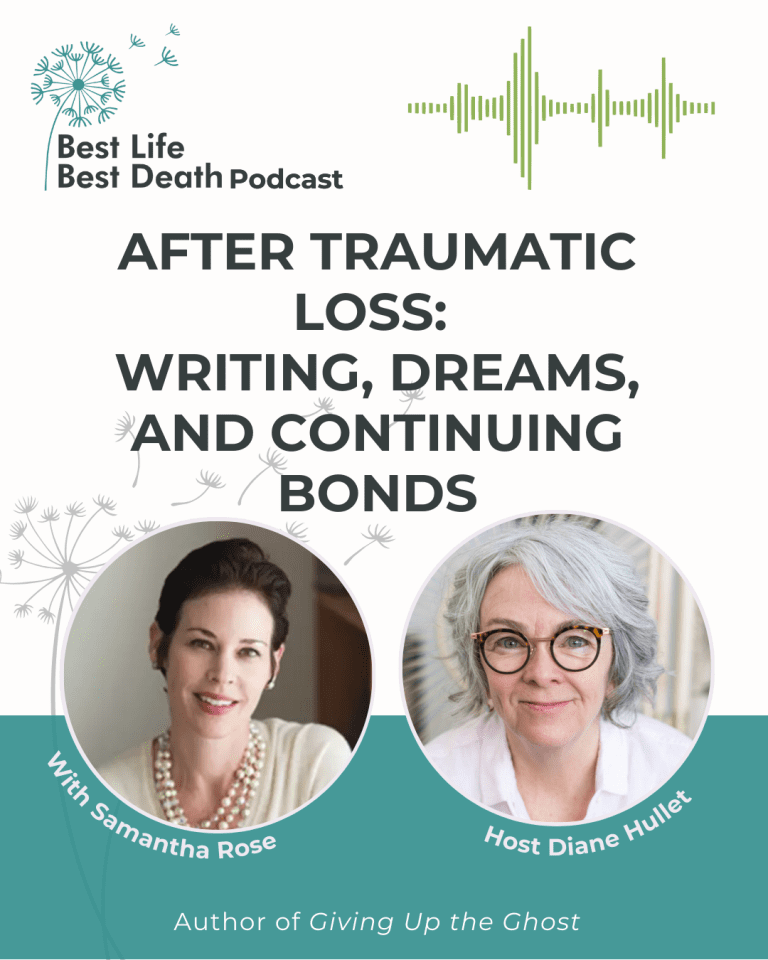
Giving Up the Ghost is a memoir about traumatic loss, identity, and the slow work of letting go, not just of people, but of the versions of ourselves we thought we would be. In this episode, I talk with author Samantha Rose about the transformations that accompanied the loss of her mother to su!c!de. Samantha shares insights from her lived experience, including what kind of support made a difference and how things shifted as she opened up a conversation with her mother through dreams and writing. Part practical, part mystical, this conversation made me eager to hear more from this longtime ghostwriter who brings her own voice forward in her first personal memoir.
For more information on Best Life Best Death please visit our website at www.bestlifebestdeath.com
Follow us on our social channels to receive pertinent and helpful resources on death, grieving, and more at:
Facebook: www.facebook.com/bestlifebestdeath
Instagram: www.instagram.com/bestlifebestdeath
Transcript:
Diane Hullet: [00:00:00] Hi, I am Diane Hullet, and you’re listening to the Best Life Best Death podcast. Today I am talking with Samantha Rose, author of Giving Up the Ghost. A daughter’s memoir. So welcome, Samantha. Hi.
Samantha Rose: Hi. Thanks for having me.
Diane Hullet: Yeah, I’m excited about this conversation. I’m excited about your book. I think there are so many interesting threads and themes in it, and I guess a part of it is just tell us a little bit about.
You and how you came to write this book, because you’ve been involved in a lot of other books. So lay that out for us in a little bio of you.
Samantha Rose: I have been a professional ghost writer for almost 20 years now, which some people don’t know what a ghost writer is. I essentially write books for other people, and I write almost exclusively in first person, so I write as.
My clients in their voice, and I’ve been doing that for a long time. And I have not [00:01:00] written in my own voice until this book. And it wasn’t the story I thought I was going to tell when I eventually wrote my own book, but it was the story that arrived on my doorstep almost five. Almost six years ago now.
And so it’s been quite an interesting journey to be a ghost writer who then writes a book. And we’ll get into this that is about the ghost of my mother. So my mom. Susan Swartz. She was a journalist and an author herself, and a well-known, well-known person, public forward person in Sonoma County, Northern California where I live, and she died by suicide right before COVID lockdown in the spring of 2020.
And I began writing as a way to try to understand. What happened and to answer [00:02:00] some of the questions left behind with a death like this, which is always shocking and always confusing.
Diane Hullet: So much and it was so interesting. You talked so articulately about the death of your stepfather and then. Your mother’s death shortly after that, and then the COVID lockdown and you had a young son and divorce.
And so all these themes are woven so beautifully, the relationship of you with all these critical, important people and even how the relationship with your mother be, becomes one of continuing bonds as they sometimes call it. And the structure of the book is so beautiful because it’s one of those books that really starts with the end.
We know that your mother dies, or I guess it starts in the middle. We know that she dies and we know that it’s tragic and shocking and all the things that suicide can be. And then you walk us through your experience as a family and as an author. How did where did you even begin to write it?
How did you even get [00:03:00] to. What was the first step into it?
Samantha Rose: I started working with a grief counselor almost immediately. I think it was within the first month after she passed. I think actually it was a couple weeks. And I knew that there was just no way I was gonna be able to get through it alone.
And I had my sisters and I had. Friends and other family members around me, but I really, I knew I was gonna need someone to hold my hand through this and help me make sense of it. And so he, his name is Rabbi B as he’s called in the book, or B, he becomes a very important person in my life. And he is woven throughout the pages of the book, and it was actually he encouraged me to write.
So we’d get on these sessions every week, every Wednesday, and I would hand write, I would journal, write furiously. He would say all these amazing things. I do think he has some of the best lines in the [00:04:00] book. And I would write them down. And at one point he said, you should write about this. You’re a writer.
This is what you do. And I thought, I don’t know. It was just so raw. And I was in such pain and grief for initially extreme pain. And I wasn’t sure I wanted to, but I realized I, I already started. And so I just started, taking notes and being aware of. How I felt in, in jotting things down, but not in any really formal way.
But then the book takes a turn as the story in my real life took a turn. When I start having very vivid dreams about my mom, and in those dreams, she starts. To answer some of the questions that I have, and my training is to write, and so I write those down and those [00:05:00] dialogues start to form and inform the storyline.
That was really just. Happening as you read it, is how it was happening for me.
Diane Hullet: Wow. I wanna, boy, I wanna highlight two things you said there. One is I think it’s so powerful that you knew right away that you needed support. And just for people listening just take note of that. Not everybody needs support in that way.
Some people muddle through or have friends that they lean on, but. I think having an ear that offers support in grief quickly like maybe it’s not for most people the first couple weeks, but quickly can make such a difference for not feeling just immensely alone. Because I think our culture does such a poor job of holding people in grief, and so there’s this loneliness and this misunderstood ness that comes with it that I think that’s really remarkable and noteworthy that you.
Found [00:06:00] that person. And how did you find Rabbi B?
Samantha Rose: He was recommended to me by a colleague slash friend. It was, it’s her brother and she said, you should talk to my brother. So their brother and sister, and they had both lost. Their father and grandmother to suicide. And so there was an, there was interest there for me to speak to someone who had been in this arena probably had an understanding of it at least a little bit better than I did initially.
And what I liked about him, it is hard to find someone to talk to it and it’s not always a fit and. I knew with him though right away there was just something about him where nothing was off the table, nothing was too scary or too awkward, or he just welcomed it all. And [00:07:00] because my mother had been she had withheld a lot about her mental state, and I just felt like I need someone.
Who’s just gonna be on a level with me and that I can, we can just get to it. And I just knew that with him right away. And that was gonna be so important because I have a lifetime history of being agreeable and a people pleaser, like so many women, so many of us. And probably if I left to my own devices, I would continue to.
Say what I thought other people wanted to hear or not say. What I thought people didn’t want to hear. And suicide is a tricky subject and people don’t wanna talk about it. I get it. It’s ugly and dark and it’s scary. But with him it wasn’t. And that was really important for me to have that.
Diane Hullet: Incredible. Yeah. From the get go. He’s, he says so beautifully, he [00:08:00] says. You tell him she died by suicide and he didn’t react. He didn’t re flinch or recoil. And he says, do you wanna talk about what she did to end her life? So like right there, he just showed up in an invitational way that was so impressive to read.
And I wanna read this one other piece he says about suicide, because I think it’s so important to keep talking about suicide as so many people are touched by it and it is so complex and hard to find. People who won’t flinch. So I thought this was incredible. He says 76 is he says to you, and you write this in the book, 76 is not a shocking age to die.
It is a shocking way to die. As you’ve likely learned from knowing my sister, I lost both my grandmother and my father to suicide. And what you’re feeling is real and it’s complicated. Suicide is a shattering. It creates chaos and a disruptive void. Unlike other deaths, it can be very difficult to [00:09:00] process, to orient to a new reality.
When someone is here one moment and then suddenly, and surprisingly they’re gone, as someone who’s been through it, what I can tell you is that suicide is dark and painful. It can be hideous, and for those of us who survive it, it leaves deep cuts and scars. Your challenge is not to cover them up, but to wear them.
Your challenge is not to look past or bypass your complicated feelings in an effort to feel better, but to go toward them and feel your deep pain to be in it. That’s where you’ll find clarity and meaning and a way forward that redeems your mom’s choices. Not right away, but eventually there can be openings and new beginnings and endings even in suicide and finding them is the work.
You say his words were sobering and also consoling. Yeah.
Samantha Rose: That was on our, that was on our first call and I, [00:10:00] they really struck me those words and I remember feeling relief and I didn’t quite understand it, and I write about that too when he says that. Leaning into it and looking at it and feeling it will somehow redeem her death.
And I remember thinking, I like how that sounds. I have no idea how we’re gonna get there, but I trust him and I’m gonna let him lead me.
Diane Hullet: Yeah. And another session with him pretty quickly on, he says, tell me about your anger. And again, going back to the kind of pleaser person, you’re like, anger what? Anger.
Why me? And then you kind, you find it, and there’s so much to be angry about often in a suicide.
Samantha Rose: Yes. I was angry for a long time. And again, credit due to B he encouraged it. And it wasn’t something I. Don’t think anyone had ever [00:11:00] encouraged me to be angry and to give words to my anger, and especially when he encourages me to get angry at her, and I think, oh God, what are we doing here?
This is this. This feels wrong. But also I feel like, yes, this is important.
Diane Hullet: Yeah, so important. He really helped you make space for all the feelings. And there’s also this incredible thread, Sam, through the whole thing about how you’re finding your voice like that there’s this piece about being a ghost writer, that you’re always in the back, you’re always not totally stepping forward in this whole experience.
And in the writing, in the book, you step forward in the biggest way possible.
Samantha Rose: That was a surprise. When I mentioned in the beginning that this was not the story I thought I would eventually tell about myself if I were to write a book with my name on the cover. In the writing of it, [00:12:00] I uncover these truths about myself.
I thought I was writing about my mom and I was. But then the magic of writing is that it starts to show you things. If you stick with it long enough that you don’t necessarily or didn’t necessarily know were there. And I have this aha where I realize that I’ve been ghostwriting for. Almost two decades, but I’d also become a ghost in my own life, in my divorce, and in just many facets of my life, playing small, hiding, not speaking up.
My mom was such a brilliant, bright light, and I talk about her being the sun and that I had unconsciously been the moon orbiting around her my whole life, and that I’m now being called. To step forward and speak up in a way that I haven’t before. And there’s the part of [00:13:00] me, the moon side that’s scared and thinking, oh, don’t do this.
And there’s the other side, the emerging side of me that’s saying it is time and you need to pick up the conversation where she has left off.
Diane Hullet: So good. So good. That’s this, there’s this whole mother daughter piece. There’s this whole self-awareness and stepping forward piece and so jumping back, you describe so well to all the practicalities that show up. She dies and there’s all the sibling, stuff and everybody taking their roles. And then how much later was it that she first appeared in a dream? And if you don’t mind, like describe, because the first dream is very small and then you really go looking for more.
And meanwhile you’ve been ghost writing for somebody who’s a medium. I don’t know, dive in there somehow with,
Samantha Rose: There’s a lot of layers. Yes. The first dream I have and I write about this is it was a short [00:14:00] dream and she just floats in. And I should say that I am a dreamer. I dream almost every night, and I often remember them, if not in the whole thing or snippets of it.
And I know that’s not everyone’s way but that’s always been, I’ve always dreamt. So it wasn’t shocking to me that she would start to slip into my dreams. But the first very vivid one, she comes in and she’s got this. Sweep of just like celestial hair. I describe as a silvery mess of beautiful, almost like diamond and crusted waves.
And she has this smirk on her face and she says, do you like my hair? And then that’s kinda it. But I woke up and I thought, oh my God, that is so her, because she had been always, perpetually. [00:15:00] Historically obsessed with her hair and that she would want to announce to me that in death she finally had good hair, seemed absolutely my mom and worthy of crossing the divide to tell me this would be like the most important thing to tell me.
And so I thought about it the next day. I just kept thinking. This just feels too on the nose to be something that my unconscious made up. And who knows, right? But I have this moment where I say, okay, if that was you. Then bring it on. I am ready. Come back and next time we’re gonna talk about more than your hair.
And so I start inviting her into my dreams, which is something I, I did learn from working with a medium. I wrote, I’ve written four books with Rebecca [00:16:00] Rosen, who is a medium in Denver. And she talks about communication with our past loved ones that we can all do this, but the number one rule is they need to be invited and they’re not gonna show up unless you say, I am inviting you in.
And so I start inviting my mom to my dreams and. Then translating them directly afterwards the next morning, and then I start inviting her onto the page almost as if I would do with a client who’s living where I ask them questions and then I listen and I write down what they say. So that’s how that evolution happened, and it was very interesting.
What came forward in that process and I started to have a deeper understanding, I think, of what might have happened and a deeper understanding of [00:17:00] her and of us. And when I got to the point where I needed to decide, is this more than just. A personal project, am I gonna actually write a book? I had some hesitation with these dream dialogues.
I, I worried that people would find it too unbelievable or that people who know her might be offended that I was writing in her voice and I ultimately decided that this feels real for me. I think what she is saying is important and it’s helping me heal, so I’m gonna keep doing it.
Diane Hullet: Yeah. It’s, to me, it’s such a wonderful part of the book and a part of your experience.
Wonderful. It sounds a little too cheesy, but it’s like it takes it to a different place, right? It becomes not just a I don’t know, this is what happened, narrative about. Life in a grief experience [00:18:00] and recovering, moving through that. I don’t know if recovery is probably not the word, but kinda moving through grief and making sense of grief.
It brings in this whole other element that changes the story a lot and. Mystical, mysterious, unbelievable. I don’t know. I think there’s more research out there on these mysterious realms than there has been in the past. And I read a statistic recently that said that 80% of people who are dying see dead relatives.
That’s a very high percentage of people who have an experience in their final days or weeks or hours. Of seeing someone who’s already died. So I don’t know, are they making it up 80%? That’s a lot of people to make up experience like that. So to me, I’ve come to see this these offerings from the other side of being part of almost what you said, this invitation for a conversation back and forth.
So I loved that she. Accepted that invitation and stepped forward for you in these [00:19:00] different ways, through the dreams and in the writing, and that you embraced it and said, okay, I’m gonna lean into this.
Samantha Rose: Yeah.
Diane Hullet: Yeah.
Samantha Rose: Like I said earlier too, she was always a very outspoken woman and she always had things to say.
She always had interesting things to say, and I felt. That I wanted to give her a voice in death. Also, that I wanted to give her an opportunity to speak about what happened and that she no longer had the luxury that we living have to just open our mouths and talk. So I would give her a voice in this way.
Diane Hullet: What was some of the most was there a particular piece of that, that felt like it unlocked something for you? Or was the whole trajectory of that experience part of what shifted things?
Samantha Rose: I. I think each part of it unlocked something that then led to the next [00:20:00] question, most of these sequences, I have a question and she tries to answer them for me.
I can’t think of anything specific that I don’t know. There wa there was one scene where we’re back at the place where she dies and. She asks me, she wants me to stop meeting her there, and she suggests that I let her go from that place, that she’s not there anymore, and that it was just one moment in time and it was one moment in a long life.
And to let her go from there and to remember not. To forget what happened, but to remember her in other places. And I remember thinking that’s right. How unfair for us to just remember one [00:21:00] tragic moment and let that define the person. Our mom, our lives are made up of so many moments, some good, some less good, some brilliant, some beautiful, but there it’s a patchwork right of moments, and I think we need to honor those who have passed by honoring the complexity of their lives.
And I remember thinking that. She was right to ask for that.
Diane Hullet: She was right. Yeah. Yeah. She opened up your thinking and your experiencing both in the dream world and in the waking world with that moment.
Beautiful. There’s a kind of a funny scene when you go to do something with ashes.
Do you wanna describe that part? It’s just,
Samantha Rose: My mom and I should say, not everyone has. The same kind of relationship that I had with my mom. We were really close and we liked each other a lot, [00:22:00] and we were lucky in that way. And so losing her was particularly difficult because we were so intimate and so close.
And part of that closeness is we shared the same kind of humor. We called it dark humor, and. So there’s a scene where I am finally going to reconcile with her ashes, and I decide to open up the box and do something with them, although I have not really thought it through beyond opening the box and anyone that’s dealt with ashes, ashe’s, nose, that they seem to multiply.
Once you open the vacuum sealed. Bag of them, and it started to create a mess in my kitchen and I’m swearing, and then I’m not sure if I should use what I should use to scoop them. It’s just this kind of a ridiculous scene of should I use a ladle or should I use a teaspoon? Or what do you do with these [00:23:00] things?
And then what do you transfer into them into another bag? And anyway, this moment where it becomes just funny to me and I’m thinking. That she really ought to be there because she would think this was hilarious. And so I’m both crying and laughing saying, you should be here. You would get this, you would think this is hilarious.
But of course she wasn’t. And so then I start making jokes to her about her, to her, that she’s just become this bag of bones and yeah. I’m glad you liked that scene. I actually enjoyed writing it. I remember also thinking, oh God, I’m gonna really piss some people off with this. But I thought it was really, I thought it was funny and I knew that she would think it was funny.
Diane Hullet: I thought it was funny, and I thought, this is such a thing about ashes. I think we, we try to make them. Solemn and we often wanna have a ceremony or sprinkle them outdoors somewhere or transfer them to an urn or something. But there is this kind of like practicality of them [00:24:00] that they’re
Samantha Rose: Yes,
Diane Hullet: kind of alchemy and sticky and they get everywhere.
And there’s a great scene in a movie where they try to. Toss some ashes and they all blow back in that face. Yes. I can’t remember the name of that film, but it’s such a funny one and so I just, I, to me it captured a real moment that people can relate to, and that you found it.
First annoying and frustrating and then found the humor in it and softened. Is the theme of a lot of what happens in this book. Yeah.
Samantha Rose: Yeah. I think we’ve gotta find the humor in a lot of this stuff that’s so hard, and at least that’s where I go, is to try to blow some.
Lightness into some of these really dark moments. Not in a way to dismiss them or to
Diane Hullet: I don’t know,
Samantha Rose: transform them into something that they’re not. But to just recognize that yes, this is awful, but also good God, isn’t this ridiculous? [00:25:00] And at least that was one of the ways in which I got through and my sisters.
They got it. We would get together and have silly laughs over some of this stuff and,
Diane Hullet: for sure. I, it’s funny, I was reading a Dr. A very dry article about Confucius yesterday because I have a daughter who’s in high school still, and she had to read this article about Confucius, and one of the comments was that in terms of, this is gonna be a tangent, but in terms of Confucius and why he was.
So powerful in his time and continued to set a long tradition in Chinese culture. They were contrasting that with the US culture, which has so little coherent tradition. So I think about something like this ash piece or a body disposition piece partly. Some cultures have huge traditions around things like this, and those traditions carry you you know what to do with the body or what to do with the ashes. But I [00:26:00] think missing, barring tradition to carry us through, we have to find our own dark humor, right? Like ability to create new traditions with family members and whatever our community is. But humor is one of the ways we cope with not having traditions to hold us.
I think
Samantha Rose: that’s interesting. I think that’s right. And there, there is an absence of a guide for a lot of this, especially with suicide.
Diane Hullet: Yes.
Samantha Rose: People don’t really wanna touch it. Like I said, it’s scary. And I understand there’s a lot of other things I’d rather talk about or think about, but it’s, it exists and death exists and losing people is part of all of our lives at some point.
But it seems as if none of us are prepared at all. And I think because there hasn’t been, and that’s. [00:27:00] So wonderful the work that you do that having conversations before, we’re in the situation where the three of the three sisters sitting around a table saying, what are we supposed to do here? What do we do first?
Are we supposed to get the death certificate? Are we supposed to get the ashes? Are we supposed to find a grief counselor? Like it the list becomes this. Insurmountable almost list of things to do that we are not equipped to do.
Diane Hullet: Yeah. Yeah. And I think we’re not equipped we don’t have a lot of traditions, we don’t have a lot of knowledge.
We don’t see it a lot. And then as my husband said when his mother died, he said, there’s all this stuff that you have to do that you never have had to do before and you’ll never have to do again. Except around this. So it’s really complex and I appreciate what you’ve written, Samantha.
I think it’s really it’s a really personal read and at the same time you’ve taken it universal and then you’ve taken it transpersonal right across the veil with these [00:28:00] experiences of inviting your mom’s spirit in to dream with you and visit you and talk with you on the page in a way that. I don’t know.
I love that you invite that mystery in without holding onto that too tightly either, how do we have these experiences and let them be what they are. Let them be as real as they feel without dismissing them or solidifying into something around that, if that makes any sense.
Samantha Rose: For me, I, my mom and I spoke almost every day, and so my initial thought was.
We spoke yesterday, why wouldn’t we speak today? Sure. She’s, no, she’s not physically here anymore. And that really pisses me off. ‘Cause I wanna call her. She’d be the first one I would call to say, oh my God, did you hear? And she wasn’t, she was no longer here to field that call. So I decided to talk to her anyway.
And I think. We can all have these [00:29:00] conversations and they may feel very one sided in the beginning, but I think for me it felt they started feeling less one sided. And I still talk to her and that’s how we keep them alive. And I think that’s how we keep their memory alive and we keep the relationship going.
And I think B might have been. The one to tell me initially that we can still have a relationship with the people that we’ve lost. And I thought how the hell does that work? But he’s right, because if we continue the conversations in real time, in present day and having new conversations, then the relationship will continue.
That’s just how it works, right? I like that and that has given me a lot of solace, and it’s been helpful in the years not having her sitting across a cafe table with me to look at [00:30:00] me. I can still converse.
Diane Hullet: Beautiful. Oh my gosh. What a beautiful final place to end, I think. How can people find out more about you and about your book?
Giving up the ghost.
Samantha Rose: If you’re interested in reading it, which I hope you are, you can get it from any of your online retailers. Amazon of course, and then all the others. You can order it. Likely your independent bookstore won’t have it in their shelves, but you can order it from them, which is what I love to do, is support our local indies.
And you can learn more about me at Yellow Sky Media dot. Com is my website and I am on Instagram, Samantha Rose, writer.
Diane Hullet: Fantastic. I can’t see, are there books percolating beyond this one?
Samantha Rose: I am back to ghost writing. I have several clients I’m working with and I actually love that work. It’s exciting to give voice [00:31:00] to other people’s stories.
And I keep getting asked, what am I gonna write next? And I’m not quite sure. I’m tempted to write about life with my teenage son, although I think he might kill me if I do that. So I’m not sure. But something my, now that I have done it, now that I’ve stepped out of the shadows and told my own story, I, I see the value of.
Of doing that. It’s very empowering and important for all of us.
Diane Hullet: Oh, I immediately think, what about some kind of a partnership, a collaboration with Rabbi B or others who have these important stories or important snippets to share? There’s so many powerful things that someone like that has said, but maybe hasn’t written them down.
Samantha Rose: I do a lot of book coaching with people who, I’m not writing their books necessarily, but they want to write and they just need that nudge or they need an advocate to [00:32:00] say, just do it. It’s a, it doesn’t have to be perfect, but if it’s in, if it’s rattling around inside and nudging you awake, it wants to be written so.
Diane Hullet: Beautiful. I don’t know if this is the place I should announce it or not. I suppose it doesn’t hurt to say it. My daughter and I have written a book, a children’s book about continuing bonds.
Samantha Rose: Oh, amazing
Diane Hullet: Signs from the other side, and it will be coming out probably in late spring or early summer of 2026.
Samantha Rose: Oh, that’s so good.
Diane Hullet: So exciting, so neat. I have not seen another children’s book quite like this. It tackles death straight on. In the book the grandmother dies, but the little girl in the book has been thinking, can you really receive signs from someone on the other side?
And she says, grandma, will you send me a sign? And grandma says, I will. Yeah. Yeah.
Samantha Rose: Beautiful.
Diane Hullet: This idea of continuing bonds, continuing relationships is so powerful. [00:33:00]
Samantha Rose: I can’t wait to read it. What’s it called?
Diane Hullet: It is called The Sky Painter.
Samantha Rose: The Sky Painter. That’s a good title. Yeah.
Diane Hullet: Yeah. Thanks again for your time giving up the Ghost.
Very interesting book. Thank you to Samantha Rose for writing the book and joining me today. As always, you can find out more about the work I do at best lifebestdeath.com. Thanks for listening.
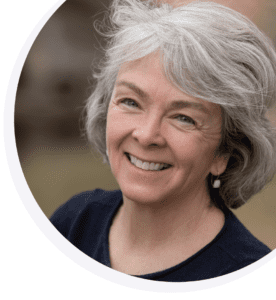
End of Life Doula, Podcaster, and founder of Best Life Best Death.