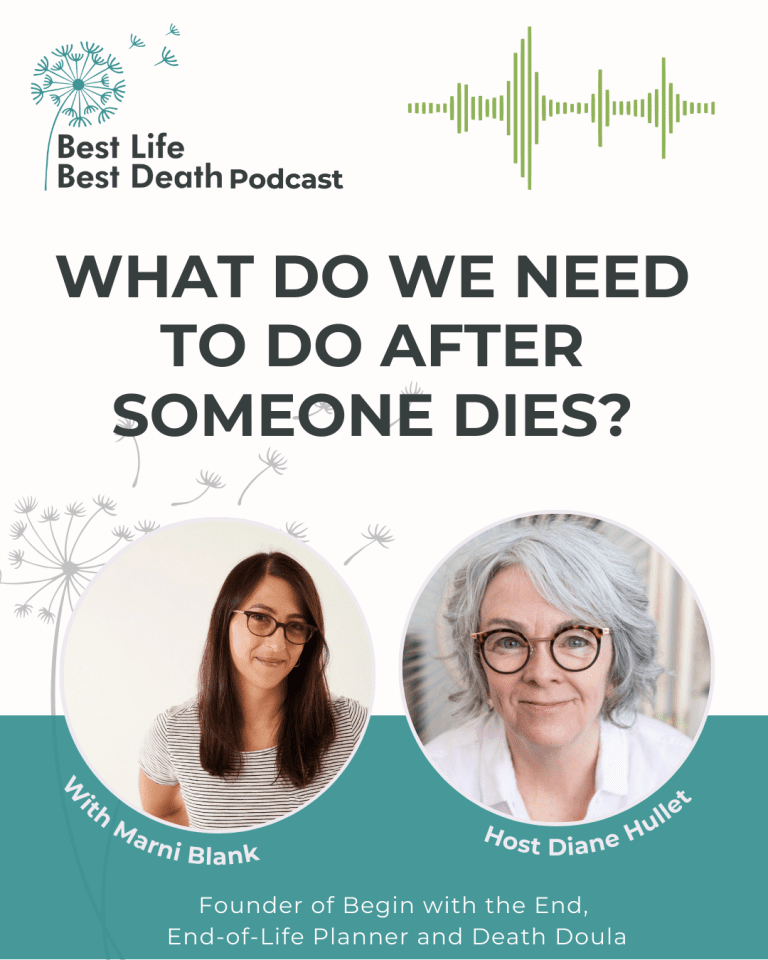
Marni Blank is an “after-loss professional.” What does that mean? Imagine someone with a legal background, lived experience of loss, a steady head for details, and the ability to step in and quarterback the team when someone in your life has died. That’s what an after-loss professional can be. I find this work both fascinating and profoundly useful.
Tune in this week to hear what Marni has to say about what actually needs to happen after a death – and if you’d like a clear, step-by-step guide, you can also download my free e-book on bestlifebestdeath.com, When Someone Dies… What Do I Need to Know?
For more information on Best Life Best Death please visit our website at www.bestlifebestdeath.com
Follow us on our social channels to receive pertinent and helpful resources on death, grieving, and more at: Facebook: www.facebook.com/bestlifebestdeath
Instagram: www.instagram.com/bestlifebestdeath
Transcript:
Diane Hullet: [00:00:00] Hi, I am Diane Hullett and you’re listening to the Best Life Best Death podcast, and I’m back this week again with Marni Blank. Marni is an end of life and after loss consultant, and I think just brings so much expertise to this conversation. Hi, Marnie. Welcome back.
Marni Blank: Thanks for having me, Diane.
Diane Hullet: I am excited because this week.
We’re gonna dive into, after someone dies, what do I need to know? What do I need to do? And this is such an interesting topic, and as my husband famously said, he said, there’s stuff you need to know how to do when someone dies that you don’t need it. Any other time in your life, you have no idea.
It’s what you need to know. And all of a sudden there’s all these things that fall on you that you have to figure out. And so I think this is a really important topic, and your expertise in law and as a death doula really brings so much to the conversation. So welcome and start in wherever you’d like.
Marni Blank: Yeah what your husband said is entirely true. [00:01:00] Someone dies, all of a sudden there’s this. Fog of grief that falls upon the family. And they’re supposed to be managing all of these different tasks or logistics that no one is taught about. And oftentimes when we are not prepared, things don’t go as smoothly as we can, and even the most prepared.
There is still this level of grief that that clouds everything else. And when someone dies it depends on who is involved. Is it the family, is it the chosen family who is part of the life? And one of the first things that someone needs to do is let everyone know.
And that can be. Really hard to do to have to say over and over again that your loved one has died. And sometimes I’ve found that it will be outsourced to, a family friend or someone who can start to share with people what’s going on. Give the specifics when they are of if there’s going to be a funeral [00:02:00] or a memorial service.
And one thing that I have worked with people in advance to plan for is, if you went through my phone, there’s 300 contacts in there, and there are people in there that I haven’t spoken to in 10 years, and there’s the plumber from two apartments ago. And people in there that don’t necessarily, in my life at this point. And so one of the things that I have worked with people is, do you have a list of the people that you want to be contacted after you’ve died? Whether that’s an email list that you know is just in your draft box of, these are the people that I want to know.
Or if it’s making a spreadsheet and saying, here are the phone numbers of the people and maybe even saying, here are the people who you might want to, create a phone tag tree with, and giving people responsibility of who are making those calls so that it doesn’t fall all on the grieving family.
So that’s just one thing to to think about in advance, [00:03:00] right?
Diane Hullet: Number one, notifying people and who are the people and how to make that a little bit easier.
Marni Blank: Yes. And then, it is really thinking about do you want to have a funeral or a memorial? Those are the things.
And depending on the religious background, things might need to move quickly. For instance, in the Jewish faith there’s, time. It’s a very quick turnaround in, in terms of, getting a body into the ground and having that funeral and then, doing Shiva.
And so depending on the religion it’s unfortunately, it has to happen very quickly and so you have to be making a lot of decisions in a very short amount of time. Again, this is where I pause to say. If you can plan in advance and think about your wishes and what it is that is important to you then you at least have that roadmap to follow.
If you know you want a traditional burial, making sure that you know which funeral home that you know is closest to you. Maybe it’s one that everyone in the family has used, or [00:04:00] maybe you’ve done some research and there’s one that feels like they will create that personal experience that, that you want.
Or thinking in advance if you want. To donate your body or brain to science, depending on what’s going on, those things need to be done in advance so that when the death occurs, that is the first call to, so that they know to come and get you or, all of the different green options.
And again, however, you can have these conversations or really think about your wishes and put it down on paper and or tell your loved ones in advance, it makes those, that first week so much easier because okay, I know. I know who I need to call. I know that this is paid for, or I know at least the amount of money I need to be thinking about paying.
And little things like that. So I would say that is the first things that you need to be thinking about.
Diane Hullet: I’d add also that I think there’s a growing movement towards home funerals a movement back towards home funerals. And [00:05:00] that’s useful to know ahead of time and think about ahead of time.
’cause there are some things you might want in place for that. And I think it’s important, I think the moments, the hours. After the last breath are so important, and I just wanna underscore this for families because there’s an impulse sometimes to do something very quickly. And I just wanna name here for anyone who’s listening that nothing has to happen fast.
And in fact that is such an important period to catch up with what’s happened. Even an expected death. When the person takes their last breath is a kind of sudden death. And so there’s this catching up with what’s happening in our body, linear time and what our soul can take in.
So I, I encourage people to just. Do nothing, pause, gather loved ones if they’re around and available, if that’s what’s happening. Let everybody have a moment with that body. It doesn’t mean call the funeral home and have them [00:06:00] taken away an hour or 10 minutes or, a quickly after a death, make space around that.
And that does not require dry ice. That does not require special planning. For people who wanna do a true home funeral and keep a body for a few days, then there are things you can do to make that work better in terms of dry ice and preparing some things ahead of time. And I think, isn’t there an excellent, there’s an excellent home funeral alliance, which I’m forgetting the name of.
I think if you Googled home funeral, it would come up right away. So that’s like a whole other piece to think about is preparing maybe everyone who’s involved. Not laying it out specifically, but what might that look like? How much time is okay with people? Might one sibling want more time than another sibling?
Can there be some compromise in there? Because otherwise things can happen really quickly. I can think of a difficult story where I. You know, mom had barely taken her last breath and the daughter who had done most of the caregiving was [00:07:00] prepared for that to be a special, sacred, let’s sit with mom a bit time.
And the siblings started like rifling through her drawers and divvying stuff up, and they had a plane to catch, and if there had been a conversation that said, our time together as a family in this is more important than that flight. Let’s please move the flight. That whole thing could have landed differently because I think this is one of the key places where families get really.
Botched up and they move at different paces. They grieve at different places. And if there can be a little discussion about how that might look like, Hey, let’s not go through mom’s things until the next day. That family has rifts in it now that are irreparable because of how those moments after mom died were handled.
So something to think about.
Marni Blank: No, that, that really hurts my heart. And it’s all of what you said is so important to think about. Death is not an emergency. And it is important to take that [00:08:00] space in the immediate moments afterwards and do what needs to be done to make you feel as complete as possible.
Whether that’s speaking to the person, whether it’s doing some sort of ritual or or just being with the family, in, in the same space. Of course not every death occurs at home or, occurs in a way that we would want it, accidents or other tragedies. And so it is dependent of course, on what is the circumstance involved and what are you working with.
And so it also is being able to be fluid or flexible because we do not know. How we’re going to die or where we’re gonna die. And thinking about these things and how, it is, what does our best stuff look like? And really taking that in advance to think about as a thought exercise and even writing it down is so important to think about and knowing that life.
Does not always go according to plan. And [00:09:00] taking the high level, my values, my wishes if we can and make them happen. But I think your point of being intentional about it, and I would say that more and more I’m finding that families are choosing to delay having a memorial or a celebration of life, whether it’s for three months, six months, a year, and really spending more time.
Thinking about how can I make this as personal to my loved one as possible? How can I make this about them? And take that space, that time to grieve to come back and think about, what would be their favorite food or the playlist that they would want. And giving everyone a minute before, before having to execute on a.
Essentially a party or a plan which can just be most people that I’ve talked to, if it is directly after the death, like an out-of-body experience. They’re not really present. They’re not really, they’re shaking hands in a line and not necessarily [00:10:00] getting to, to listen to the stories or, to honor their loved ones the way that they would otherwise want.
So also remembering that it is okay to delay. Doing that celebration of life or honoring your person to give it, that breathing room.
Diane Hullet: Yeah. And also. To play around as a counterpoint, I do think there’s something really powerful about a funeral, a closure a what do I wanna say?
Like a public naming of what has happened. And so I’d also throw this out. Go ahead and have a funeral in the time that’s close to the death. Then have a second funeral or a second celebration of life or another way of marking the year. So there’s both, and I think families have to really thread their way through that because sometimes I think the delay is harder on families.
And I no right answers here, but just real permission to explore like what’s right for your family system. Do you need to have it and name. [00:11:00] And publicly say this has occurred. There is a change. There’s a change for us as family members. There’s a change to that deceased person now being an ancestor and let everybody get to their new right places because a death does completely reconfigure a family.
Marni Blank: Completely and I com. And I agree with you, bearing the body, having some something immediately can be very cathartic for people to have some sense of closure and then doing something down the line in more of a, an honoring afterwards. It can be both. It can be, and it, it could be either or.
Whatever works for your family. There is no right answer in how, a lot of people don’t want anything and it’s more for the family it really is. Everything is becoming my, in my opinion, a lot more personalized to what does that person really want? What did they want? And what will also bring closure to the family?
And that looks different for everyone.
Diane Hullet: Yeah. I always when [00:12:00] people say, ah, I don’t care, I’ll be dead. I don’t, it doesn’t matter to me. I always push back a little, I think that’s not actually helpful. That’s not actually helpful for your family. And I think there’s a real, there’s a continuum, I guess I would call it, right?
Between I’m gonna lay out exactly how it has to go and be rigid about what p passages or poetry is read. And it’s gotta be exactly like this. Or I don’t care, do nothing. I’ll be dead. There’s a whole lot in the middle that is really about naming that this has occurred and here are some ideas you could incorporate if it felt right, and this might be the funeral home to work with or something like that.
Like giving some people some guidelines is a level of kindness, I think in all of this. Okay, but I digress because you were talking about there’s notifying people, there’s the time after what happens, there’s decisions about body disposition. What else?
Marni Blank: Yeah. And this is not necessarily in the order, [00:13:00] there, there are a lot of.
Paperwork and logistics that need to be addressed. And one of the main things is, making sure that death certificates are ordered and typically the funeral home will take care of organizing that and notifying social security that, that a death has occurred. And so typically that is something that is, the funeral home’s responsibility, but making sure that you have, eight to 10 copies of the death certificate because you’re gonna need that for many different things.
Many government organizations or, the banks and, investment firms are all going to need confirmation of the death, and so it’s important to have that. It typically takes a couple of weeks to get so knowing that it’s not gonna be something that happens right away. But again, the.
There is no true emergency, in terms of it’s going to be a process in knowing that you can’t rush it. And many times our government systems don’t allow us to rush it, that there are going [00:14:00] to be delays and that’s. Very frustrating for many people, but also it is the reality of the situation. And so one of the first things that I typically recommend people do are notifying the credit card companies and the bank accounts of a death.
Because you do not want fraud or scammers to, to take advantage. And really making sure, if someone lived in a house on their own, making sure that. The locks are, making sure that everything is secure in the house, that could be clearing out the refrigerator, making sure that mail is being forwarded and making sure that the house is secure and that, things like homeowner’s insurance are being, kept up to date while everything is being figured out.
So taking inventory of what’s going on in someone’s life. And making sure that you are keeping on that track while you are closing everything down. For me it would also be talking to an estate attorney who [00:15:00] will guide you on whether you need to go through probate, which is really just the idea that if there is a will, it needs to go to court to say, yes, this is a valid, will, please go forward.
If someone doesn’t have a will, and that is. 66% of of our society, 66% do not have a will, and that will still go through a court process. It just is called administration instead of probate and it will then again nominate someone who’s going to be in charge of closing everything down. Many people’s first calls after the hospital or after, talking to family and everything is also a financial advisor if that person had one to let them know. And, getting that process started of making sure if, we talked about in our last episode the importance of having TODs these transfer on deaths, that name beneficiaries on your accounts, getting that process started because that does not have to wait for a court process to start.
Diane Hullet: Good to know. I know one friend, this was [00:16:00] years ago and his mom was aging by herself, and the friend and I talked about that. It might be helpful if he is the oldest son got on her bank accounts. He got on her bank accounts as a signer, and that was great. That was a good relationship and that made sense to do.
And about three weeks later, she got in a bad car accident. And he said, oh, if you had not talked to me about getting on our account, this would’ve been such a hassle because he was able to simply keep paying bills and do everything that needed doing. Now that wasn’t a death, but that was an example of how important this coordination between family members is.
Marni Blank: Yes. And that’s a great point, having a power of attorney in advance so that if someone is hurt or injured, that you’re able to say, Hey, bank, like I have permission to do this. It’s not always best. And again, I’m not offering legal advice. It’s not always best to become. A joint access to an account because then it might mess up [00:17:00] who you want your money to go to after a death.
Before making those sort of decisions, I would talk to an attorney, I would talk to your financial advisor and decide what’s right for you. But. But making sure that there’s no fraud or that the house is secure, I think are some of the first things to be thinking about and making sure, and then, when I’m working with someone, we go through someone’s what are we looking at here? Did they have property? Did they have cars? Did they have accounts? Did they have debt? Did they have a mortgage? We’re thinking we’re, I have, a hundred questions that I’m asking. It does, it’s not as overwhelming. It’s overwhelming, but we do it thoughtfully and over time.
But we’re looking at someone’s full picture of what’s going on. And who needs to be part of this conversation and then creating sort of a roadmap of tasks that need to happen. What are the important things that need to be done first? Sort of what we’ve started to talk about what is important but can wait and, it will be a process.
And then what’s important, [00:18:00] but, we can put on the back burner and things like, do you wanna close or memorialize a Facebook account or other social media things? But what we talked about in the last episode about our digital life, it really is starting to, untangle someone’s life and see where everything is.
And again, take this inventory of, where are there, accounts and money or assets. Where are their liabilities and where are their debts? And starting to understand what’s going on, and then you can start to do piece by piece, taking care of everything.
Diane Hullet: Great idea.
This idea of a roadmap, big picture. Where are we? What needs to happen? What can be delayed? What needs to happen right away? And you work Marni as an after loss professional. Talk about what a, what is an after loss professional and how does one find them?
Marni Blank: Yes. For most people it. No one has taught how to do these things, just like you were talking about in the [00:19:00] beginning.
And so having someone to guide you through the process to make sure that things aren’t falling through the cracks, and to keep accountability and making sure that things continue to move forward and taking some of these tasks off their plate. In my experience, when someone. In a state of, grief, it is really hard to be dealing with tasks and logistics and paperwork.
Things are very foggy and you, that’s not what you wanna be focusing on. And when you are just focusing on paperwork and tasks and logistics, it is really hard to feel your feelings or be in grief. And it’s not like those feelings. Go away. They’re just pushed down to an inopportune moment later.
And so how are we creating space so that things are moving forward, that you are doing what you need to do in that role, and that’s the role of executor and sometimes family, other family members. How are you making space to make sure that those things are happening, but also giving space to grieve, to heal.
To eventually get back to work. If you’re working, there, [00:20:00] you people live a complete life and adding a full-time extra job on top of it is entirely overwhelming. So how are you getting that support? And this is one area where I say get the support. Because we’re not taught it. And sometimes even you’ve experienced what it looks like when someone has not planned, if a parent died and they left, no roadmap or no understanding of what’s going on, it makes you even more, it’s it shows how important it is to be planning in advance also.
So if the two go really hand in hand, if you have planned in advance. The gift to your family is to have a more useful experience after you’ve died, and so I encourage everyone to be thinking about that.
Diane Hullet: And this idea to me, this idea that there are people who love this and have created this roadmap before and want to create a spreadsheet for me about what the tasks are and who’s gonna do them in this after loss professional field.
I just, that just makes me [00:21:00] giddy with happiness because I would find it so very overwhelming. But are, this niche field of after loss professionals? Yes. Are they available everywhere or.
Marni Blank: So I did training through a program called pals, professionals of After Loss Services, and they they’re an incredible organization that also has a directory of professionals in your area who can help serve.
I work virtually across the country. If someone needs boots on the ground in terms of an estate cleanout, some after loss professionals will go into the home and help, make sure that things are cleared out or help sell or donate. Or gift items and help the family through that.
So it really depends on whether you need someone physically present, but a lot of these things can be done virtually. For anyone. The process is the same. If you need to get forms from, a bank having to say over and over to strangers that your loved one has died, [00:22:00] can be just.
Retraumatizing for many people and so can you allow someone else to support you during that process and get the paperwork and help you understand what you need to do and quarterback the process so that you have someone who is helping so you don’t have to do it yourself.
Diane Hullet: I assume that the estate could pay for that.
It doesn’t necessarily, yes. Have to be the individual. So this is something that you if, again, there has to be enough finances and privilege to make this even an option, but if that’s in place and if that’s interesting and appealing to you, you do not have to do this all by yourself. So just to underscore that for listeners, I think is really valuable.
Marni Blank: It’s a great, it’s a great point. Just like the account who will do the final tax return, the attorney that you will. Consult and or hire to help through the probate process if you need to go through the probate process and an after loss professional, these are all items that would fall under an estate expense.
And so if you [00:23:00] had to pay out of pocket, the estate would pay you back. Or if there is a pot of money initially, that it would just be paid for out of that. It’s a great point.
Diane Hullet: Yeah, it’s not, this is not impossible to do by yourself, but this is also something that there are people who can help you do a roadmap.
Do you have anything on your website that’s like a download, free download information about this aspect?
Marni Blank: I have a, on my website I have a list of the tasks. There’s, it says after a death and it lists sort of the things to be thinking about. There’s no download per se, but it’s a great suggestion.
But there is a, high level, here are the tasks. To be thinking about. And many people when they see it are saying, I actually do want someone to help me with it. But you know what, there are those people who want to feel productive or helpful after the death. It helps them with closure.
And so in that way people like me are hired to keep people on track, to remind them and keep accountability for the tasks [00:24:00] that need to be done. Maybe help with some of the research, but that the individual tasks are done by the person themselves because that’s something that they wanna do and that it’s important to them.
And there’s that option in en route as well.
Diane Hullet: I go back to it being such a complex weaving of pieces here, that it’s, we’re, it’s just complex, right? Someone has died. We are grieving and there’s so many tasks to do and this both like head and heart, like making sense of that at difficult times in our lives is.
Is just, oh, I don’t know. I’m just struck by the complexity of it. And there’s, there’s a beautiful quote by Lori Anderson and she was the wife of Lou Reed, longtime partner of a famous musician, Lou Reed, and she wrote a beautiful article for Rolling Stone, or maybe she was interviewed for it.
But she says, she felt by the end of Lou’s life that the purpose of death was the release of love. [00:25:00] And that there was so much love between the two of them and so much love between their, them and their community that leaned in to support them. That there was just this incredible expansion and this kind of almost unreal transformation that’s possible at the end of life.
And then we’re also hit with all these tasks. And so here we are in this surreal state of love and grief and loss and a big hole in our lives. And then there’s all this stuff we need to do. So
Marni Blank: it’s so true. Yeah. Grief is love. That is exactly what it is. And I will also point out that, sometimes people hire me because it was a challenging relationship and that maybe their.
Is grief in a different way of not having a relationship that you wanted with the person who died or there was unresolved things that happened. And they also need to have those boundaries after death and that they need someone who’s helping them through the process because they [00:26:00] just don’t have the capacity to do it.
And so it, it falls into that category too, which, I wanna normalize that a lot of family dynamics are very challenging. We don’t always get. That we need from the person who’s died and that, having professionals who are taking some of that space, so that you can.
Continue to have your boundaries can be important. Also,
Diane Hullet: really important and clarity between siblings. There can also just Oh yeah. Might be helpful to have an outside person who’s organizing the task so that the siblings can keep their relationship and not be frustrated with one another for a variety of reasons.
Right.
Marni Blank: Absolutely. Sibling dynamics can get very complicated before and after a death, depending on, we can grow up in the same house and have very different relationships with our parents or, have very different roles. And, however much one can have those sibling conversations in advance and really get on the same page, or at least understand other people’s perspectives so [00:27:00] that when you get to the, after the death, like you were talking about with that family.
And going through the parents’ things, that’s so that, that sounds so devastating. Yet how can you lovingly, even if you have different perspectives, get through this together.
Diane Hullet: So well put. What else do you think folks need to know about after death?
Marni Blank: Just that it’s a process and that it can take a long time, in a state, and when I say a state, it really just means this process of going through.
The court process and making sure that everything’s closed down and taken care of. It can take 12 to 18 months. If it’s a complicated thing, it can take longer. And so just understanding that it’s it takes time, it takes energy. And it’s okay to have lulls. Sometimes we’ll be lulls because you’re waiting on other people or other organizations or things to get back to you.
And just. Patience and kindness to oneself that this is, again, this is not like a [00:28:00] perfection thing. It can feel like muddling through and that’s okay. Also. It’s and asking for help really it’s really, you don’t have to do it all by yourself. It doesn’t have to be professional, but how are you getting that support?
And that might just look like self care of having that friend that you’re taking that walk with and being able to vent to. Or it can be asking, other family members to take some of these things off your plate. If you don’t have money for professionals, that’s okay. There are other ways in which to, to ask and get what you need.
Diane Hullet: I love that you clarified this, this term estate, like I, oh, whenever anybody says estate, I get doubt abbey in my head. This, like these estates. And so it has this kind of big I don’t know, big quality to it. And really it’s just. If you own assets, you have an estate, right?
And so that I think is important to name I, and
Marni Blank: assets could be, it could be your coin collection, it could be, a guitar collection. It could be you, like a, clothing that has [00:29:00] vintage, it does not have to be something where you are millions of dollars. This is, these are just your things and your bank accounts and things like that.
It could be your ip. If you have a following of 50,000 people on Instagram, that is an asset. So it’s thinking holistically, like you said, it’s not down in Abbey. It’s just real life.
Diane Hullet: It’s things, it’s what we all own. If you own a car, if you own anything, this applies.
I I wanna encourage listeners to not be part of the 66% of people who don’t have a will. I think that’s really, that is a shocking statistic. Go ahead. Face, face your mortality. You don’t have to dwell on this, you can just face it. Get some paperwork done and sign it and it can be good enough.
It doesn’t have to be perfect. It needs to be good enough for now, so that if you are debilitated in some way, you have left things kinder for those you love. Whether that’s family of birth, family of choice, friends, whoever it is [00:30:00] who’s gonna be coming in your apartment and finding sex toys and removing them.
Marni Blank: It’s a real fear.
Diane Hullet: Whatever it is, we all need support and we all need a village to help us get through this. So identify who your village is, do your paperwork. Get a little bit educated about after death care and processes, and there’s this capacity to hire a professional. If there’s the capacity to do it, they are out there and you can find them to get help.
Marni Blank: Yeah. Yep. You’ve said it all. You’ve mic drop.
Diane Hullet: Super. Thanks so much, Marni, for bringing your expertise and your perspective to best Life, best Death listeners, I’m so happy that we had two weeks of conversation about these really important kind of practical things, but also practical at a high level.
Marni Blank: Yeah. Thank you so much for the thoughtful conversation. I really appreciate it.
Diane Hullet: Wonderful. You’ve been listening to the Best Life Best Death podcast. You can find out more about Marnie’s work at Begin with the [00:31:00] end.co.com, but.co and say what your Instagram account is again.
Marni Blank: It’s begin with, underscore the end.
Diane Hullet: Beautiful. And as always, you can find out more about the work I do at bestlifebestdeath.com. Thanks so much for listening.
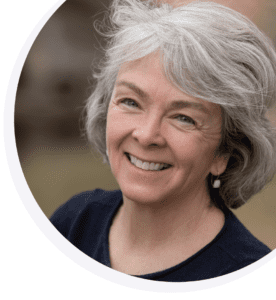
End of Life Doula, Podcaster, and founder of Best Life Best Death.