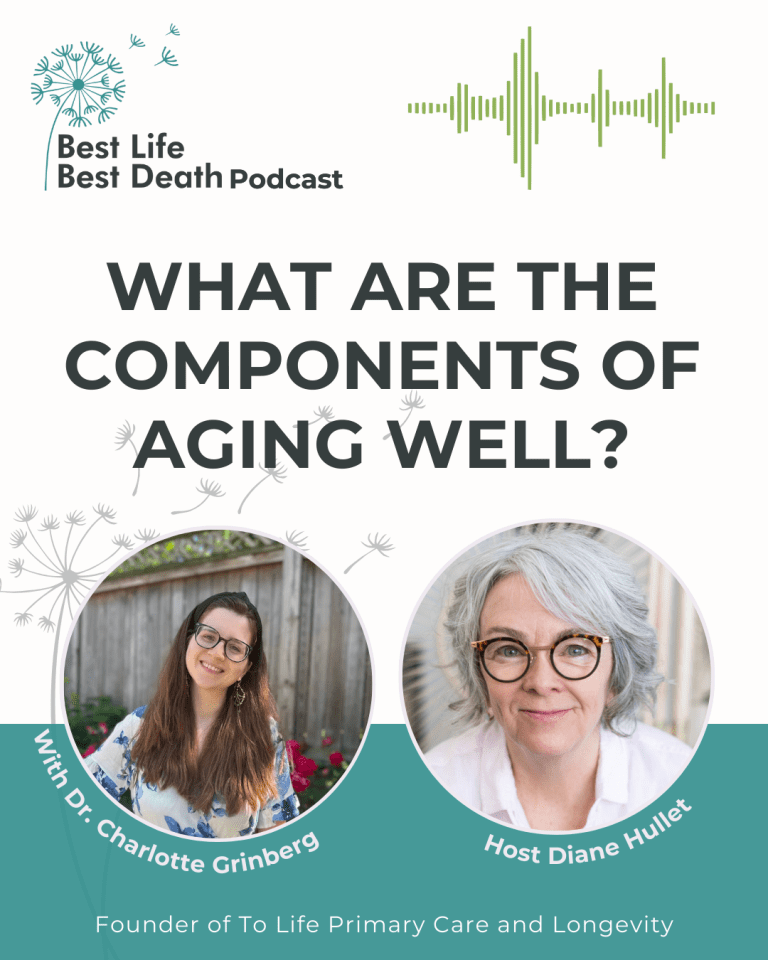
From her early experiences as a young birth doula, through medical school, into working in oncology and hospice, this doctor has seen beauty and denial go hand-in-hand. Realizing that many of us die from diseases created by choices in how we live, she now offers a primary care practice focused on support for better, healthier longevity. What does it mean to age well? How might we get the support we need to make lifestyle changes that can affect the most common diseases? How did seeing 1,000 deaths in one year change how this doctor and mother decided to live her life? https://www.tolifelongevity.com
For more information on Best Life Best Death please visit our website at www.bestlifebestdeath.com
Follow us on our social channels to receive pertinent and helpful resources on death, grieving, and more at:
Facebook: www.facebook.com/bestlifebestdeath
Instagram: www.instagram.com/bestlifebestdeath
Transcript:
What Are the Components of Aging Well? – Dr. Charlotte Grinberg, Founder of To Life Primary Care and Longevity
Diane Hullet: [00:00:00] Hi, I am Diane Hullet, and you’re listening to the Best Life Best Death podcast. Today I’ve got a doctor on board, Dr. Charlotte Grinberg, and Charlotte’s joining me from Washington DC, and I’m delighted about this conversation. Hi, Dr. Greenberg.
Dr. Charlotte Grinberg: Hi Diane. It’s wonderful to meet you and join your podcast.
Thanks for having me.
Diane Hullet: Yeah, this is great. We got connected through Dr. Matthew Tyler, and I think he really felt like there would be a nice synergy between Best Life, best death, and the work you do. Tell us about, how you got into medicine and how you got into the specifics of what you’re doing now.
Dr. Charlotte Grinberg: Absolutely. So I actually started out as a childbirth doula when I was in high school. I always. I think ever since I’m a little kid, I actually just loved taking care of people. Like I always ran on the playground when someone got injured, and I think I was just a high empathy, wanting to take care of other people.
Kid. When I was in high school, this opportunity came up for me to shadow midwives at a birth center outside of the suburbs of Philadelphia. And [00:01:00] that was a, I know you’re a death doula, but for me, just being a childbirth doula and seeing women like show up and support people through the labor process and how being a support like both emotional and physical and spiritual could make a really big difference to the experience was very eye-opening to me.
So I went through like a formal doula certification. I became certified, I think maybe as like the youngest doula in the United States at the time, at age 16. And then I went to college and med school definitely with the intention to do obstetrics. That was like my dream and my goal. But then when I was in medical school, it was like the first time I navigated a number of personal and professional deaths.
Like I had really never seen death before. And in a short period of time, I had an aunt, I was very close to die of metastatic lung cancer. I had, my first pregnancy ended in fetal loss after 18 weeks, and then I saw a woman actually die during childbirth. So it was just a lot all at once, [00:02:00] and I spent a lot of time like reflecting on how uncomfortable and stressed and chaotic everything felt from the people around me.
Like people were just really struggling to talk about it. Support one another, navigate it like it was just very high stress and I actually felt and I don’t know why, but I felt very calm through it. And I felt like these are things that are really like, it’s, these are important life events that we’re experiencing and we have to find ways to talk and connect with one another.
And so that sort of was the beginning catalyst for the change in my professional direction where I really decided okay I feel like there’s a need. That’s not being met in terms of being able to talk and support people through end of life, whether it’s expected or unexpected. And so then I put myself on the trajectory to train in hospice.
Diane Hullet: Wow, Charlotte. Oh, you’ve just said so much. I think there is this incredible quality in some people with who have the ability to [00:03:00] stand in that, and stand in the midst of birth or of death or of that combination that you witnessed too and simply be present to the enormity of the human experience.
And there’s something about the way, a lot of. Our culture, secular, modern culture, if you wanna call it that, doesn’t know what to do with it. And we kind of panic and we want experts, but we don’t even know who the experts are. And I’m not even sure all the experts know how to stand in it.
And so how incredible that at an early age, 16, you found you could stand in birth and then transfer that to standing in death. I think that’s so moving. And so you trained in hospice and then what did you do next?
Dr. Charlotte Grinberg: Yeah, so I went to a residency in internal medicine and I was actually taking care of a very elderly population in Cambridge, Massachusetts.
Just naturally a lot of those patients were aging. They were navigating like, do I need to go to a nursing home? Do I need my kids to start taking care of me? Should I, transition to hospice? Am I eligible for hospice? Then the pandemic happened, so there were also a lot of [00:04:00] deaths like happening, and so I think I.
Really, again, like just gained a lot of comfort and expertise in navigating end of life care for an aging population. After I graduated, I did one one year of working as an oncology hospitalist, so I took care of patients with cancer who were hospitalized, and those patients were really young, honestly, like that was my first time taking care of people who were like in their twenties, thirties, forties, fifties, and they were, a lot of them actively dying.
And there was like so much denial and so much discomfort both from the healthcare providers and the specialists and then also family members and like the patients themselves. And so it was like, I think that’s where I like really was like, oh my gosh, like we’re not having these conversations. We’re doing such a disservice.
So many people are dying even though we know that they are, but they’re not able to. Say goodbye or even accept the fact that there, like I just, there was, I’ve never just seen so much denial in [00:05:00] such a compressed period of time. And so I then went on to do a fellowship in, you do a fellowship both in hospice and palliative medicine.
And then when I finished that one year fellowship, I then immediately got a job as a hospice medical director. So I really felt like I wanted to focus on taking care of people who were terminally ill in the last six months of their life and try to make the experiences. Loving and compassionate, and. Supportive as possible
Diane Hullet: And out of denial.
You said a really big thing there and I was thinking about, the book Being Mortal, which I recommend to people all the time by Atul Gowane. I find it so moving that one of the things he does in that book is he follows it. A cancer patient who I believe was in her thirties, and he says how we failed her by the end of following her story through the book, he says, we failed her so spectacularly because she did not know she was dying until 48 hours before she died.
She really didn’t know it, or didn’t accept it, or hadn’t heard it. And so this piece about denial is so [00:06:00] huge, and so you, you’ve really worked in this field for a long time and then your practice transitioned again.
Dr. Charlotte Grinberg: Yeah, so this is just read. So I was a hospice medical director for a few years, and I think it’s been, very meaningful.
Like people who work in hospice are true like angels on this earth. Like I am so moved and inspired by my coworkers every single day from like the nurses to the volunteers, to the chaplains, to the social workers. Like they just really show up for people when they are truly having their hardest days and they are at their worst and they show up with so much.
Love and compassion and empathy and support. And so it, it’s a, it’s amazing to like work in that environment. And it’s also very humbling to see that much tragedy and sadness because it makes you develop, immense gratitude for your life, right? Like every day I just come home from the workday, just feeling so much relief and gratitude for being able to talk and.
Here [00:07:00] and eat and use the bathroom, and I don’t take anything for granted. So I think just both professionally and personally, it’s been unbelievably meaningful. I think what happened is that. At some point, like the amount of chaos that I see among most families, like there are some, beautiful deaths that I see and witness, but a lot of them in present day society just do feel very chaotic because of all these negative emotions, like the shame, the guilt, the fear, the anger, the distrust, the lack of preparing, the rifts, the finances, the legis, all of that.
It just like really got to me. It made me very sad. I was like, they’re, like we’re catching people too late. Honestly, like I feel like people are so activated, like they’re. They’re in fight or flight and they’re in crisis mode and they’re not able to digest or receive information and process it in a way that can maybe meaningfully make a change in that moment, like possibly like maybe decades [00:08:00] later.
But I think in that moment things felt very chaotic for most people. And so I think that was really impacting me. And then every death certificate basically I fill out has like heart disease, diabetes. Cancer, like a lot of diseases on there that I’m like, we always say that so much of this is like preventable.
And so many people have all these like comorbidities and I seeing them like, dying from it. And so I think all those things together just made me feel like I. I feel like there has to be a better model out there that’s not just trying to take keep care of people in the last six months of their life, but is trying to move things further upstream.
And so that’s why I’ve transitioned into what’s called the longevity space or improving health span. It. It’s so funny. It’s like we’re, most of us are like internists or some of us are specialists, but the general philosophy is like, we want to help people live as many good years as possible.
So not denying that death exists, but just having people have as much [00:09:00] autonomy or control with the time that they do have, and to take proactively as good care of themselves as possible so that they lead meaningful lives. And for me, in hopes that then when they do enter the chapter of having a terminal illness.
And dying from that, that they enter that with a greater sense of peace and that they, and acceptance, because they actually did take good care of themselves.
Diane Hullet: They had some agency, yeah. Over their lives and therefore feel more agency and connection maybe over their deaths.
Oh, wow. There’s so many things I wanna circle back to. One is this ca chaos at the deathbed, quote unquote, but also chaos in the. Times leading up to the a death. I think one of the things I’m always struck by is if you don’t have conversations with family, friends, caretaker, whoever’s helping you, if you don’t have conversations with them ahead of time, then in the crisis.
It’s gonna be chaos and almost everybody ends up in some kind of crisis. Call it capital C or [00:10:00] small C. You go to the emergency room, you fall, you have an accident of some kind. There’s a question, should we intubate, should we do CPR? If you haven’t talked upstream, then in the crisis, it’s chaos to make those decisions.
And as you said, you bring all the family dynamic to it,
Dr. Charlotte Grinberg: a hundred percent. And I think like I’ve seen it done well. Like I’ve seen people just know exactly what decisions to make because their parents have just told them again and again. They’ve written it down, they’ve talked about it, they’ve heard it just countless of times.
All the kids are on the same page. They really feel like a deep sense of like connection and understanding and closure even before the trauma or accident happens. And so I’ve seen it done and it’s so like beautiful. Like I know that’s a weird word to use in the setting of like sadness and tragedy and like such a heartbreaking life event, but it can really bond people and bring them closer and help people actually go through a lot of [00:11:00] psychological growth.
And so when you see that, but then like when you see what it usually looks like and just how chaotic it is. It makes me, yeah, it just makes me, it made me very sad, honestly I don’t have any other way to describe it, but like this could be so much better for people.
Diane Hullet: Yeah. Oh gosh. It’s it really, it’s not that talking about it ahead of time will solve everything and it’s not.
It won’t still be giant challenges as well as sadness and grief and loss, but there’s something about the decision making points being less chaotic, that just quiet. Everything down.
Dr. Charlotte Grinberg: Yeah.
Diane Hullet: I, so I think it’s so interesting. So yeah, you talk on your website about longevity medicine, and I think this is such a beautiful phrase, and you were heading into that too.
What, what are some of these chronic diseases that kind of spin out of lifestyle that’s one way to go. That’s we could call that terrible choices medicine versus like longevity medicine or, I don’t know, terrible choices. I don’t mean to sound all [00:12:00] judgy, choices that really impact your health in a super negative way and guarantee that you will die of something related to those diseases.
So yeah, talk about,
Dr. Charlotte Grinberg: yeah,
Diane Hullet: poor
Dr. Charlotte Grinberg: choices. It’s hard,
Diane Hullet: this longevity,
Dr. Charlotte Grinberg: it’s hard not to talk about in a way like that. Places blame, if people don’t do these things, if that makes sense, right? It’s like I wanna empower people to lead as healthy lifestyles as possible, but also acknowledge that there are things outside of people’s control, right?
Like people could truly do all those things and still get a serious illness, and so they’re not at fault for that. And then at the same time, it’s like you don’t wanna make people feel too bad for not doing those things. Also so it’s very complex and nuanced in my mind. But at the end of the day, like when you look at the data, like for people over the age of 50 who don’t smoke, like more than 80% of diseases that people die from are from like four categories.
So atherosclerotic disease, so like heart related issues, cancer neurodegenerative diseases like Alzheimer’s, and then [00:13:00] these like metabolic illnesses. Like related to liver dysfunction or type two diabetes related to like in insulin abnormalities. And so I feel like that’s a lot, right? That’s significant and we should talk about that.
And the way that like our current healthcare system is set up is so like reactive and disease focused and very fragmented. And also chaotic that we’re not like holistically looking at people and actually focused on prevention and the things that really can make a difference. It’s like people like hear about it, but they’re not having it like change really how they live and interact with day-to-day life and themselves.
Diane Hullet: One of the things you say on your website that I think is so great is you say, your mission now is to help people stay well before they become too sick to enjoy life fully. This work requires not just medical knowledge, but also motivation. Partnership and personalized support. [00:14:00] So I, I think the things you probably talk about with people are no surprise to any of us, right?
Like exercise, eat more vegetables than red meat, right? Low alcohol consumption, these kinds of things we hear over and over again. But how do you actually make connection to make those lifestyle changes?
Dr. Charlotte Grinberg: Yeah. But like when’s the last time you had a doctor who spent like an hour with you asking you in.
Incredible detail, like really to do a minute by minute, hour by hour dissection of like, how do you move throughout the day? What do you put in your body? What is your sleep routine and how does it impact you? And then get all of that information, then come up with a very actionable plan, and then honestly follow up with you like regularly.
And then get, collect the data, personalized data that can help guide and motivate you. Like that just doesn’t exist. And I think that’s like the level of support that people need. And they also need a lot of introspection, right? Like [00:15:00] a lot of time is spent. So it’s it’s so funny. I feel like I feel like the field of palliative care has came into existence because doctors like lost the skill to be able to just like connect and communicate with people and understand them and figure out what their values are and their goals and.
Their principles and their, so palliative care exists to help the healthcare system just do what it like should it be able to do itself. And so I feel like longevity medicine is existing to help the sort of healthcare system. It’s like the equivalent, it’s like the palliative care of healthcare in that it’s like we’re trying to take what like might seem as like basic, but actually requires more time, more support, more connection.
More follow up, more like emotional intelligence as well and apply that to these general principles of what health should actually be.
Diane Hullet: I love that it is what health should actually be. Healthcare should [00:16:00] actually be. And so what is this kind of longevity medicine? Can people find this in their area?
Is this sort of a specialty?
Dr. Charlotte Grinberg: Yeah, so I think it’s becoming it’s pretty easy to find, I would say in like major cities like New York cities in California, Miami, those are like, I think where you can find like the true leaders in long the longevity space. There are some people, so like Dr.
Peter Attia wrote this book Outlive that’s like very popular and very famous and he has an amazing podcast and puts out a lot of free content like every week just trying to make these like principles really accessible to people. NDA Wright just wrote a book called Unbreakable that’s more focused on women who are like perimenopausal men menopausal.
And also again, like. Just trying to make this information more accessible to people. If they can’t find a provider who specializes in it, at the very least, like a lot of it is things that people can do. On their own with a lot of discipline. A lot of it is like spending time really thinking about what is your [00:17:00] motivation, right?
What is your why? Really envisioning what do I wanna look like and do when I’m in my sixties, seventies, eighties, nineties, right? What? What do I wanna be capable of doing by the time I get to like my hundredth birthday? What are my values? What, a lot of similar questions that we ask that you probably ask people as a death doula, right?
Just like what is important to you? What do you value, like what do you, what things do not wanna regret. And then use that as the motivator for people to make all of these changes. It has to be like very personalized and individualized, and it has to, it’s not it’s not like it’s not just like exercise more or eat better.
It’s like your whole mindset has to change and your lifestyle also has to change as well too.
Diane Hullet: I love this. It’s a what’s your why? Yeah. What’s your why? What’s your motivation? Is it that you wanna be able to get up and down off the floor with kids or that you wanna be able to walk with a friend or that you wanna be able to, [00:18:00] I don’t know, ski.
I’ve got a friend who’s a ski patroller in her seventies and they are just about to do their retraining for the winter season. And I just can’t wait till she goes to this new mountain. And, most ski patrol buys are probably in their thirties or forties. What will they take away once they meet her and see her skills and what she brings to that kind of emergency situation on the ski mountain?
But most people I know aren’t aiming to be ski patrol, experts in their seventies. But what is your why? What do you wanna be doing and how do you then take the steps to go towards making that a reality?
Dr. Charlotte Grinberg: Yeah, for me, like I took terrible care of myself, like throughout. College and medical school, and even residency, like terrible.
Like I, I just was like sitting all the time, very sedentary, like studying constantly. I even herniated a disc in my spine and someone told me I would need like surgery, which I thankfully I didn’t need, but. I like, and I still took my medical boards through excruciating pain, like just [00:19:00] taking Tylenol and Ibuprofen ate terribly like in the middle of the night during residency.
Just really took very poor care of myself. And then it wasn’t until like I started to see my kids like, not be babies, but like a little bit older and and then I. And I have five kids and just seeing them grow up and I was like, wow, I wanna be my best version of myself for them and I wanna be able to engage and play with them in very mobile active ways.
And I wanna be able to do that for my grandkids and maybe even great grandkids. And I was seeing a lot of grandparents. In my life not be able to interact with grandchildren in, in mobile active ways. And I was like, I don’t want that for myself. And so that became like my motivator, but it ha it met me like at the right time and the right place and I was able to make these like really drastic changes because I always just go back to that image of what is the kind of grandparent I wanna be to my grandchildren?
Diane Hullet: Yeah that’s so true. Do you sometimes I sometimes walk through a grocery store and I just go oh my [00:20:00] gosh, most of the stuff in here isn’t food. This is incredible to me, and yet, what am I drawn to get? Oh I’ll get a bag of chips, or, oh, I’ll get this or that. We sort
Dr. Charlotte Grinberg: of treat
Diane Hullet: ourselves with poor food when we know that the most important thing is Whole Foods, and
Dr. Charlotte Grinberg: yeah, it’s so hard. Like I feel like we, there are so many barriers to being able to lead this kind of lifestyle. And so I think it’s important to acknowledge that there are financial barriers, there are time barriers, there are childcare barriers for people like me in their sort of reproductive years.
And then there’s just this psychological barrier of the addictive nature of all these things, right? Like we’re more sedentary than we’ve ever been like because of our phones and the computers. We have poor diets more than ever before because of the processed foods that exist, but they’re so addictive and so it does require just such like a mental load to be able to overcome these things.
And so again, it’s if you are, paying for a doctor to hold you accountable, like there is more stake in the game if [00:21:00] your spouse or your neighbors or your best friends like also are on board and excited and. You guys are sharing recipes and exercising outside together, and like you need all of those things.
You need a lot of things to be able to counteract like all of the barriers that exist in modern day society.
Diane Hullet: Wow, Charlotte. I think that was such a succinct summary of that. That’s so true. And we try to do so much in isolation these days. I think it’s really interesting. So creating community around all of that, whatever that looks like, whatever community means to you, how to get out there and utilize community as a motivator is huge.
Dr. Charlotte Grinberg: Yeah. So for me, basically two years ago, we essentially upended everything in our lives. We were in Boston, that’s where like I’d done all my medical training. I had a great job. Our kids were in school there. We had grandparents there, but I took care of a thousand dying patients that year. And in that I just like really internalized the finality of life.
And so my [00:22:00] husband and I did this calculation. We were like, we have, so my, his best friend was married to my childhood best friend and we did this calculation where we were like, we’re only seeing them about once a year. And so we’re like, oh my gosh, if we only live for 60 more years, we’re only gonna see each other for 60 more times.
And that was such a sad reality. And so we basically like. From we, we basically moved and then we bought homes right next to each other. So now I live right next to them. And we have very similar values around how do we wanna raise our kids? Like how do we wanna be healthy? Like how do we wanna take care of ourselves?
And we’re very motivated to do it together. So I feel like a lot of these big lifestyle changes happened for me personally after we made this move because. Our lives became so intertwined with like people that we care so deeply about, and I think they’re grateful to me for just like constantly being the person who’s reminding everyone that like we do die.
And that’s scary to hear, right? That’s like a scary reality. But I think [00:23:00] you can give some people a sense of control and agency, right? Like you can say take care of yourself, right? That is something you can control and you can do. And there is no time like the present to start doing that.
Diane Hullet: That is such an amazing story.
I know people who would like to do something like that, but I think fear holds us back. Economics holds us back. There’s lots.
Dr. Charlotte Grinberg: Yeah,
Diane Hullet: or
Dr. Charlotte Grinberg: maybe all you have to see is a thousand people die. That’s what did it for me. Like I didn’t even see, I didn’t even see the home you moved into. I never saw the neighborhood.
I didn’t even see the home. I was just like, whatever. None of that matters. Like I just wanna live next to them because I just know, like you just see it like you just see at the end like how much. Family and friendship and community like matters to people, right? Like I almost never hear about people’s jobs, honestly, and or like their money or their personal, like they, I don’t know, you people aren’t like wearing nice clothing or jewelry or even talking about or caring about their furniture or their [00:24:00] artwork.
Like they just want, they’re like happy about the presence of their loved ones, or they’re very sad about the absence of them. I know it’s extreme. I know it’s like very extreme, maybe like what I did, but I’m so grateful to it ’cause I feel like it’s leading such a it’s inspired and created such like a meaningful life for me.
Diane Hullet: Such a community. You went right towards the heart of your most beloved community and said, let’s do this more. Let’s have this
Dr. Charlotte Grinberg: happen. Yeah.
Diane Hullet: And obviously you knew each other well enough. You knew you could make that work. It wasn’t a huge gamble. There’s, there was this great article in the New York Times recently about a place called The Bird’s Nest in Texas.
Woman decided to buy. Plot of land, which actually turned out to be a dry, not super fabulous plot of land, but it was cheap and she could afford it. And she put in concrete pads for like RVs and got it plumbed for that. And then she invited women to come live there. And so it’s a. Women’s community of tiny houses.
Wow. They have some great norms. Basically if someone’s outside, they’re free game to [00:25:00] talk to, but if someone’s inside, you don’t go knock on their door. Like everybody gets space and maybe, I think one night a week they gather in a community outdoor space, anybody who wants to, and they cook together and play, games and cards and stuff.
But this was such a great example of creating community, creating the life that you want so that you’re. Heading into older years in a different way than isolated and stuck in some way.
Dr. Charlotte Grinberg: Yeah. And there’s so much data to support it, right? Like where you live and who your neighbors are and how socially connected you’re with people are like major contributors to longevity.
Diane Hullet: Wow. And movement. That’s the other thing I think about the number of elderly people who really go towards sedentary and stay there is pretty stunning.
Dr. Charlotte Grinberg: Yeah.
Diane Hullet: Oh, I know the other thing I was gonna ask you there, there are these kind of interesting, modern sort of tech tools talk to us about that.
A friend of mine just had her OID artery in her neck, [00:26:00] imaged as a way to get information about plaque in her heart. So I had breakfast with her the other day. She said, oh God, I’m on this terrible diet. I absolutely hate it. But my partner and I are both doing it because we both have plaque and so she’s it was like plants and beans and a little protein, no red meat, no butter, no carbs, all this stuff.
And she said her partner had lost like 10 pounds in a month.
Dr. Charlotte Grinberg: Yeah, that sounds like the green Mediterranean diet.
Diane Hullet: I think so. Yeah. And so anyway, talk about the little artery thing and then I know also, I know someone who did one of the full body scans Yeah. And some really interesting technology that can give us information.
Yeah. Do you utilize any of that or like any of that?
Dr. Charlotte Grinberg: For sure. There are so many recent products in recent years and a lot of them actually are now becoming like direct to consumer. So just because I think a lot of people do wanna take good care of themselves and they don’t trust like the healthcare system to do that.
And there’s part truth to that, but also part sadness because again, I think if you have a doctor who [00:27:00] has the time and the expertise and the open-mindedness to engage with these things, then again. Most things like do require thoughtful follow up and possible interventions and ongoing monitoring, and so I think it is good to find a.
Like a medical partner for those things. But there are actually, yeah, there are tons of tools now that, that help people. And I think people want the data, right? It’s like there’s something jarring about seeing abnormal values to then motivate behavior change. And especially since we’re just now programmed as like modern day people to like wanna be in control and want data and like continuous data and like access things immediately.
So I would say a few things that I see a lot of my patients or people that I know using are one wearables, like the Aura Ring or the Whoop Bracelet, or even an Apple Watch that will help with trending sleep and your heart rate variability. Also some of these things measure like the Apple Watch will measure what’s called VO two max.
Which is like how much [00:28:00] oxygen you can give your body during moments of exercise, and that’s actually a huge predictor for longevity. And there are specific aerobic training exercises that you can do to improve your VO O2 max. So being able to monitor that is very helpful and important. And then tracking your sleep is also just very helpful because you can get a better sense of how consistently are you falling asleep? How good is the quality of your sleep? What are you eating before you sleep? What is your like ritual routine before you sleep? And how is that then impacting the impact, like how good quality sleep that you’re having? Some of my patients are doing like continuous glucose monitoring.
To get a better sense of like their sugar spikes and lows. And again, like the data is really like to try to help motivate people to be more thoughtful about what they’re eating. So sometimes people are like, don’t really pay attention, but now of a sudden if they have constant monitoring of it, they see okay, I ate this thing, now my sugar spiked.
Then I had horrible night’s sleep. So all of this data [00:29:00] proves to me that I shouldn’t be doing this. So I think these things are helpful if they’re gonna inform people. I think there’s a category of people where it like will cause anxiety, do you know what I mean? Like they’ll become actually more anxious and I don’t think anxiety is like a good thing.
So you just have to get a sense of who you are as like a person and are you gonna respond and be motivated by the additional data? Or is it gonna stress you out and be like debilitating?
Diane Hullet: I think that makes me realize that if I had a continuous glucose monitor right now, the pumpkin cringle from Trader Joe’s definitely spiked my blood sugar before we got on this call and was absolutely worth it for the moment.
Well, Charlotte, I thank you so much for your insights. I think this is really I think it’s a really interesting trajectory that you went from birth. Into medicine towards death. And then now you’re really talking about this longevity cycle. How can we age well? What does it mean to age well? What do we do?
And how do you create the motivation to do that and make that happen in your own [00:30:00] life?
Dr. Charlotte Grinberg: Yeah. I feel so blessed that I got to like experience and witness honestly the two most intense, emotional and physical and transformative lifecycle events. That people don’t really think about or know much about until they experience it.
And then again, they’re not usually able to experience like the most deep version of the physical and emotional intensity because like they’re focused on the sort of higher end, chaotic parts of it. And so for me to go so deep into those things as a doula, right? To be fully all in and fully present I’ve learned like so much.
Wisdom. Yeah. Just about like how to how special and meaningful and beautiful and finite and special like life is. And so I think I, yeah, I just have this just immense, like gratitude. I really don’t take anything for granted. And I hope I can, I hope I can like impart that sort of wisdom with, for people [00:31:00] without having to maybe, like having to need to experience those things themselves.
That’s the goal. But but I think maybe there, maybe it’s worth like also just finding ways like you did to like, volunteer in the hospice setting or. Try to go to people’s births. I think like the more we actually expose ourselves to these lifecycle events, we would find a lot of inspiration in them.
Diane Hullet: A huge amount of inspiration and I encourage people to lean into deaths too, right? Like we have a tendency right now to be, oh, I didn’t go to the funeral. I didn’t know the person that well.
Dr. Charlotte Grinberg: Yeah,
Diane Hullet: I need something to show up and I always get something out of showing up for those lifecycle events as you call them.
Dr. Charlotte Grinberg: Yeah.
Diane Hullet: It’s
Dr. Charlotte Grinberg: just I a hundred percent. Yeah. Any single time someone’s anytime I hear like about. A funeral or like a celebration of birth. I like try my best to show up because I think people are just like in this elevated. Yeah, state of reflection, like their mo like their move, they’re really contemplating like about their existence and their, their dynamics.
And it’s just, [00:32:00] it is a time for like contemplation and connection.
Diane Hullet: It’s like the heightened places of humanity. And they’re so interesting. People probably say to you they say to me, oh, that sounds really depressing. Your work sounds really hard. And I think. No, it’s like the most beautiful spaces of what people live in.
It’s the most extreme sad, but it’s also the most extreme connection. Yeah.
Dr. Charlotte Grinberg: And
Diane Hullet: everything meaningless falls away.
Dr. Charlotte Grinberg: Yeah. I’ll never forget, like one time I saw this like dying father and his like middle age son. Was massaging his temples. It was like at the bedside and just like massaging his dad’s temples while like crying.
And later he said oh, my dad used to always do that to me when I was sick. When I was like a little kid, I would be really sick and I would line his lap and he would massage my temples like that. And so I wanted to give him that same level of like comfort and presence. And I, yeah, just it’s like one of the most beautiful things I’ve ever seen in my whole life, right? Like the connection between father and [00:33:00] son, somebody who I would never have anticipated like having that emotion, and then that connection to their childhood and what it meant for them. And I just felt like so lucky to be able to be there and like witness that.
This is, and then like when I do that kind of stuff to my own kids, right? Then I come home and it’s I wanna do this for my kids. And when they’re not feeling well, I wanna show up with to them like a hundred percent and be fully present and show them that I care and that I’m trying to make them feel better and massage their temples, like in honor of that, and also in hopes that they remember that and that it’s like a formative experience in their own lives.
Diane Hullet: Compassion. How do we develop compassion and connection? So beautiful. Charlotte, Dr. Grinberg, how can people Yeah. More about the work you do?
Dr. Charlotte Grinberg: So I just have a website like www.twolifelongevity.com. Yeah. So I would start there. I do have a Instagram and Twitter, but I wouldn’t say I’m super active just ’cause.
I try to be very present in the day to day. So you’re
Diane Hullet: busy raising
Dr. Charlotte Grinberg: funds? [00:34:00] Yeah.
Diane Hullet: Yeah. I feel like I,
Dr. Charlotte Grinberg: yeah, for better or for worse, I’m like minimizing, I’m not on social media that much, but I’m really good on email. I love to connect with people. I love conversations like this. Like where you feel like you, yeah, just get to learn from one another and connect.
And I try to be very responsive, like by email and through my website and then just trying to write more. I love writing, and so there are links to articles I’ve written as well, too.
Diane Hullet: Beautiful. Beautiful. Thanks so much for joining me.
Dr. Charlotte Grinberg: Of course. Thanks for having me.
Diane Hullet: You’ve been listening to the Best Life Best Death podcast, and as always, you can find out more about the work I do at bestlifebestdeath.com. Thanks again for joining us.
End of Life Doula, Podcaster, and founder of Best Life Best Death.