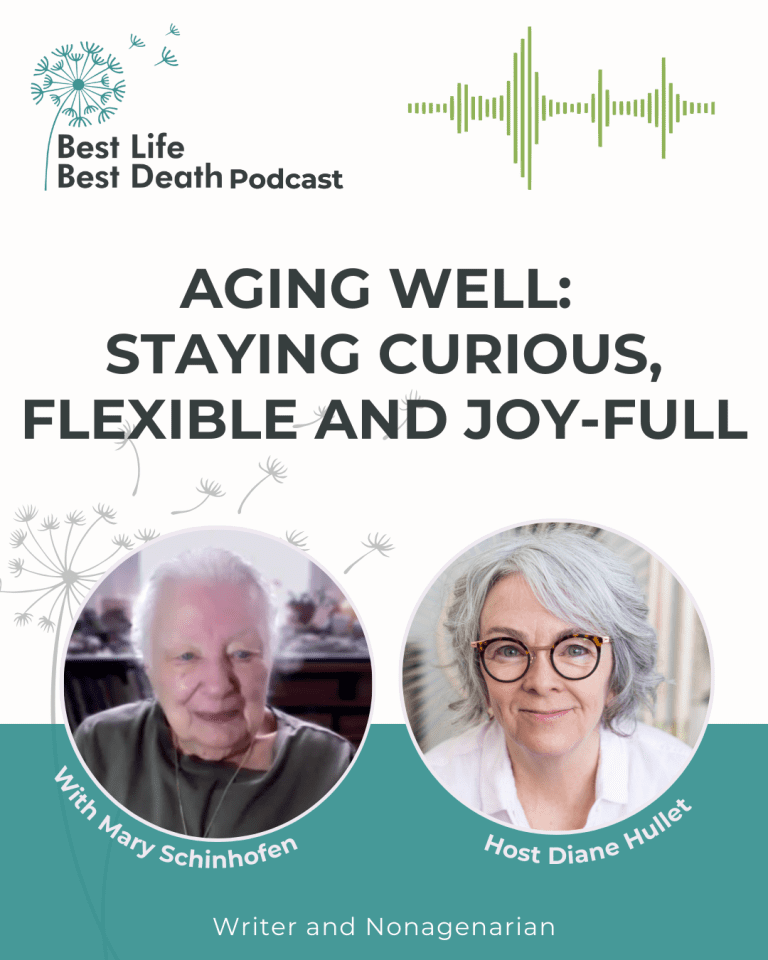
Join me in conversation with a dynamic woman in her nineties who founded a writing group with friends that is now a sustaining source of inspiration and shared connection. We know that social connection is key to staying engaged as we age, and Mary reflects on what she’s learned about why it matters. As she says so beautifully, “another element of flexibility reveals itself as we age – one that enables us to leave behind ‘what used to be,’ and open ourselves fully to ‘what actually is.’” Ready to be inspired?
For more information on Best Life Best Death please visit our website at www.bestlifebestdeath.com
Follow us on our social channels to receive pertinent and helpful resources on death, grieving, and more at:
Facebook: www.facebook.com/bestlifebestdeath
Instagram: www.instagram.com/bestlifebestdeath
Transcript:
Diane Hullet: [00:00:00] Hi, I am Diane Hullet, and you’re listening to the Best Life Best Death podcast. And today I’ve got a really fun and wonderful guest. Welcome to Mary Shin Hoen. Hi Mary.
Mary Schinhofen: Hi. It’s great to be here.
Diane Hullet: I’m excited. Is this your first podcast? Yes. Excellent. Okay I might have had my youngest guest ever and it was her fir first podcast and you might be one of my older guests and it’s your first podcast, so I kinda love that.
And I reached out to Mary because a friend of mine shared an article that Mary had written, and it’s called A Writer’s Club for Older Adults. Soothed my grief as we’ve ranted, raved and wrangled with aging. And it was a first person article that appeared in a Pittsburgh magazine and my friend shared it with me and I read it and I just, gosh, Mary, I just thought there was so much wonderful stuff and it that needed to be shared.
So I reached out and here we [00:01:00] are. Here we are. Yeah. In the article you talk about this, but let’s talk about it here. How did you come to start this writer’s club in your eighties, 90, in your nineties?
Mary Schinhofen: Five years ago my husband died. We would’ve been married 67 years. And, I had never lived alone.
I had gone from mine, my mother died. I went from our family home to my aunt’s, and then I got married and I went, we set up housekeeping together, Ray and I, and I was lost. I felt like I was free falling. I didn’t know, I didn’t know how to do, I couldn’t reach the light bulbs. I couldn’t change my own light bulb.
I, I found myself in a totally different place in my life [00:02:00] and it was lonely. Fast forward about four years and a friend of mine, Kathy, to write and she was bemoaning the fact that their writing group had dissolved and so she didn’t have a group to write with anymore, and she loved to, to write haiku.
And I, and I had to write in the past. And so it occurred to me for selfish reasons that we should hold the meeting. I said, why don’t you start a writing group? And she liked that idea. So she invited two members from the previous group and then a couple of our mutual friends, but for selfish reasons, I said, oh, we can have it at my house.
’cause I don’t drive anymore. And it’s hard for me to ask for rides every time I [00:03:00] need to go someplace. So we started to meet here in, in the house, and it turned out to be pretty phenomenal. It was sharing, it was getting in touch with our deepest feeling. It was writing something and reading it out loud and listening to how other people reacted to it.
So we decided we needed to have a name before our group. And the youngest person in our group is, I think 82, and I’m in my nineties, so we decided to call it the non-writers group now or never.
Diane Hullet: I love it now or never non That’s really good. Non-writers group. So it’s interesting how it’s like you came together around writing, but it really turned out to be more than that.
It’s like through the writing you really found [00:04:00] companionship and connection, as you said.
Mary Schinhofen: And that’s so important. Not only for older people, for all of us. Yeah. So important. And and I used to teach English and at a prep school I, and I had a student there who got in touch with me and we had coffee together, and I told her about the group.
That’s when the editor, or I think he, anyway, someone from Public Source called me and said, would you like to write a first person essay? Okay. And it’s like dropping a pebble in a pond. The ripples have just gone out and out. And I, and I’m hoping that other people who feel that they need more social contact in their lives.
We’ll go out and do something that will bring them joy in others, get together.
Diane Hullet: [00:05:00] Yes. I love that. Get together over that. What I love about it is you created a regular schedule and you had regular people come and so everyone knew to count on it. And it seems like you also made it not a big hostess hassle.
It’s not like you serve a bunch of food or something, so it didn’t have to be a big deal. It could be kinda low key, but it was regular and consistent, and it was also a thing that you worked on in between meetings. So you write and you do things, and I’m just so struck by, isolation I think is such an issue for the elderly, but also for our whole society right now.
People feel very disconnected from one another.
Mary Schinhofen: Yeah. And that’s a health issue too, because they’re finding out that loneliness and isolation can lead to illness and this. We all face death, [00:06:00] but we want to be as healthy in the meantime as we can, and being together helps that.
Diane Hullet: Yeah, absolutely.
I love that you called it you’ve ranted, raved, and wrangled about aging.
And tell us it, your group developed some rules for itself. What were some of the rules that evolved?
Mary Schinhofen: Okay. One of the rules is that we have to have it on a regular basis. So we meet the second Wednesday of every month. That’s important because you need to fit it into your schedule and you need to look forward to it.
We had started out meeting like at four 30, but when Win winter came upon us, we decided to meet earlier in the day so that people didn’t have to drive when it was dark. So that rule was changed. People bring snacks, nothing, they’re not assigned or anything, [00:07:00] but just women bring snacks and so after we’ve shared our work.
We sit around and talk and talk, and we have prompts. One of, one of the, oh geez, I can’t even remember what it’s called anymore. I should have brought my notebook with me, but it’s writing without a particular letter, so we decided not. To use the letter E, which is very common, and to write a paragraph.
And we had a half hour to do it. And so we all wrote a paragraph without the letter E and when I looked it up and Wikipedia, ’cause there is a name for it there was a novel, actually 500 page novel that was written without the letter E and it got good reviews. I can’t imagine how in the world somebody would write a novel without the letter [00:08:00] E
Diane Hullet: I’m thinking of the word, the if you can’t use the word the what do you
Mary Schinhofen: do,
Diane Hullet: what
Mary Schinhofen: do you do?
You can use that. Anyway, so what we did then afterwards, while we’re, sharing whatever everyone brought, we tried to have a conversation without the letter E and this just. Dissolved into the funniest encounter that you can imagine because would say something and then somebody’s there’s an E.
So we never quite know, yeah. What it’s going to be. And that’s part of the fund, that’s part of the anticipation.
Diane Hullet: Now, who decides what the prompt is for each time? Do you take turns deciding what the prompt will be? Sometimes
Mary Schinhofen: during the month between meetings, one of us will say, Hey, I just thought of a prompt.
How, what do you think about this? Then sometimes at the [00:09:00] meeting somebody will just say, I thought maybe we could write about this. And then if all else fails, I have a an official list of 30 prompts in case we get stuck.
Diane Hullet: Sounds like getting stuck is not a problem with this writing group. You just go so you share a prompt that day, which you’ve come up with kind of spontaneously, and then you write at the time.
Mary Schinhofen: Yes.
Diane Hullet: And then there’s sharing of the writing and talks, talking and snacking.
Mary Schinhofen: Yeah and also time to read whatever we may have written. In the month between the meetings.
Diane Hullet: Oh, interesting. Are people working on particular things? Has anybody got a, legacy letters or a novel or short stories or poetry that they work on?
Mary Schinhofen: A couple of our members have had chap books published, so they have, and they were part of the original group that had dissolved and, [00:10:00] no one in the group right now is writing a novel. We do write poetry sometimes for example, there’s a wonderful poet, I believe her name is Joy Harjo, and she wrote a book a poem on the kitchen table about the kitchen table.
So we wrote a paragraph about. Kitchen tables. Our memories of kitchen tables. When Ray and I got married, we were so poor. We used an ironing board for a kitchen table. We had no table until his aunt took pity on us and gave us a table. So I was able to go back to that memory, and write about it.
We have had people ask us. If they can join. And there is one woman that I am hoping will be able to come to the December [00:11:00] meeting. She is writing a novel about the stories that her grandmother told her about the plantation, and I think that’s very exciting. So I don’t know where this group is going to go, but it is growing very slowly and and we’re enjoying it.
Diane Hullet: There’s something about the chemistry of a group like that, isn’t it? And when the chemistry’s good and everybody’s at ease with each other and happy to share, you hesitate to bring someone new in because it’s going so well. Yeah.
Mary Schinhofen: That, that’s true. And one thing that we have decided, that we’ve decided that.
People who join or the women who join. I think we do want to keep it all women. The women who join must be old enough.
Diane Hullet: Yes. Over 80. Over 80 or over
Mary Schinhofen: 70? [00:12:00] No, over 80. Because perspective changes. There were stages in life and there’s a totally new one after 80. I found that my seventies, one of the most active decades of my life, but when I turned 80, things really began to change.
Your priorities change and it’s difficult to form a group when the perspectives are all different.
Diane Hullet: That makes so much sense. Yeah. When you were in your seventies, what was the action that you were busy with in that decade? I was
Mary Schinhofen: teaching high school and I I retired and I had always wanted to take classes, art classes, and I never had.
So I began to take art classes at [00:13:00] our local museum for about eight years. And and that was wonderful. That was wonderful. But I started to paint seriously when I was in my seventies.
Diane Hullet: That’s fantastic. So you’ve really had this link to creativity for a long time in different ways.
Mary Schinhofen: Okay. I’m going to get on my soapbox right now.
Please do. I firmly believe that we are all creative. It’s part of our human existence, it’s part of our humanity, it’s part of our DNA, our genetic structure. We are creative, and unfortunately, I think that this creativity is. Shamed or pushed out of us by the time we reached the fourth grade.
It was Picasso who said it took [00:14:00] him I don’t know, 45 years to learn how to paint like a 3-year-old. And we cannot really live a full life without expressing that creativity. It’s like a hunger inside of us. If we don’t respect it and address it and act upon it, we as individuals and as a community and as a country, we will suffer.
Diane Hullet: Yes, I agree completely. We’re poorer for it. We personally are poorer for it. And our communities are less enriched. And I agree with you completely. It doesn’t matter what your mode is. It doesn’t matter what you know. Painting, writing, singing, dancing, movement, fabric, cooking. Yeah. Sew.
It doesn’t matter what it is, woodworking, gardening. [00:15:00] But how you connect with something bigger than yourself and move it through you is so gorgeous. It’s such a good feeling.
Mary Schinhofen: Yeah.
Diane Hullet: Yeah. I find it’s interesting. There are certain things I do creatively alone, and then there are certain things I do with other people, and those are very different experiences.
Did you find that with the writing group, there’s writing by yourself, and then there’s writing in a group? I,
Mary Schinhofen: I have a habit of waking up at three o’clock in the morning. And that’s when there was a haiku embedded in that article that you read. That’s my best time for Haiku. Three o’clock in the morning.
Diane Hullet: That is a really good time to do it, isn’t it? Is that the one about is that the poetry about the Flagstones? Yes. I’ll read it [00:16:00] here. Shall I read it or do you have it in front of you? That would
Mary Schinhofen: be lovely. I don’t have it in front of me.
Diane Hullet: Okay. Here’s the, now we know this haiku was written at 3:00 AM what?
A, oh, I have to get the syllables right. What joy in seeing a defiant thrust of green between the flagstones. Beautiful. I love even that haiku speaks to kind of creativity and how things can burst through in the most unexpected places
Mary Schinhofen: and the persistence of life. Yes.
Diane Hullet: Yes.
Mary Schinhofen: And there’s an African proverb and I am hope I’m getting it right.
When death comes for you, may he find you alive. Yes.
Diane Hullet: Yes, exactly. And I think there’s something, I don’t know how you would speak to this, but there’s something about what you said at the beginning. We can’t stop mortality. It is coming, but [00:17:00] we can meet it in a different way. We can have some choice if our minds are good, if it’s not a sudden death, there’s some choice in how we meet that.
Would you agree?
Mary Schinhofen: Oh, absolutely. Absolutely. And that choice takes a lot of work and courage. I keep going back to our society, but our social structure does not allow the gracefulness of getting old. It’s all focused on youth and beauty and, just. So not only does that harm old people who are overlooked because we’re done for, but it’s also harming our young people who can’t possibly live up to those standards and who are getting a warped idea of what it means to be human.
Diane Hullet: Yes. And [00:18:00] what these chapters of our lives look like. I keep being struck right now. I’m 60 and I have gray hair, and I’m often assumed to be older than I am because of my hair, and I just, I find that fascinating that there’s this assumption that 60 looks a certain way and 70 or 75 looks a different way, and what happened to just aging naturally and beautifully.
Mary Schinhofen: Yeah. There’s a beauty to it and actually. I would never take you for being 60. You look much younger.
Diane Hullet: Oh, good. I didn’t know you were in your nineties. We’ve got this Good, Mary what else would you say about this chapter? Do you feel like, would you call it your final chapter?
Would you call it your best chapter? What? What is the nineties for you?
Mary Schinhofen: It’s different. It’s very different. I believe it’s called Jro [00:19:00] Transcendence. Erickson had, I think it was eight stages of life, and he was working on the ninth stage when he got older and he died and his wife took it over.
But it’s what I’m going through now. It’s where things really change. You look at people. And choose you, choose your friends very carefully. You don’t, I don’t want to take part in as many things as I used to. It’s not isolating, it’s not disengaging. It’s just that I want to savor what I am doing and that the crazy busyness of my life for so many years.
No longer holds any meaning or doesn’t appeal to me anymore. So there are real changes.
Diane Hullet: Yeah. Pri it’s almost like pri [00:20:00] priorities have just really shifted.
Mary Schinhofen: And, you learn to be gentler to yourself, I think, and forgive yourself and others and, be grateful every morning that you’ve awakened for another day.
But we don’t honor that in our culture, in our society. We really don’t, and we should. I think about the old villages in Europe where the generations, small villages, everyone knew everyone and the. The older person was accepted for who they were. They were old. Yeah. And and loved and kids would come and you know it.
We don’t have that anymore. We don’t have that. Yeah.
Diane Hullet: We really don’t.
I think it’s at the, I think it’s at the core of something that’s been lost or at least misplaced. I wonder if there are still [00:21:00] pockets of it in places. I know I’ve had a couple of friends who’ve ended up bringing their mothers to live with them at the very end of life, and that’s been so moving for the families to experience because it’s so uncommon right now.
Yes. And then yet I also look at the families and caregivers dealing with dementia and how difficult that is as a society. We can’t always have the people we love with us.
Mary Schinhofen: Yes.
Diane Hullet: I think it’s exciting not only that you started the writing group, but also that you wrote about it and now you’ve been on your first podcast about it.
Maybe this will lead to other podcasts. Next thing you’ll be on a Anderson Cooper,
Mary Schinhofen: oh, please, no.
It’s nice to share ideas and it’s fun. It’s fun to be able to reach so many people, but that’s not the point.
Diane Hullet: No, that’s not the point. But the point is, I think there is something [00:22:00] about sharing the wisdom of our elders and your, your kind of message of stay creative and stay connected and find those connections if you don’t have them already.
I think that’s so valuable.
Mary Schinhofen: And one other thing, be flexible because you’ve got to give up a lot. I have. I’m old enough now to have seen people who are now gone who had bitter deaths because they wanted to be who they were when they were 35 or 25. And you can’t, it’s impossible. Ah, and the heartbreak and the bitterness and the anger that they held inside of them was really disturbing.
Diane Hullet: So [00:23:00] flexibility and acceptance, is that a word you’d say? Yeah. Interesting to accept the creaky bones or the arthritis or the bad knee. But
Mary Schinhofen: you’re looking forward to the painting or the, so you can’t garden anymore, you can’t get down on your hands and knees, but maybe you can baby that potted plant that you’ve got.
Yes. The Christmas cactus that’s behind you. That’s right. I’m sure you’ve read becoming Mortal.
Diane Hullet: Yes. Being Mortal. Being Mortal. Mortal Aul. Gwane Being Mortal.
Mary Schinhofen: That’s such a wonderful book. And in it he talks about the people who were either in an retirement home or something, but they had lost interest until he brought in the plants and the visiting animals.
The parakeet, that’s the best scene and 90 parakeets and no [00:24:00] cages because the cages hadn’t arrived yet.
Diane Hullet: That it’s so funny the minute you said so you can’t keep gardening book, could you care for the house plant? That’s exactly the part of that book I pictured too, and I was gonna bring up, because there’s something so gorgeous about it that they give people a plant and they perk up.
We, we all need life. We all need creating. And there was something about that. Having something to care for made a huge difference.
Mary Schinhofen: Yes. Being needed by something.
Diane Hullet: Yes. Yes. Oh, so much wisdom. So much wisdom. I love it. I love it. Mary. I really value this observation you’ve made that a consistent ongoing group really matters.
I may just have to mention, because my parents are 88 and 90, and they both have consistent [00:25:00] groups that they’re part of, and some of those groups listen to the podcast, so we’ll just say. Hey, lunch groups. Say a little shout out to the lunch groups because I see what that does for everybody in the group to feel cared for and looked after and commiserated with.
And, you’re sharing your ups and your downs and your joys and your difficulties, and that’s so different than carrying those things alone. Yeah. I will share your article, Mary, and may it go wide. And I just appreciate your insights. Any last things you’d wanna share?
Mary Schinhofen: No, I don’t think so except that I’m so grateful to get this message out because I think it can’t be overestimated.
We need to grab life with both hands. Stay away [00:26:00] from little deaths.
Diane Hullet: I love that. Perfect place to end. Okay. You can find out more about Mary, not by going to her website ’cause I don’t think she has a website, but you can read her article available through Pittsburgh’s public source and I’ll share that as well.
Thanks for being my guest.
Mary Schinhofen: Thank you for asking me.
Diane Hullet: Yeah, I’m so happy. I reached out via email and I thought she’s either gonna not do email or think I’m crazy, or hopefully she’ll say yes. So good. This episode is gonna go up new Year’s Week, and I think it’s a great kind of beginning of the year, listen for people to say, Hey, what kind of creativity, what kind of social connection might I bring into my life?
This January, February, what have I been wanting to do with a group that I just haven’t done? I know my neighborhood women have just started playing Mahjong, so that’s a thing that’s brings people together [00:27:00] for sure.
Mary Schinhofen: Oh, that’s so funny because over Thanksgiving I spend Thanksgiving with a friend and there, there were people there I didn’t know.
One entire afternoon, one of the women and I spent talking about Mahjong ’cause I never played it. And she gave me a set of rules and she it sounds fascinating. So that might be my next group.
Diane Hullet: I love it. I love it. Okay. Maybe you and I’ll touch base in a year and see which one of us figured out the Mahjong rules and maybe we can do it on Zoom.
There you go. There you go. So far I haven’t progressed past Euchre. That’s my game of choice as a mid-Westerner. But super thanks again, Mary. Wait before we stop, Mary and I have two editorial clarifications. Number one, go Mary. I
Mary Schinhofen: unfortunately aged a couple of our [00:28:00] members. Our membership starts in the seventies, not in the eighties as I stated.
Diane Hullet: My goodness. Thank goodness we caught that moment. And secondly, I was thinking when Mary was talking about how they wrote poems about kitchen tables, I wanted to share a great writing prompt that I love. There’s a poem by Pablo Neruda called Ode to My Socks, and you can have a great time writing Ode to your favorite, object. Your favorite ironing board or your favorite article of clothing, or your favorite quilt or your favorite potted plant. So look up ode to my socks and sorry, we aged you group. Okay. Now that we’ve added that back in, as always, you can find out more about the work I do at bestlifebestdeath.com.
Thanks for listening.
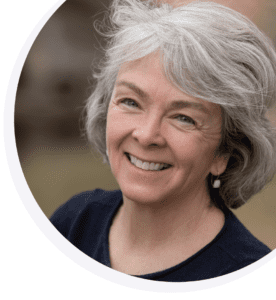
End of Life Doula, Podcaster, and founder of Best Life Best Death.