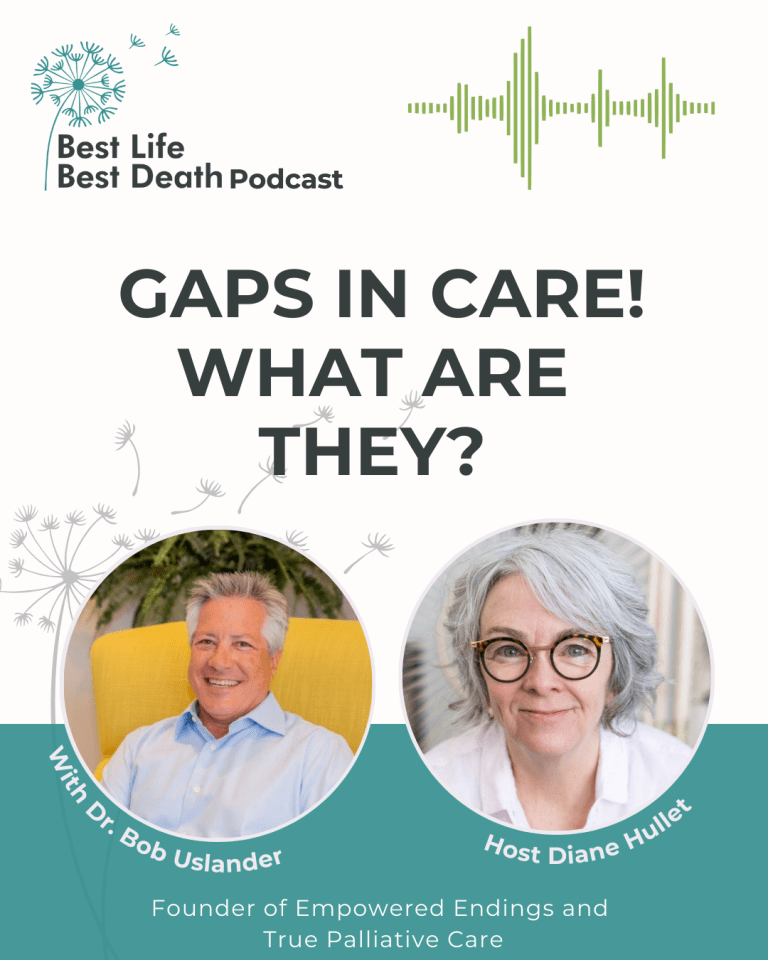
This week, Dr. Uslander and I dive into the often-overlooked transition from hospital to home. How can that shift go more smoothly? What does it really take to understand a discharge summary? And how can families prepare for a period that is so often confusing, rushed, and chaotic? Unfortunately, the current U.S. medical system seems primarily designed to prioritize profit, increase efficiency, and reduce liability. As a result, far more responsibility lands on patients, families and caregivers. We are left to decipher medical instructions, identify gaps in care, ask for the right resources, and advocate for ourselves and our loved ones at exactly the time when we may feel least able to do so. This week’s conversation on BLBD explores ways to navigate this transition with more clarity and confidence. Visit: https://empoweredendings.com
For more information on Best Life Best Death please visit our website at www.bestlifebestdeath.com
Follow us on our social channels to receive pertinent and helpful resources on death, grieving, and more at:
Facebook: www.facebook.com/bestlifebestdeath
Instagram: www.instagram.com/bestlifebestdeath
Transcript:
Diane Hullet: [00:00:00] Hi, I am Diane Hullet and you’re listening to the Best Life Best Death podcast, and I’m here today with Dr. Bob sle. Welcome back Dr. Slender. Thanks,
Dr. Bob Uslander: Diane. Happy to be back.
Diane Hullet: Bob and his partner Elizabeth have a pretty incredible organization called Empowered Endings, and they’ve also got an organization called True Palliative Care.
Got both of those names right. You did you, I just think you have so much to offer in terms of being both a doctor, a physician, and also an educator and a passionate educator at that. And so we were talking and decided we’d like to talk further about gaps that people find when they run into the health system and especially at the end of life.
And, you know, I was thinking about my colleague and Canadian death doula, Sarah Kerr. It says, you know, we can’t change that death is coming, but if there’s time we can change how we meet it. And this is, it’s such a small [00:01:00] idea, but such a big idea at the same time that we do have some ability to manage how we meet death.
And one of the ways is by facing that there are gaps.
Dr. Bob Uslander: Yeah, no doubt about it. There are, there are, there are many gaps. And as we’ve talked about, previously, and even in previous podcasts, most people don’t know about the gaps and they don’t become aware of them until they have just fallen through the floor and because of the gap and they’re now in this, in this really scary space.
And I didn’t know about the gaps. I, I mean, I was a physician for many years and I knew of some of the gaps. I was an ER doctor for 25 years. I saw lots of people come into the emergency room who were experiencing the gaps and were struggling as, as a result. I had firsthand, I had a, you know, front row seat in, into the many of the gaps, [00:02:00] but I wasn’t very aware of the gaps in end of life care.
To be honest, some of them for sure, that we were approaching, we weren’t taking care of our elderly and, and our, you know, people in nursing homes adequately. And they, they weren’t being honored or, or cared for with dignity. But there were a lot of other elements that I just assumed were being handled well, and until I was actually in that space, partly as a professional and partly as a family member.
I, I, I wasn’t aware of so many of these gaps. I started my, my, after being an ER doctor for 25 years, I started my own practice in 2016 largely to fill the gaps because I, I, I saw them and it be, and it just became sort of my, my purpose and my passion to, of help people avoid struggling when they didn’t have to.[00:03:00]
There were certain things that people are going to, are gonna cause struggling and some suffering, and you can’t, you can’t change that. You can’t change the fact that somebody’s going to be diagnosed with metastatic lung cancer at the age of 45, you know? Or that somebody has fallen and, and hit their head and now has a, you know, a intracranial bleed.
There are certain things you can’t change. But there are certain things that you can, and, and that’s what I’m really passionate about and that’s why I do a lot of education so that people can have this awareness of what they can do.
Diane Hullet: Yeah. Yeah. We
Dr. Bob Uslander: probably should talk about some of that, huh?
Diane Hullet: Yeah, yeah. No, it’s so, it’s so my, my head just starts spinning with, with questions and thoughts, but, you know, let’s, let’s dive into like, what are some of the gaps and do you know, I, I keep picturing when you set a hole in the floor, like I picture this like gap in a.
Series of planks in a wooden floor and suddenly there’s a hole, you [00:04:00] know, what can people do to better understand these before they trip and fall into them? And what are some of the planks we can lay over the top as support?
Dr. Bob Uslander: Yeah. Yeah, it’s great visual. I, I think the, the, the first and foremost in my mind is, is planning is, is doing advanced planning for the things that might unfold in the future.
A lot of people aren’t interested in doing that. They don’t, they don’t feel like it’s important. They don’t want to have the challenging conversations. You know, it’s kind of the same way. A lot of people don’t, don’t budget or don’t do estate planning and, and, and then. They, when, when they die, it leaves a terrible mess for everybody else.
Or in, in the case of not budgeting, it can be leave a terrible mess for them. So planning is a really important part of this because it, it gets conversations started so that you can start learning [00:05:00] about what’s really going on. But you have to be doing the planning with people who are knowledgeable and can provide you the education.
A lot of people. Do like an off the shelf advanced healthcare directive. With from that they got off, off the internet or from a, an attorney and they complete that and they think that they’ve done their planning. And turns out that’s actually not adequate in many, many cases. So it, it’s a, a false sense of security getting educated and, and doing some advanced planning with people who can really tell you about what the, what the, the true.
Challenges may be as you, as you age and start developing illnesses or, or lose your ability to communicate because of dementia or things like that. So the planning piece is really important. I, I have a lot of patients who come into my practice who have. Had conversations with their loved ones and sometimes, [00:06:00] you know, they’re terminal, they’re at the end of their life and their, their family say, you know, mom has always talked about how she would never wanna be in this position, in this condition.
And, and if she did, she told us, you know, that she would want to be, you know. Really, you know, guide, guide it out. Or Dad always said if he couldn’t take care of himself, if he couldn’t like watch football and eat ice cream, that he, you know, he, there’s no reason to live. And, and so now dad’s lost his independence and he’s, you know, he’s in in bed and he’s in pain and it’s no surprise to anyone that he is looking for a way out because he’s made it clear from early on when people are ha when people come to those.
At the end of life, and they’ve, and they’ve given people the, the, you know, understanding of how they would be approaching it or what they would or wouldn’t wanna do. That’s really helpful. It, it, it softens the, the whole experience for people. So that’s one [00:07:00] planning, talking to doctors, talking to you know, end of life, doulas, social workers and doing, filling out your advanced healthcare directive.
In a meaningful way, not just, not just with the, the check boxes and, and the kind of the, the big rocks, but thinking about all the, all the pieces that might be important along the way. So that’s, that’s, that’s number one. I think that’s the biggest gap that that exists. They’re all big. Actually, I take, I was gonna say that’s
Diane Hullet: interesting because that’s actually a gap that’s in our control.
Like that’s what I’m struck by. That’s actually a gap listeners that everyone can do something about today, you know? So that’s not a gap that we sort of have an excuse about because that’s not a problem with the medical system. That’s just us. Being willing to look at our mortality. And I think the biggest reason people don’t fill it out is out of fear.
I think it’s just this, like, I’m afraid if I name these things somehow I’m bringing it closer. You’re, [00:08:00] you’re not changing your destiny date of death by filling out an advanced directive. You’re just making things easier for the rest of the people in your life.
Dr. Bob Uslander: Yeah, for sure. Yeah. No, I, and I, and I, I think a lot of that’s part of it and that there’s a lot of people that just.
They just don’t bother. They just figure if something happens. It’s not, it’s, it’s not on me. Someone, my people, like someone figure it out. Will take care of this Someone’ll, figure it out. My kids are
Diane Hullet: smart. They’ll figure it out. Yeah. My partner’s got this. Yeah.
Dr. Bob Uslander: And, you know, eventually people, they figure out most of it, but it also creates a lot of stress and Yeah.
And often st stress and conflict within families when, when it’s left to them to figure it out. And you got them, guided them or, you know, guilt
Diane Hullet: For sure. Some guilt. Guilt. And did I do what I think they, did I do what they wanted me to do? I think I did, but I never heard them say it. Yeah.
Dr. Bob Uslander: Yeah. So we, we take people through a really complic.
Comprehensive, really amazing advanced care planning [00:09:00] process. And then they get through that, they get a very robust, comprehensive, advanced healthcare directive that’s loaded up onto a, a portal on, on the so it’s accessible to them. They get a QR code so that anybody who has the QR code can access their documents.
And we also have them do little video. That expresses in their own words what’s most important to them, what, what they would or wouldn’t want if they couldn’t communicate. So that’s very helpful. But there’s, there’s other options, but just do the planning, have the conversations. That’s, that is, like you said, that’s, that’s within our control.
So when we talk about other gaps in the end of, you know, especially focusing on the end of life space, and these are things that I wasn’t aware of and I become aware of and doing my best to try to, you know, fill them where I can. Most of the time when, when a person gets admitted to hospice, when they decide that, you know, they’re really focused on comfort, they’re not looking to [00:10:00] procure, they’re needing this additional support that hospice can offer.
What people don’t understand is that the majority of the time, you’ll never see a doctor again. You will lose the relationship with your primary care doctors, your specialists, the people who have been on your team, on at your side, and you will now be cared for by a team of people. The physician, there’s always a physician who’s part of the team, but, but the vast majority of the time, they never see the patients or communicate with the patient or family.
All of the care is being done and all the communication is being done through nurses and social workers. And the doctor is, it’s typically somebody who’s signing forms and okaying a prescription, but not really engaging in the care of the patient. That’s, that’s just, that’s a huge gap. And that’s a, that’s a, a challenge for, for many people, many of whom don’t know that’s what they’re getting when they sign up for [00:11:00] hospice.
So we try to make sure that people understand and, and provide that kind of position, backup support for people who are on hospice, who, who want the, the engagement of a, of a caring and committed position.
Diane Hullet: Yeah.
Dr. Bob Uslander: Yeah. Other gaps. There’s, there’s often very little support for families who are trying to support their loved one and navigate this, the system without much knowledge or, or experie in doing it.
And they’re often help being asked to help make decisions about treatment or no treatment about. What kind of additional care might needs might be there. And, and also doing a lot of the care themselves. And they’re overwhelmed and they’re scared and they’re grieving, and the system just doesn’t have a way to support them.
There’s nothing in place. There’s when, when people [00:12:00] go on hospice, there’s a, there can be a bit of support for families, but it’s, it’s usually limited. Until they’re on hospice, there’s really nothing because there’s no, there’s no mechanism in the healthcare system for doctors to get paid to talk to the family members.
They can’t bill for that. And so it just, they, they may try to call somebody at the end of the day and, and or not, but most of the time, families have very little support in, in navigating these really complex and challenging situations.
Diane Hullet: Wow. So hard. So hard because navigating these complex situations is exactly what it’s all about, is how do you navigate it,
Dr. Bob Uslander: right?
So finding advocates, finding people who can support you is, is really, is really a, a critical piece. And we just, we need to do a better job in the healthcare system of, of recognizing and addressing that.
Diane Hullet: But there is something about going into it knowing that that’s a gap that makes it [00:13:00] a little more palatable or something a little more you’re not shocked by it unless you, you know, going into it thinking there’ll be a lot of support and then finding out there’s not is harder.
Dr. Bob Uslander: Right. Yeah. And some people, some people are more proactive and they’ll find support groups. If they develop one with Alzheimer’s disease, then they may find an Alzheimer’s support group or cancer survive support groups. There are, there are some organizations out there that are trying to fill the gaps, but it’s, it’s, it’s, it’s too little and, and, you know, too few and often too late.
Other also there’s, there’s relatively little. Focus on there. There isn’t, especially when people are in this palliative care mode and chronic serious illness, moving into the end of life space and going on hospice, there is, there isn’t somebody who’s typically walking the walk along with the patient and with the family and helping them understand, like a [00:14:00] Sherpa, a guide that could help them know where the path is and help carry some of that load.
End of life death Doulas are now a, a burgeoning industry and, and a lot of, a lot of the reason that they’re coming into be, into being is to help fill that space to be able, that, that’s, that’s what end of life and death doulas do. That’s why they’re there, is to help. Be a companion walk, walk the path with people so that they, they can have a better sense of, of what’s coming and how to find the support and what needs to be put in place.
The questions that need to be asked.
Diane Hullet: Yeah, and it’s a really interesting level of support. I think this is maybe tricky for, for listeners to kind of hear the difference. It’s not medical support, but what a lot of families need more of is emotional support and educational support, and as you said, right, and logistical
Dr. Bob Uslander: support
Diane Hullet: and seeing what’s coming.
And there’s something too [00:15:00] about. What a doula can provide in terms of almost like being a neutral listener in a family system who can help hear the different points of view and hear the different discrepancies of what people are thinking and needing and, and help get everybody rowing in the same direction as the way I think of it.
And, and as many of you who live in families know, that can often be challenging. So a voice that comes in and helps. The family all pull in the same direction, just makes a really big difference for the whole experience. So even though they’re not giving the medical advice, and they may or may not know the system advice, they can help you find the system.
But almost more importantly is, is seeing a bigger path together. Because I’m struck by you know, I feel like death can be a, a situation that really tears families apart, end of life, call it, or it can really bring families together for sure. We’ve probably all seen both of those, right? Yeah. And the ones where the family [00:16:00] comes together rose in the same direction and figures out what each, each role, each one plays and, and kind of digs in family, friends, support system, what a difference that makes, because I think these experiences, especially as caregivers, are so, so isolating.
Yeah. So. Yeah, and I find it interesting because there is this kind of attitude right now of like, but I don’t wanna pay for that. And what I say to people is, a death doula might actually be the most important money you spend. Like there’s all this money being spent at that time of life and gosh, I don’t know, somebody who can support the family and educate the family might be the best money.
Dr. Bob Uslander: I, I completely agree. And, and there’s, and there’s different, different types of doulas there. Some of them are more focused on, on checklists and making sure that you’re doing all the things and preparing and getting everything in place. Others do come with a more kind of a [00:17:00] spiritual focus. We’re helping to create rituals or.
You know, maybe legacy projects. Some of them are retired hospice nurses who have a more clinical experience. So there’s, there’s a wide range and I, and I’m, I’m not suggesting that that one doula is going to be the, the same as another or, or even appropriate for as a circumstances situation. But, but I think it’s, there’s, there’s, they often contribute meaningfully.
And, and I think it’s important if you’re looking for that kind of support, that you’re understanding what kind, what you need and finding the, the, the people that have that kind of particular training and, and focus. But I, like you say, an end of life experience can either be traumatic or it can be transformational.
And. A lot of, a lot of the reason that we do what we do is because so many of the experiences that we had with patients and families going through this end of life [00:18:00] journey were transformational. And so few of them result were traumatic, where people lived with regret and it’s like, wow, this is pretty amazing.
You know, it’s not rocket science, it’s, you know, it doesn’t require robotic surgery or, you know, investment of a hundred million dollars for a new facility. It’s. Just showing up. It’s giving, it’s being present and making sure that, that those small details are being attended to. So, yeah. Yeah. So another, another gap that I find is, is really significant is that people are not being educated about their options as people are approaching the end of life journey and, and their own experience.
Many, many times if, and probably most of the time they’re sort of pushed along by the healthcare system, you should be doing this treatment. Oh, the treatment’s not working, you’re having too many complications. Let’s do this treatment. [00:19:00] Or I’m sorry, it’s time to, you know, there’s nothing else we can do. So now it’s time for hospice and people go into hospice and then.
They are told, well, you know, you, you should stop these medicines, you should take this medicine, you should do this, you should do that. A lot of the time patients, they, they’re, they’re sort of just pawns and, and their own experience. People have options and they have options that they’re often not aware of.
They, and the options that I, that I am more specifically speaking about are in states that allow it people, people have the option of going through medical aid and dying. So people who are competent to make decisions and have a terminal condition with a life expectancy of less than six months can make, can request, as you know support from a physician to help go through the medical aid and dying process and be able to choose the time, place and, and, and with whom they’ll die.
And that’s a beautiful, [00:20:00] gentle, very dignified process. And, and it’s available to people in, I think maybe 12 states now, where there’s, there’s, there’s, there’s a growing number. California, where I live is one of them, and then there are a couple of states that don’t require people to be residents of those states, and that’s Oregon and Vermont, where people can travel to those states and go through this process.
When people understand that they have access to this, it can be, it can be really. Give, give them a sense of peace of mind that nothing else will, and get back a sense of control. And so that’s beautiful. And then, and then people everywhere who have the ability to make decisions can choose to go through voluntarily stopping eating and drinking.
If they decide that they’re. They’ll, the, the quality of their life is no longer adequate for them based on a number of different factors, and voluntarily stopping eating and drinking can also be a very gentle, dignified, and beautiful process when it’s approached and [00:21:00] supported well.
Diane Hullet: I think it’s so powerful to name those two.
And, and by the way, there’s a great map on compassion and choices on their website that’s constantly updating, which states are legal, which states have voted, it will never be legal, and which states are kind of in process with legislation. So I look at that map occasionally. It’s interesting, but I, I do think it’s fascinating what you’ve just brought up, Bob.
I find very few people realize that voluntarily stopping eating and drinking is a valid exit ramp. Yeah. And you know, sometimes I’ll say that to someone and they go, oh, that’s terrible. I hear it’s very painful. And I have to pause and say no, with the proper assistance, with the proper medical support, it’s, it’s not, it is how the body naturally shuts down and it is available to everyone.
I, I don’t know, I one time said it was free and someone kind of corrected me and said, well, it’s not really free ’cause. Really need support. You need some caregivers. So free [00:22:00] is kind of an exaggeration, but it is. It is not expensive. And if you are cognizant and competent, you can choose that and it’s very powerful.
And there’s some incredible videos. Probably the best resource for that is v said resources.com.
Dr. Bob Uslander: Absolutely. That’s what I always is it
Diane Hullet: dotcom.org.com.
Dr. Bob Uslander: It’s do com. Com, yeah. Visa resources.com. Yeah, I, and, and when I, when I meet with people and, and have these conversations, that’s the, that’s the, the main resource that I give them as well.
And I’ve supported dozens, you know, well over a hundred people at this point through the V said process. And I, it, it is, I mean, increasingly confident. That with, with the right support, it could be done in a beautiful, gentle way. Without the right support. It, it could be a struggle. And I, I wouldn’t recommend it for, for people to do it without the right support.
Which in, in, for us, it, it often involves nursing care, [00:23:00] which can be a bit expensive and the hospice care, which is not expensive. ’cause that’s, you know, that’s, covered by insurance and Medicare, but it, it, I wouldn’t recommend somebody do that without getting a fair amount of, of, you know, information about it and, and getting the right support team in place.
But if you have that, then it is a way to get out of a really horrific to circumstance. And some of the people that go through BS in our, in, in, in our community are people who have been diagnosed with dementia. They’re losing capacities, but they still retain enough decision making capacity enough understanding that of what’s happening, and they make the choice to not allow the pro, the, the disease to progress to the point where they no longer have the ability to make decisions and, and can then be, you know, alive for years in a state that they would never want to be in, and their families having to navigate [00:24:00] all of that.
So other, you know, there’s other, we have people who are very frail in their nineties, have lost their, hairy, their vision, their, their mobility is incredibly impaired. They’re in pain. They don’t have a terminal condition. So they’re, they don’t qualify for medical aid and dying. Or they live in a community that, in a, in a state that doesn’t allow medical and dying.
So a lot of different reasons why people. Might approach this and, but most, it’s a gap because most people aren’t aware that it’s a viable option and that it could be done gently. I know we’re kind of running short on time. The, the, the last two gaps that I, I really try to help people ex, you know, understand and we try to mitigate them is the lack of collaboration.
There’s just a lot of siloing in healthcare and. People suffer from physicians and other healthcare providers and not [00:25:00] communicating with each other about, about what’s happening, what’s best for the patient. And, and so it becomes very challenging when you don’t have like a quarterback or somebody who’s helping to keep everybody in, in, you know, in the know and, and working in, in the same direction for the patients and families.
And then last was well the last one that I’m, I’m gonna talk about anyway, I’m sure there are many others is, is, is quality of life enhancing services and therapies, things that could be done to improve quality of life while somebody is essentially on the path to dying. And a lot of those are, are not a addressed, when people go on hospice, they no longer have access to physical therapy. They no longer have access to nutritional support or services. We, we really focus on music and music therapy and massage and [00:26:00] acupuncture and energy healing and aromatherapy, doing whatever can be done.
To give somebody a, a sense of connection, a sense of joy, and a sense of, of pleasure while they’re in, in these other really, you know, challenging circumstances.
Diane Hullet: You know, the one I heard recently, Bob, that I thought was so interesting, it was an end of life person who spoke about yoga nidra, and I had to kind of look that up to find out even what it was.
I would call it guided meditation. But she said, you know, guided visualization, guided meditation is. So underutilized for stress and fear at the end of life. And I thought, well, how simple is that? I mean, that’s just, that’s just words. Yeah. That’s just sharing, you know, word medicine with people that can help them relax and ease into this place of I think it was Ramdas who said maybe death is just like taking off a tight shoe.
You know? Mm-hmm. So what if we could relax as we, as we move towards [00:27:00] taking off that, that tight shoe, you know?
Dr. Bob Uslander: Well, I, I hear you. That’s why I wear flip flops most of the time. So.
Diane Hullet: There you go. Well, Bob, thanks so much for joining me. I really appreciate these gaps that you’ve talked about and, and some of your ideas about, you know, planks to lay over the gaps to make a difference.
And you’re making a huge difference with your work through empowered endings and true palliative care. And folks can find it more about you at those websites.
Dr. Bob Uslander: Thanks, Dan. Thanks for allowing me to come on. And, you know, I, I love our conversations and if it makes a, a positive difference for one person it’s time well spent.
Diane Hullet: Exactly. Exactly. Well, thanks so much for listening and thanks for joining me, Bob. You can find out more about the work I do at bestlifebestdeath.com Thanks for joining.
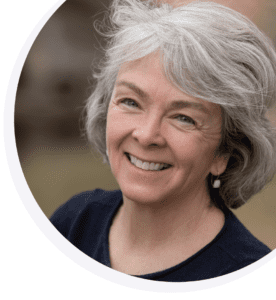
End of Life Doula, Podcaster, and founder of Best Life Best Death.