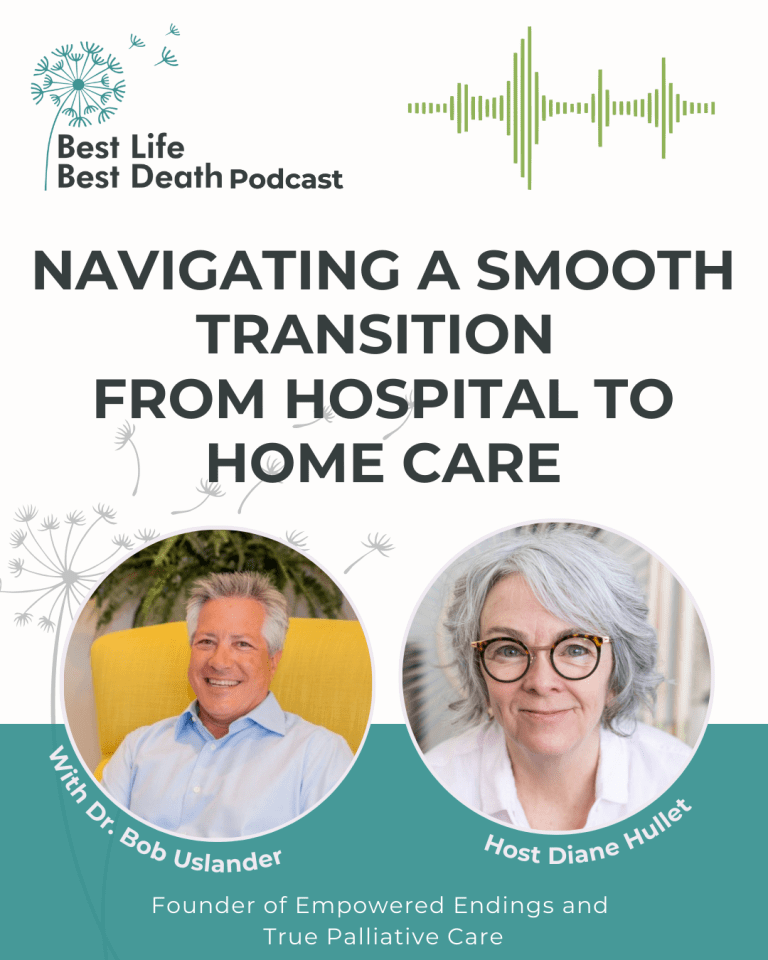
This week, Dr. Uslander and I dive into the often-overlooked transition from hospital to home. How can that shift go more smoothly? What does it really take to understand a discharge summary? And how can families prepare for a period that is so often confusing, rushed, and chaotic? Unfortunately, the current U.S. medical system seems primarily designed to prioritize profit, increase efficiency, and reduce liability. As a result, far more responsibility lands on patients, families and caregivers. We are left to decipher medical instructions, identify gaps in care, ask for the right resources, and advocate for ourselves and our loved ones at exactly the time when we may feel least able to do so. This week’s conversation on BLBD explores ways to navigate this transition with more clarity and confidence. Visit: https://empoweredendings.com
For more information on Best Life Best Death please visit our website at www.bestlifebestdeath.com
Follow us on our social channels to receive pertinent and helpful resources on death, grieving, and more at:
Facebook: www.facebook.com/bestlifebestdeath
Instagram: www.instagram.com/bestlifebestdeath
Transcript:
Diane Hullet: [00:00:00] Hi, I am Diane Hullet, and you’re listening to the Best Life Best Death podcast, and I’m here again with a guest I’ve had before Dr. Bob Yule. Hi, Dr. Yule. Hey, Diane.
Dr. Bob Uslander: Yeah, to be with you again.
Diane Hullet: Glad to have you back. We talked back on episode 1 41 and I think you know, in my mind you’re just one of those doctors who’s both working hard in the field and working hard to advocate and educate at other levels in the field.
And so I think that makes for a really interesting podcast conversation.
Dr. Bob Uslander: Well, I do too. And I, you know, I love to have these opportunities to, because there’s, there’s so much information that people need to have access to, and I it’s, it’s hard to get it, it’s hard to find it. Unfortunately, most people kind of start finding this information when it’s almost too late.
When they’re in situations that they, they never imagined being in, [00:01:00] often don’t know how they got there. Now they’re just sort of grasping to, to try to find, you know, find a solution, find a path forward. So hopefully somebody can hear this and it’ll, it, it can spark some conversations or some awareness that will, that will benefit them and avoid some of the struggle that, that is really not necessary and can be pretty traumatizing on top of the, the trauma that comes with.
Serious or terminal illness.
Diane Hullet: I think that’s so well put. And, and it’s, it is funny that there isn’t like a way to get the information until you have to have the information. I mean, there are ways to get it, but we just don’t tend to take it in until we absolutely need it. And then those are times of stress and chaos and fast decision making and it’s, it’s really challenging.
Yeah. So, well, so we thought we’d talk on this episode about kind of this. Navigating a smooth transition from hospital to home care. And I think there’s so many important forks in the [00:02:00] road when someone’s been hospitalized, but one of those important transition moments is when you’re leaving the hospital and you’re going home.
And I think as a doctor, you’ve got a lot to share about that, making that transition as smooth as it can be. Not that it’s still gonna have some bumps and hiccups, but. You know, what would, what, what, where would you even start to think about that kind of transition?
Dr. Bob Uslander: Well, there’s so much there. You know, it’s a, it’s I’m gonna write a book about it.
’cause I think, I think that, or at least have a couple of chapters dedicated to it there. ’cause there’s, I mean, there’s so many different potential scenarios. There are some things that I, that I believe can be sort of, try to be sort of standard or applicable across the board. But, but I think one, one of the things that comes to, comes to mind and I, a large part of why I started the practice that I did back, you know, 10 years ago, is that people need an advocate.[00:03:00]
Most people who are trying to navigate the healthcare system don’t have the, the tools. They don’t have the experience and, and they find themselves being pushed along and sort of being pawns in a system that is not really designed to, to take care of them. The healthcare system is really much of it is designed to try to increase profit, to try to increase efficiency and to try to reduce liability and, so the individuals often get lost in the free, even though there are people who, many of whom work in the, who work in the healthcare system, wish that they could do a better job, wish that they could have more support in supporting others. The reality is it that that most of the time, the individuals who are in the hospital.
[00:04:00] Needing to get home. And the families and loved ones who care for them are, are just not resourced adequately, or supported adequately. So finding advocates and people who can help to navigate for you is really critical. And it, I’m not it, I’m not sure at what point that is. So, a, at, at what point it, it, it’s appropriate to reach out to these people?
Some people. Once you’re diagnosed with a, with a, a condition that may end up creating complications and may end up putting you in the hospital it would be appropriate to start looking in your, in your community for care managers, nurse care managers or geriatric care managers. I think they call them aging life care specialists.
Now there there are, there are people out there who. Recognized what, where the gaps are and that people need support and now have, have businesses serving people in that way. So [00:05:00] when you’re in the hospital and you’re looking ahead at being discharged having somebody maybe reach out, talk to the case managers or the discharge planners who are on the, on your team and asking them for those resources is another, is another option.
But first and foremost. If you can find an advocate who can help navigate the healthcare system on your behalf with you,
Diane Hullet: and you’re saying that person is, is typically not in the healthcare system themselves, or might they be sort of a social worker that you’re working with there?
Dr. Bob Uslander: You know, the pe, the social workers who are in the hospitals or in the nursing homes, or the places where you might be, you know, people maybe trying to get discharged from.
They can’t really work truly on your behalf. They’re, they are assigned to you, but their primary allegiance is not to you. Their primary [00:06:00] allegiance is to the institution that they work at. So it’s possible that you will get somebody who is really committed and we’ll go above and beyond out of their way.
But most of the time it would be, it would behoove somebody to find. A, a person who is not part of that healthcare system, but can come in and understands the, the dynamics and the complexities and the terrain of the local healthcare system and the, the options that might be available for the types of services that you would need, the type of location where you may be best suited if you can’t go home right away.
So again, aging life care specialist, care managers. A friend who is a retired nurse or physician, somebody who has the experience whether it’s a paid person or a volunteer person to help you navigate this unfamiliar terrain.
Diane Hullet: So again, you’re thrown into a [00:07:00] situation. The person’s hospitalized, you’re navigating all of that, and then they say, okay, this person’s headed home.
Now if you don’t have this person lined up and you don’t have this person in your back pocket, or they’re not in your region or area, wow, what? What can you do as just the adult child or the dear friend or the spouse?
Dr. Bob Uslander: Well, then you have to become that advocate. If, if you, if you don’t have somebody who you can hire or bring in, then you have to learn how, how to, how to do that.
And sometimes you have to learn fast. And I, I think an important component there is to find somebody who’s in the healthcare, on the healthcare team, whether it’s a nurse or a physician, or a social worker or a physical therapist, or. And somebody who is willing to, to really sit with you and, and hear you and, and and become [00:08:00] an advocate for you.
And sometimes it’s hard to do that because everyone’s busy and moving fast and, and it sometimes seems a little intimidating to ask that of, of people when it’s not coming naturally. But, but you, that, that’s another important piece. So you have to have somebody who you can ask questions of and trust that they’ll take the time to really understand what it is that you are asking.
I know one of the, in general, when people are being discharged from the hospital. And we’ll speak to the hospital. Nursing homes and other types of facilities are, you know, rehab centers. There’re there’s similar, there’s some similarities, but, but there’s also some major difference when someone’s going home from the hospital.
They’re trying to, to, to do this in the most efficient manner because they’re also at working on discharges for multiple other people. They’re all stacked on top of each other and they’re trying [00:09:00] to do it as efficiently as possible and. They will often try to take the path of least resistance. And I’m speaking kind of, of the, the, the discharge planners and case managers at the hospitals, the physicians and the nurses who are caring for people.
They’re not as involved in the actual process. They need to do their part. They need to, you know. Write the orders and order the discharge and, and things, but, but then it’s on the, the other team, the social workers, case managers, discharge planners to try to put in place whatever’s needed for a safe discharge.
That could be transportation, that could be durable metal medical equipment in the home that could be lining up helping to make sure that there’s appropriate home care or nurses, and that could be going on to hospice. When I speak of, of trying to do things in the most efficient manner. That’s one of the reasons [00:10:00] why people get admitted to the hospice when they don’t necessarily belong on hospice.
When you’re being discharged from the hospital, the easiest way to get somebody home is to have them admitted to hospice, and so the case managers and discharge planners and, and probably the, as many of the physicians, the hospitalists and specialists. Are, are inclined to recommend that service A because they, they believe that they’ll, the person will get more support than, than they might otherwise.
And B, the hospice will come in and, and really streamline the discharge to get them the transportation that they need, the bed, the, the oxygen, the wheelchair, the equipment. And, and then what I’ve seen happen on not infrequently. Is that people agree to go on hospice because it seems to make sense, and then they get home and [00:11:00] they find out what hospice is and it’s not what they’re looking for.
And that can be a real, you know, challenging situation to extricate yourself from. And, and so, so that’d be, that’s something that I think many people need to be. Watching out for, and family members and whoever’s advocating, not agreeing to things without really understanding what it is that you’re agreeing to.
And in those situations there’s so much stress and so much overwhelm and so much fear that it’s hard to ask the questions. It’s hard to see the, the field clearly. So a, a caution about, about, yeah, one of the ways in which people are not served optimally. Because of the discharge process and,
Diane Hullet: and balancing that with that being in hospice sooner rather than later, if it’s appropriate, is a good thing because of the support, because of the [00:12:00] medical support and emotional support and educational support.
Also I was thinking about, you know, I’ve heard of situations where people end up. You know, you’re being discharged from the hospital, but the family is actually being asked to do a fair amount of medical follow up. You know, whether it’s changing bags or putting in inserting or shots in the stomach or what have you.
How do you make sure you understand what’s being asked of you?
Dr. Bob Uslander: That’s a really good question. And that’s part of that, that’s part of having the education, the knowledge of, of what? Questions to ask. When they, they’ll, they’ll come in and they’ll sort of give you a discharge summary. Sometimes they give it to you in advance.
Sometimes you get it when you’re in the wheelchair on your way out the door. But, but somebody needs to be reviewing all the different medications and treatments and appointments that are coming up and giving [00:13:00] you an opportunity to, to really understand what they mean. And sometimes that just gets glossed over.
So what happens, what frequently happens is the whole, the discharge happens is happens quickly, often. People have been waiting to get home. They, they want to go home. They’ve been in the hospital too long and they’re just really anxious to get home. And finally, the day comes and everything. This is flurry of activity and the doctor puts the orders in and the medications are, are ordered from the pharmacy, sometimes brought to the patient.
Sometimes they have to go pick them up. And then all this list of instructions and follow up appointments. And again, you need to, you need to advocate. For yourself or your loved one and, and have them, whether it’s a nurse or a discharge planner or a physician, whoever’s coming in there to have that sort of final conversation.
Have them sit down [00:14:00] and have them spend the time that, that you need to make sure that you are able to look through things and get your questions answered. There’s, there’s only so much you can do. And when that’s not made available to you, but you are, they, they’re not going, they can’t forcibly remove you from the premises until you’re ready.
So again, I don’t think, I’m not suggesting that people be belligerent and, you know, in protest, but if you don’t have, feel like you’ve had your, your questions answered and it hasn’t been done in a way that feels. Complete enough, then you need to escalate it. You need to go to the charge nurse, or you need to ask the charge nurse to, and if they’re not able to give you the, the, the satisfaction and the information, then you need to go to the director of nursing.
And again, this is a, it’s a, it, it, it’s a stressful situation and it’s sometimes hard to, you know, [00:15:00] stay real cool and calm and, and patient, but. I mean, it’s sort of like being at the airport when plates are being canceled. You need to somehow advocate for yourself and maintain your cool in the, in the face of really stressful circumstances.
But, and I know it’s not, I, I’m, I’m saying all this as, as if it’s like easy to find all of these, all this support, and I know that it’s, it, it’s not necessarily here, you know, in California I can. I can provide support and service to anybody in California as a California licensed physician, working on my Colorado license.
By the way, hopefully that’ll happen before long, but, but sometimes it’s just a matter of somebody needing to talk to a, a caring, knowledgeable person who can give them some direction, so we make ourselves available. My whole team, one of the things that we, that we provide is a, is a kind of a quick consultation.
So that people can get this [00:16:00] information that they, that they need and then take it and actually put it into, into action. I wish there was more of that available and maybe over time there will be, but here we are.
Diane Hullet: Here we are. Here we are. So, so finding an advocate, if you can, getting really clear instructions for what needs to be done at home and making sure it isn’t just you know, written instructions that you vaguely understand, but actually maybe practicing or watching the nurse do it or doing it yourself, whatever.
For sure.
Dr. Bob Uslander: Yeah. If there are gonna be injections that need to happen or things, then you absolutely need to get appropriate instruction. And, and they should also, the hospital should also be. I don’t, some systems do this, some don’t. But providing a very quick follow up the following day after being, after going home where there’s follow up, either by phone or an in-person visit for certain types of discharges where they’re coming to ensure that the, the information is understood and, and [00:17:00] being followed up on appropriately.
It’s also, I think, important to, to prepare for the dis the time of discharge with a list of questions. And not expect that you’re gonna remember everything that you think about, that you’ve thought about asking, but, but have your list of questions ready and find the right person to, to, to spend the time with you and record the, the conversation as well.
Yeah, so I mean everyone you know get eight. With ai you can now record these conversations and get a transcript and a summary and an and an action list, and I think it’s important to be. Keep recording a, not, not, not so that you’re trying to catch somebody saying something that they, that they shouldn’t be, but so that you can go back and replay it in case you, you forget any, anything.
I, I, I always encourage people to record important conversations with healthcare providers and not just rely on their memory or even [00:18:00] even their notes, and if a provider isn’t comfortable with that. That that’s a, that, that’s a, a, a red flag for me. And I’d be, I’d be really careful. I, I’d be concerned about that.
Diane Hullet: Yeah. How does, how does palliative fit in with this? Like would somebody typically be discharged potentially with a palliative care team, or how does Empowered Endings fit in with that?
Dr. Bob Uslander: Well, so this is a great question. So Empowered Endings is really focusing on the, on the, the people who are terminally ill and helping to support them in having access to end of life options.
Sometimes it’s just like a, a concierge level of support for people who are on traditional hospice to, to provide additional wraparound service. Because a lot of times, you know, hospice, hospice comes in and, and they have intermittent nursing visits and social workers, and they provide some type of support, but they don’t [00:19:00] have, they don’t have the kind of engagement that many people want.
Hospice comes in and they leave. And, and they don’t the many times, most times, in fact, patients on hospice will never see a doctor again once they get admitted to hospice. And many people want to have a physician who’s able to engage with them and counsel and advocate for them when they’re on hospice.
So Empowered Endings is really focused on, on those folks. And helping the people go through medical aid and dying or voluntarily stop being, eating and drinking. True palliative care is our other entity, and that’s the part of the practice that really focuses on caring for people who are further upstream, who aren’t in that end of life phase, who are, they might be terminally ill, but they’re not focused on preparing for the end as much as preparing for living.
And doing everything they can to live optimally until they’re, until [00:20:00] they’re in the true dying phase, the best life, be best death. You know, we’re, we’re, we try to help people live their best life and die their best death and whatever, whatever, wherever we need to meet them to support them. So true palliative care is, would, would be helping people get out of the hospital who are looking to get better or to maintain.
Sometimes that means that they need, that they’re continuing treatment with their oncologist or their cardiologist, or they’re, they might need, you know, IV fluids at home or different types of antibiotics or treatments or physical therapy. So that’s, we try to put all of those pieces in place when people are discharged from the hospital.
Sometimes there’s palliative care consults that are made and, and they would be following up with palliative care providers after they leave. There aren’t many places where palliative care is truly developed within the traditional system to the [00:21:00] point where it’s at, it adequately meets people’s needs when they’re more complex, or they are looking for more moment to moment, day-to-day guidance.
Palliative care when it’s delivered to people in the hospital. Palliative care teams in the hospital are, are often very involved and very engaged and supportive and helpful. At this point, most of the time upon discharge, the palliative care support is much less consistent and reliable. That’s not to say it doesn’t exist and that you can’t find su good support, but I think in different communities, some communities have no palliative care support.
Some have mediocre, some have moderately good, some are stellar. It’s hard to know in each community what you all have access to, which is again, why it’s important to have people who are knowledgeable about what’s available in the healthcare system, in in your community.
Diane Hullet: In your community? Yeah. Yeah. I think, Bob, if [00:22:00] it were up to you and I, we’d be finding all these gaps in the healthcare system and plugging them.
Right.
Dr. Bob Uslander: These, well, we’re finding them. We’ve, we’re finding them. There’s no, there’s no shortage of gaps and it’s not hard to, to see them when you’re really paying attention. It, the, the challenge is plugging them,
Diane Hullet: the challenge is plugging them big time. Yeah. And I think families don’t realize the gaps until they’re in the system either.
Dr. Bob Uslander: A hundred percent.
Diane Hullet: So, you know, I guess I’m thinking sort of, you know, message to listeners is sort of have these conversations look things up. The minute there’s a hard diagnosis, start to explore what these support systems are in your area so that when a crisis comes, you’re, you’re already kind of, you’ve backfilled yourself for some of this information.
Right?
Dr. Bob Uslander: Yeah. Yeah. I, I, I agree. And I, I think part of the, part of this is, is starting to have conversations early with your family. And going through an like advanced care planning process. [00:23:00] So you’re, you can be filling out the forms that, that would like the advanced healthcare directive, which would identify who’s going to speak on your behalf if you get to the point where you can’t communicate appropriately.
And, and it helps people understand what you would want, what you wouldn’t want, how aggressively you’d wanna be cared for, how you, you would want to approach things if you develop dementia. And it, it allows the conversations to happen and sometimes that that will spark, okay, well, what else would we need to do?
What other information do we need to gather? Who else would we need to potentially engage with to, to be able to fulfill these wishes? And, yeah, I, I, I see it all the time that people just do not address these things. They’re not proactive. They’re, they just feel, they think that the healthcare system’s gonna show up for them when they need it, and it usually [00:24:00] doesn’t.
It occasionally does, but it usually doesn’t in the way that people really need, and then they find themselves in this abyss, frustrated, angry, afraid, overwhelmed. And they don’t know how to get out. And the, the goal was to avoid falling into that abyss. We can’t necessarily avoid the, some of the, the health challenges and the, the heart attacks, or the cancer diagnoses or the complications, but it doesn’t have to be.
So stressful and so traumatic and such a struggle. Those things are, are avoidable, largely avoidable with appropriate, you know, attention, care and, and a bit of proactive effort.
Diane Hullet: I love that. That’s a perfect place to stop, Bob. I think proactive effort. Proactive effort is really what we wanna say. It’s like I, I, I would like to support people with less chaos, better understood choices and [00:25:00] smoother transitions, right?
So this transition in a disease process or a frailty process all along the way are gonna be transitions. How do we get proactive about preparing for those so that we can do them as best we can? Yeah, they’re still hard. They’re still painful. There’s so much complication, but it’s worse because of our system and our lack of preparation and our, I’m sorry, Barbara Karn said it recently, she said a lot of people just wanna be little ostriches with their head in the sand.
Right?
Dr. Bob Uslander: They, yeah, and I mean, if, and if you understand that, that doing that is going to have potential negative impact and you’re willing to accept that, well then, then. But if you’re, if you’re not wanting to find yourself in, in that, that abyss, then get your head outta the sand. Look at, you know, pay attention to the, to your blogs and your website.
Pay attention to empowered endings.com and true palliative care and learn, find the resources and get yourself [00:26:00] educated.
Diane Hullet: So well said, and you’ve just, I was just gonna say, tell us where we can find out more about you. Empowered endings.com.
Dr. Bob Uslander: Dot com and true palliative care.com.
Diane Hullet: Beautiful and true is spelled T-R-U-E-T-R-U-E.
True palliative care.com. Wonderful. True.
Dr. Bob Uslander: Yeah, true is for it. It, it, it could stand for many things, but trust, respect, understanding and empathy is really the heart of the heart of our, our model,
Diane Hullet: so, ah, I love that. Well, thanks so much for being a guest and thank you. Thanks for having me. All the work you do you can find out more about the work I do at bestlifebestdeath.com. Thanks so much for listening.
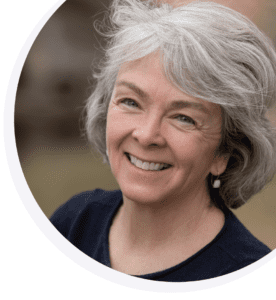
End of Life Doula, Podcaster, and founder of Best Life Best Death.