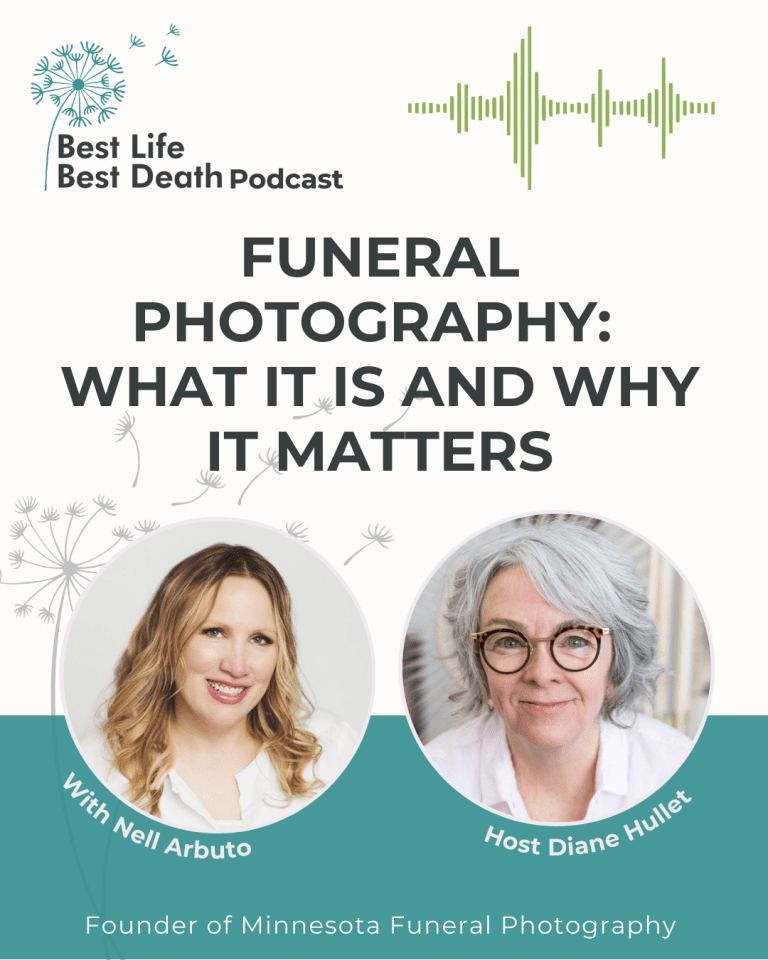
This episode explores the small-yet-potentially-vast world of funeral photography. When everyone we love is gathered in one place, often for the last time, what might it mean to have photographs of that moment? Is it comforting? Intrusive? Sacred?
I’m joined by Nell Arbuto, founder of Minnesota Funeral Photography, who works in this niche field. Nell shares her why and her how: how she approaches families, how consent works, and what she’s learned about memory, grief, and presence. Forget the blurry group shots from Uncle Bob – what if we intentionally captured the beauty, the love, and the quiet sacredness of a funeral? And what if those images became a keepsake album, not of death, but of connection?
For more information on Best Life Best Death please visit our website at www.bestlifebestdeath.com
Follow us on our social channels to receive pertinent and helpful resources on death, grieving, and more at:
Facebook: www.facebook.com/bestlifebestdeath
Instagram: www.instagram.com/bestlifebestdeath
Transcript:
Diane Hullet: [00:00:00] Hi, I am Diane Hullet, and you’re listening to the Best Life Best Death podcast, and today I’ve got an interesting guest that I think people may or may not be familiar with this idea. Welcome to Nell Alberto. Hi Nell.
Nell Arbuto: Hi. Thank you so much for having me.
Diane Hullet: Yeah. A lot of people reach out to me and say, Hey, I’d be interested in being a guest, or I’m an agent and I’ve got some people you might wanna be guests with and now just emailed me recently, you, I can speak to you.
You emailed me recently and was said, hey, I’m a funeral photographer in Minnesota and I would love to talk about why that matters. And I was so taken by it because. It. It isn’t really a subject. I’ve heard that much before, and yet it makes so much sense to me that people would wanna capture some images of people gathered on special days.
So tell us a little bit about Minnesota funeral photography and how you got into this work.
Nell Arbuto: I’ve, I started off as a portrait photographer. I did go to photography [00:01:00] school and I was a wedding photographer for many years, and of course I photographed families and babies and children. And then a few years ago, my parents both died.
My dad died first, and then my mom died after three years later. And so at his funeral, because I’m a photographer, I wanted to take pictures because we worked really hard. My sisters and I. We worked really hard just to make it a very uplifting funeral and just my dad was a happy, everything’s great kind of guy and so we just really tried to make it uplifting and all the family was there and friends were there.
And so I brought my camera and then I didn’t get any pictures because. I’m the daughter and I had a lot of things to do, talk to my family or attend. And so I did get one or two pictures at the end. In fact, I got one at home of his urn when everything was over. And so that was where I first thought about photography.
Oh, I wish that doesn’t exist. I should think about that. And [00:02:00] then my mom died again three years later. And her service was even more glorious just because my mom was this saintly woman and people made beautiful flower arrangements and just nice things on the memory table. And we again, all spoke, the grandchildren all sing this beautiful song.
I didn’t get any pictures again, because when you’re the immediate family member, you just you need to be present. You don’t have time to photograph your parents’ funeral, of course. And so that’s kinda where that idea began. And I thought, if I wanted this. I didn’t get it then there must be other people who would want it too.
And so I started my business in March of 2020 officially working just to make people aware because it isn’t something common, it isn’t something people ever think of until after the fact. And then when I talk to them and tell them when I do, they think, oh, I wish I would’ve had that for my mother, father, husband, wife.
And then it’s too late by that point. So I’m [00:03:00] always working too. Raise awareness of the beauty of funeral photography and celebration of life photography.
Diane Hullet: Yes. I think this is so important. I’m so struck by it because the photos on your website are so beautiful, and of course, they’re professional photography level, so they’re, they capture.
Moments and people and groups of people and special items and all these kinds of things. And as you said, it’s the, what is it? The cobbler’s children have no shoes. Like the
Nell Arbuto: photographer
Diane Hullet: has no photos.
Nell Arbuto: I have no photos.
Diane Hullet: Yeah. And yet these really important events, and I’m struck too by.
For so many people now family is so spread far and thin, right? So people come in for something. You really are gathering special people together who don’t typically get together these days. So I think it’s really amazing. And I wonder, I imagine it’s something any portrait photographer could take up, but you’ve said, let me specialize in this.
Are there particular shots that you try to get or not get? [00:04:00]
Nell Arbuto: So I really am going around looking for beautiful moments and just emotional moments. Of course, I photograph the service and the speakers, anything that’s happening, I’m gonna be there to photograph it. But then I am walking around and I’m looking for little details.
I’m looking for pictures of just people, inter interactions between family members, people hugging, I just I’m scanning and at every funeral there’s always a couple pictures that they’re my favorite. They just move me and just a few of I can see them in my mind and they’re just like, that’s the photo, that’s the emotional one of this man just looking down, holding his program, just being sad at his friend, or there’s one gentleman and he was a police officer, and so all the police, of course, the whole force came and all the local law enforcement and just somebody he was.
Just looking down at the casket. Can’t see the body of course, but just him just praying or he’s thinking or and it is just beautiful moments. So I look [00:05:00] around for that and that’s something that I don’t think the random guest can do that. I always promote take something, take if somebody can take pictures.
If you don’t have a professional, have somebody that’s not a key family member. Just take family pictures or take some pictures. Of course you should and can do that. But it’s hard to, it’s hard to see that if you’re not used to it, if you’re not looking for it. I say wedding photography trained me for any kind of photography, and so I’m used to that.
And I, I just look for the beauty in the day and happy moments because there’s a lot of happy things, like people are happy to be together. When I spoke at my, I think it was my mom’s funeral, I looked out and I said, this is the happy part of this day because I get to see all these people that I love.
And so everybody comes to the funeral and I wish I had photos of my relatives and friends because they came out to support, come out to support you.
Diane Hullet: Yes, absolutely. What do people do with these photos after?
Nell Arbuto: Good questions. I put them into an album. I have an album company that I [00:06:00] use. I give all of the photos to the family members so they get a digital file, which people want.
But now I always offer an album and so I’ll make, I’ll design one with maybe 40 or 50 of the best pictures. People can get prints everything through me also, and those come in a nice, beautiful portrait box. But they can print them themselves. I didn’t used to do an album that was an add-on if people wanted to.
But then I thought, you know what, I know no one’s gonna do anything with them if they’re just sitting on their computer. And I don’t have any satisfaction in handing over a downloaded file. But I do find a lot of satisfaction in making this beautiful album for them because it is, it’s like their family history and it’s nice to have a tangible product.
And again, I’m an artist, so I believe in tangible art.
Diane Hullet: I think that makes so much sense. You’re absolutely right. People are gonna go, oh, I got these great photos on my computer, but so many of us have so many pictures, it’s hard to actually make something [00:07:00] happen. And then
Nell Arbuto: they’ll get deleted someday.
Diane Hullet: Yeah. Yeah. So here’s a tangible album, or here are tangible prints to share with aunts and uncles or whoever. So I, do you feel like this is a building field, a not so building field?
Nell Arbuto: I hope so. I don’t know. When I started five years ago, six years ago almost, there was one man in Australia that I could find online and he seemed to me been established.
And then I couldn’t find anybody else. There was me, so in my mind there were the two of us on the whole planet doing funeral photography. And of course professional photographers have, they’ve always they have photographed, like somebody photographers have always photographed funerals, of course, but I hadn’t found any then.
And now I think there’s somebody in California and maybe there are more. I haven’t looked lately, but. I’m I come up, I’m the only one that comes up online in my area.
Diane Hullet: I’m seeing like an, like a [00:08:00] National Funeral Photographer’s Association conference or something
Nell Arbuto: maybe.
Diane Hullet: Amazing.
Nell Arbuto: And a lot of people I don’t like, I love funerals.
I’m so open about death. I love funerals. Like they are sad and they’re. They’re sad, of course, they’re always sad. But I just think there’s a lot of beauty in it and I think it’s important. I’m a photographer, so of course I think photos are important. Not everybody thinks it’s important.
I can’t really think of anything more optional about a funeral than photography, but I think it does take a certain person, a certain kind of person that’s okay with that. Okay, being around death, oh, there’s a body, or, oh, these people are sad. Or there’s a lot of traumatic deaths or suicidal deaths, and not everybody’s comfortable with that or wants to be around that.
But I really like it. I always come away from funerals feeling like uplifted, or I wanna be more like that person, or I’m grateful for what I have, or I don’t. I enjoy them.
Diane Hullet: Yeah,
Nell Arbuto: which sounds strange.
Diane Hullet: No,
Nell Arbuto: not
Diane Hullet: at
Nell Arbuto: all. People. People that work in the death and dying [00:09:00] industry, I’m sure they know what I mean.
Diane Hullet: Yeah. We know what you mean. I think there’s something, I think when people there’s so many reasons people dislike funerals, but one of them is they’ve been to bad funerals. Like I’ve been to a bad funerals. I went to one funeral when I was sitting next to my husband and I leaned over and I said, if you do a funeral like this, I would haunt you forever.
I think if you’ve been to bad funerals, you think, oh, I don’t wanna have some impersonal lame person who doesn’t even know me saying dumb things or
Nell Arbuto: Right.
Diane Hullet: Whatever the lack of connection is. But if you’ve been to a good funeral, you know how good it can be and how important it is for the people who remain.
And I’m very getting more and more outspoken about this trend right now, of not having a funeral or someone saying, I’ll say to somebody what do you think about after you’re gone? What would you like your family to do? And they say, oh, I don’t care. I’ll be gone. Doesn’t matter. There’s a lack of understanding of [00:10:00] the importance of a funeral in that
Nell Arbuto: yes,
Diane Hullet: And a funeral marks a huge transition.
Someone was here and now they are not. And the whole dynamic of a family friend community changes with the loss of that person. So I feel like it’s one of the more important rituals that we have and so to have this kind of modern thing of dismissing it or doing it months later. Now you’re in Minnesota.
I can see maybe it’s hard to get people to come from all over the country in the dead of winter in Minnesota,
Nell Arbuto: right? Yes.
Diane Hullet: I understand that sometimes they’re delayed a bit, but there’s still something so powerful about coming together and naming this change. So I’m getting a little more adamant about that lately in podcasts.
’cause I’m bucking this trend of oh, don’t bother to do anything. Or one person told me that they’re, parent had said, I don’t want anything. So they felt like they had to honor those wishes, and yet it left the adult children and grandchildren bereft. So be careful what you say.
Maybe tell your Don’t do
Nell Arbuto: [00:11:00] that.
Diane Hullet: There you go.
Nell Arbuto: It’s terrible trend. That is a terrible trend because it’s like you need, it’s psychological and I’ve just read. A little bit here and there about the importance of like children attending funerals and that they can see, oh, where is my parent? Or where is this person?
And it is, I think it’s a healing type of experience. It sounds like that’s what you think too. So that’s an awful trend. You definitely. Stop that out.
Diane Hullet: Okay. I’m gonna, I’m gonna personally go on a crusade from that. Yeah. The the other thing I was gonna ask you if you’re familiar with, I think it’s interesting, I don’t know a ton about this, but I think in the Victorian era there was this whole trend of taking photos of deceased people, like of the dead body propped up in a chair or lying in the bed.
What do you know about that?
Nell Arbuto: Yes, people did that because obviously for many reasons. But you got a photo of yourself possibly if you were going off to war because they might never see you again, but this was the last chance. That’s one of the reasons. [00:12:00] And so a lot of people I think, do wonder when they hear a funeral photographer, oh, are you photographing the body?
And of course not like that. But if a family wants me to photograph the body, I always ask them. And they’ll say yes, or they’ll say no, and
Diane Hullet: yeah,
Nell Arbuto: I’ll, I will do whatever they want. I do try to take a picture of their hands. Like a lot of times people are holding flowers or they’re holding a book or they’re holding some meaningful item.
And so I always try to do that no matter what. But if it’s their loved one, like I don’t think it has to be. It is not creepy. I’m not gonna post these online, but it’s for the family. It’s their mothers, their father, and so if they want that, I will definitely do that.
Diane Hullet: I’ve always been so struck by how powerful it is to see a body at a funeral, like in a coffin.
Because I’m from the Midwest, we still have uhhuh, open casket funerals here and there. Yes. And I’ve also obviously been to things that are more like ashes up the front in an urn or something like that, [00:13:00] but it’s. So powerful to see a body at a funeral and it’s so clear that the person is gone. Right?
That’s what I think is so amazing about it. They don’t even really look like themselves. No. Un animated by the spirit having left. It just you’re so clear. It’s shell. And I’ve had that experience with pets as well when our dog recently, we put a big old, wonderful dog down in the last year.
Once she’s gone and her heart is stopped, you feel her body and see her body as the shell that it is sore not in there. There’s something very powerful about that and I definitely, I know people say, oh, I’ve never, whoa, I’ve never seen a body. I don’t wanna see a body. How creepy. It’s not creepy.
It’s educational.
Nell Arbuto: Yes. And it’s life. Like we’re so removed from death now because we don’t we don’t handle the bodies anymore. Back in the old days, you’d sit out in your living room or just things of that nature and now somebody just comes in, [00:14:00] puts in, zips you away and you may or may not see them again.
But yeah, it is okay to spend time with the body or see the body.
Diane Hullet: Yeah. Yeah. It makes a big difference. I think Uhhuh, those grieving, it’s like it, it helps you catch up to the reality of what’s happened, I think. Yeah. And then I don’t mean to overgeneralize, obviously there are families and communities and religions where there is a more prescribed.
Way the, that all rolls out. But generally in broad secular American culture, it’s, yeah, it’s whisk it away. And I just put up a social media post recently that said, what’s the first thing you need to do when someone dies? And my answer was nothing. Like just do nothing. Let that be some sacred space.
Nell Arbuto: Right. Yeah. And even, and I didn’t realize this until a couple years ago, that people, some people would think if you don’t, if you’re cremated, which a lot of the funerals I photograph, they are cremated, but they still have a funeral and they still have. Beautiful. It’s the same as a, it’s a celebration of life, if you [00:15:00] wanna change terms, but it’s still all the same be beautiful effects.
So I think obviously yeah, people should have a service no matter if you’re very traditionally or you’re cremated.
Diane Hullet: Yep, yep. Oh, I love it. You’ve just got a dog who’s jumped up my little doggie. Hi pooch. He says, I might get comfortable in the sunshine.
Nell Arbuto: This is our first dog, so we love her.
She’s moved up our bed to our pillows now and it’s,
Diane Hullet: yes, she’s found her way. Are there any I don’t know if you can recall this, but are there any sort of unusual funerals you’ve photographed?
Nell Arbuto: Yes. So there was one last year that I photographed, which was so amazing. It was a Indian funeral and from, they were from India and they were Christian Indians.
And that was my first experience of all of the guests and all of the family being photographed with the deceased. Everybody would come up and it was like stage [00:16:00] family photos, just with the casket. I had not done that before, but I think it’s a great idea. And a lot of people there, they had cameras, like this group, they were, they hired me, so obviously photography was important to them, but they had a lot of people recording and taking pictures.
And so I hadn’t done that before. And we did that right up until actually the service had started and we were still up there taking pictures because a lot of people had to get in there which was really cool. And that. That was unusual for me. I had not seen that before.
Diane Hullet: Beautiful. I saw on your website there’s a picture of a bagpiper.
Of course that’s Oh,
Nell Arbuto: yes.
Diane Hullet: Unusual, but it’s beautiful I think.
Nell Arbuto: Yes. That was over at we have a Smet, it’s Lakewood Cemetery and. It is the most beautiful cemetery, and so this gentleman’s funeral was there, and yeah, just a whole like a, it’s like a cathedral, like an old Italian cathedral in Minnesota. It was handmade by artisans.
That was just great. Of course, it [00:17:00] just adds to the beauty and the emotion. I
Diane Hullet: wonder why people have this idea. I hear people sometimes say I just don’t want people to be sad. And I’m always scratching my head over that if you die, if the loved one dies, isn’t sadness a big piece of that?
Yeah. I don’t know. Do you? You can’t stop it. Yeah,
Nell Arbuto: you can’t stop it. You can’t stop sadness.
Diane Hullet: Have you heard people make that kind of reference? Let’s have this be upbeat, or let’s make this happy or.
Nell Arbuto: Yes. And I think there’s a couple parts to that. One in general, we have, as a society, again, can’t speak for everybody, but there seems to be a trend that we don’t like funerals because they are sad and we don’t wanna feel bad and we don’t wanna make other people sad.
And like you said earlier, I think a lot of funerals. I think of a funeral sometimes. They’re like stodgy. They’re in an old building. It’s dark. They’re playing like sad organ music, and it’s just not, it’s very somber. And so [00:18:00] I don’t think people like that because they feel, they come out and they’re like, oh, this is heavy, this is dark.
It’s, I’m already sad. And then we’re in this depressing place. And so I have seen a trend out here. There’s a company that I work with they’re called sendoff. They do more uplifting, that may not be the right word, but just more custom. Like they have funeral services in a brewery or in a garden or some sort of other, just a prettier, different kind of a venue.
Those kinds of funerals that I’ve been to when the funeral home and it doesn’t have to be like, I’ve been to very uplifting funeral funerals and funeral homes or all my parents and my sister, they were, had their service in a church and those were very uplifting. But I think you have to work hard to just make it uplifting.
Have music, have nice music. I personally, I don’t believe in organ music at funerals. I want a piano. Not to make it happy because you wanna mask the sadness, but [00:19:00] just it’s a celebration. Like my mom and my dad, they were happy people. My sister was an amazing person. Happy, just, and we wanted it positive to reflect her and I come from a religious background and we know where they’re.
I know where they are. I know what they’re doing. I know I’m gonna see them again. And so it all is not lost. It’s just a very sad time at the moment.
Diane Hullet: Yeah, there’s, I definitely see a trend of personalizing it, right? Yeah. Whether it’s in, within a religion or within a more secular, there’s this, how do you make it personal about the person, personal about the family, and that seems to me, what makes it uplifting? When it’s connected Yes and real. When it’s somebody who didn’t know the person very well, or it’s all strictly religious. I’ve been to a couple of Catholic services that were all just simply a Catholic mass. Nothing really about the person, and it has its own beauty, but it’s different than something that really [00:20:00] connects with.
Yeah. The person and sometimes those are two different events. I don’t know. Yeah. Yeah. There’s something just about making space to talk about the person who died and capture the images of the people who are there, is what you highlight.
Nell Arbuto: Yes. And a lot of people don’t remember the funeral day, like family members.
They’re sad, they’re in morning, they don’t remember who was there. They don’t remember. The details, and I think it is a healing experience to just look back and comprehend what has just happened because it is a big blur. So that’s another reason that I think it’s important.
Diane Hullet: Now thanks so much for joining me.
And how how can people find out about the work you do?
Nell Arbuto: I am online, so if you do a search, you could just type in Minnesota funeral photography and I will be the only one that comes up. Or just funeral photography. It’s the website is. Mn as in Minnesota, mn funeral photography.com, and I’m on Facebook and Instagram and [00:21:00] yeah I love to hear from people.
It’s something interesting and I think people should hear about it and learn about it, and at least think about it so they can be informed.
Diane Hullet: I think so too. What pops in my head is for listeners who aren’t in Minnesota, which might be most people listening you could look at Nell’s website, get ideas, find a photographer in your area.
As you said, if you’ve got wedding experience, you really can do anything. So it’s just, it’s an event. It’s simply an event. And
Nell Arbuto: I love to travel. I’ve traveled outta state a couple times, so
Diane Hullet: available to get to you
Nell Arbuto: worldwide photographer.
Diane Hullet: Famous for her funeral capturing.
Nell Arbuto: That’s right.
Diane Hullet: Thanks again, Nel.
Thank you. You’ve been listening. So the Best Life, best Death podcast. And as always, you can find out more about the work I do at bestlifebestdeath.com. Thanks for listening.
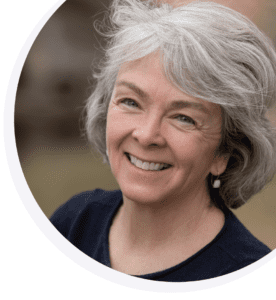
End of Life Doula, Podcaster, and founder of Best Life Best Death.