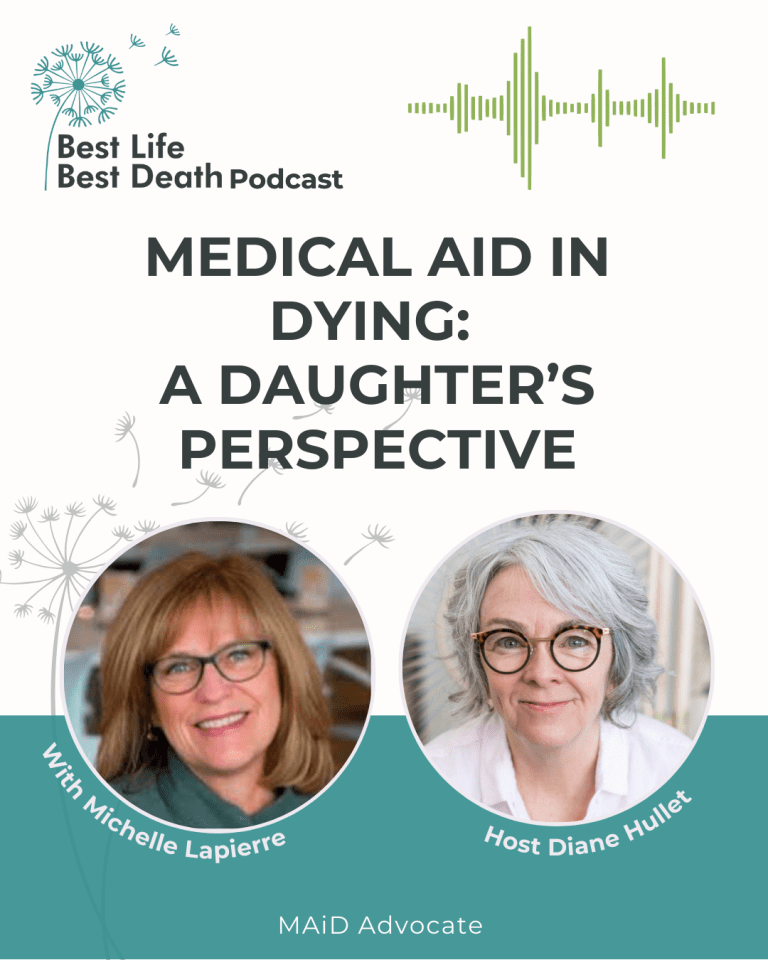
In my view, Michelle Lapierre was fortunate: she and her mother talked openly about end-of-life choices well before those conversations became necessary. And when her mother did become terminally ill, she was clear about her choice: to use Medical Aid in Dying, which has been legal in Colorado since 2017. What led them to have such clarity? What was the experience like? How does Michelle feel about it, years later? How do states like Colorado regulate and advocate for individuals to have this medical option at the end of life? Join us to hear an intimate and educated perspective on MAiD.
For more information on Best Life Best Death please visit our website at www.bestlifebestdeath.com
Follow us on our social channels to receive pertinent and helpful resources on death, grieving, and more at:
Facebook: www.facebook.com/bestlifebestdeath
Instagram: www.instagram.com/bestlifebestdeath
Transcript:
Diane Hullet: [00:00:00] Hi, I am Diane Hallett, and you’re listening to the Best Life Best Death podcast. Today I’ve got a fellow Coloradan as a guest. My guest is Michelle LaPierre, and we’re gonna talk about made medical aid and dying in the State of Colorado and as a concept. And Michelle’s got a real personal story to share about how that impacted her life and how she came to be a speaker and a, an advocate.
For medical aid and dying. So welcome, Michelle. That’s kinda a long intro.
Michelle Lapierre: Thank you. I’m so glad to be with you today.
Diane Hullet: Yeah. Yeah. I think, oh gosh. There’s so many interesting things we can say about medical aid and dying, but let’s just jump right in and tell us your story of how you got interested or introduced to this concept of made.
Michelle Lapierre: I’m happy to do that. And there are several states that have legalized medical aid and dying. I’m sorry I don’t have the list right in front of me, but Colorado legalized it in [00:01:00] 2016 and I followed it with interest because probably. Six or seven years earlier, my stepfather chose to take his life, which was highly traumatic for the family, and it was a really big hurdle to get past.
And so it would, what my mom and I had always said was, had we known he was so interested in transitioning, we would’ve tried to find a better way to do it. And so we had the benefit of those conversations. Throughout the years being able to share our desires with each other. I’m an only child with an only child, so we’re a small but tight family.
All here in Colorado. And it came to pass that my mom had a terminal illness that was being managed, but she had a fall and was quite elderly. Not really. She was 80, 88, 89, but she was not a person interested in going into assisted living or [00:02:00] truly burdening me and my daughter and her great-grandchildren and, and really just said, you know what? Time’s up I’m ready to I’m ready to go. I need you to go get me that stuff. And I’m like, okay, mom. I had remembered. The stories that were coming out once this law had been made made, had become legal because there was a lot of back and forth in terms of whether people thought that was ethical or moral or whatever.
And so I started doing my research and found Barbara Morris, who we ultimately had as our our physician who helped us go through this whole process. We, my mom, we had talked about it so long. It wasn’t an issue that we had to grapple with really at all. It was her desire to stay in control of her life as she always had.
And and I respected that and knew that, that she [00:03:00] was coming from the right place on this. Now with Maid, you have to be of sound mind, right? And so we didn’t have any dementia or Alzheimer’s to deal with, which is makes things magnificently more difficult. But anyway the odd thing was I explained to her oncologist that she was gonna stop going to chemo.
And I explained to her primary care what we were doing, both of them. Went off on me. Frankly, the physician admonished me. He did not do it in front of my mother, which was really good, but it was illegal, it was immoral, it was blah, blah, blah. He’ll have nothing to do with it. And I’m like, all right, here’s the link to the law.
And and the good news was he did come back and apologize and no one in his practice, which held. Geriatric patients. No one in that practice knew about Maid, [00:04:00] and I was like, what? The oncologist had a different perspective because she was connected to a faith-based healthcare system, and I knew by law, I had to say to her, put this in my mom’s record.
This is what my mom chose, is choosing to do. She refused. And wanted me to bring my mom in. I brought my mom in, did everything that she could, and my mom was just like, look, this is my choice. And so it was really it stayed with me that we got such pushback from the medical community with they had no idea.
I was just shocked about that.
Diane Hullet: What year was that, Michelle?
Michelle Lapierre: This was 2023.
Diane Hullet: Interesting because Colorado is unique among the states that have medical aid in dying. Because Colorado passed it as a law by voters. [00:05:00] Or I’m not sure I’m saying that quite correctly. Yes. But it was like a referendum of voters and the majority of Colorado’s coloradoans a large percentage.
I think it was passed by 60% said this should be legal. And so then it went through the steps to be a law. But how interesting, from 2016 to 2023, and there are still doctors who didn’t know, which is one of the reasons Barbara Morris and others got so activated to realize they needed an advocacy group.
And so End of Life Options is the advocacy group in Colorado that you’ve subsequently gotten involved in. But I digress. I get ahead of myself. So how interesting you know that at that time, even after the law had been passed, a family member, you had to be educated and pushed back against the pushback in order to have this be understood.
Michelle Lapierre: Yeah, I mean I I thank my mom for making me a very strong-willed smart woman, and [00:06:00] because that’s how I felt too. I’m like, what if people were dealing with the trauma of all of this, right? And hadn’t had the conversations that mom and I had and didn’t know where to turn it. It was, this was just three years ago, right?
So End of Life Options, Colorado just started two years ago. And so it was really difficult. It was almost an underground situation. So I actually got to, be friends with one of the nurses at the rehab facility my mom was at, ’cause she had fallen. And I said, I remember reading about this lady in the paper, this, and she was really drug through the mud and part of this was political that these faith bath organizations.
Had their own opinion about this and really were pushing back on everything and damp, tamping things down. Anyway, she found her contact information and we went through there. But yeah, it was not e it’s easier now to navigate than it was then because now we [00:07:00] have a resource like end of life options Colorado, and so anyway, she helped me walk through. There are various steps you have to do. You have to do a written form, you have to get a second opinion. The physicians have to interview the patient to make sure that they’re not being coerced or anything like that. And then, and Dr. Morris helped bring these resources together.
The. The, I don’t wanna get too much into the details, but the way that this happens now is through a liquid. It used to be through pills, and the liquid has to be managed by a compound pharmacist, which precious feel, maybe in Colorado, I think there’s three right through the whole state. And and it’s fairly expensive still.
It’s not covered by insurance. We had to go through and get that. There’s a couple of different ways to do it. You can get [00:08:00] it and not have it together because the efficacy. Diminishes once you put all of these concoctions together so you can get them in separate containers and put them together on your own.
And I think I wish I had a better handle on the on the details, but I think most people who get ’em don’t use them, they’ll die naturally.
Diane Hullet: I think the statistics are that they have kept statistics on the number of people who fill the prescription. They don’t have statistics on the number of people who use it, but anecdotal evidence is that people fill it.
I think in order to feel like they have that in their back pocket, but often don’t go ahead and use it, that they do their disease overtakes them before they make that choice.
Michelle Lapierre: And then just another aside, when someone chooses medical aid and dying, that is not on their death certificate. The terminal illness that they’re required to have in order to qualify, that’s what’s on their [00:09:00] death certificate.
So getting that data would really be superficial
Diane Hullet: And tricky. It would be fascinating data and maybe important data, but I don’t, we don’t have a way to collect it. But this piece that, Barbara and others came together in order to say, how do we lay the groundwork?
How do we help educate physicians and educate the public and educate nurses and educate primary care doctors? This became really important. And I think Colorado became a bit of a. A model to say if you pass the law before you’ve got advocacy in place, you actually run into some different sorts of challenges.
So they almost have to happen hand in hand. That the groups and the collectives that are supporting people have to be in place to help even make the law. Come to pass. So
As a family member you’ve both, you went through that personally and it’s very moving to me that you had a different experience with your father.
Was it your father? Do I have that correct?
Michelle Lapierre: It’s
Diane Hullet: my [00:10:00] father. Yeah.
Yeah. A different experience with your father that was so much more traumatic, that was one of the ways that opened the path for you and your mom to talk about this possibility and make this a reality. And yet, what was it like as a daughter for you?
Michelle Lapierre: I’ll even take a step further back. My biological dad loved my dad. We had to pull the plug on him. And so I’ve had these three now distinct end of life experiences.
Diane Hullet: Yeah.
Michelle Lapierre: The fir the first two were pretty uncomfortable. This one was more transformational for me.
Then I experienced with the other two in maybe ’cause I got a little older, whatever, but it helped me. Come to terms with death a little bit more. The experience that my daughter and I were with my mom in her bed oh, I wanna, can I just go back for one second? Because she had decided that this was gonna happen and we had a close in date that [00:11:00] pharmacist mixed all this concoction for us, which I was grateful for because it’s lethal.
Stuff. And so anyway we had that available to us and my mom ingested it and it was under five minutes before she went into a deep sleep. And I promise you what my daughter and I saw, we saw her soul lift up and. It was a glorious moment. It was a peaceful moment. It was a joyful moment.
I could sense that there were people up there waiting to grab her and w wow what an experience we got to have. And I’m glad I got to experience it with my daughter because, I’m like, come along because they’re for the grace of God. And I think what that did was, it laid down a [00:12:00] path for some different grief for me because I felt like I was part of this next step, whatever.
I don’t know if you know who Andrea Gibson is. She’s our recently departed poet laureate. And. A couple of the words that she says. She says, dying is the opposite of leaving. I am more with you than I ever was before. That is exactly how to this day. I still feel my mom’s presence is is a joyful presence.
It’s a peaceful presence. It’s I come from a long line of mischief makers and so she does hide stuff on us on occasion.
Diane Hullet: She’s a little, she’s a little sneaky spirit over there doing tricky things from the other side. Sassy. I love that. I love that sense, Michelle, that you, because there was such a deliberate kind of being with her and.
She felt that community with her daughter and granddaughter there, that there was space [00:13:00] for beauty. Even in the sadness and the difficulty and the tragedy and the choice it wasn’t a tragedy because of the deliberate conscious choice that you all were making and participating in. And I do, I think you’re absolutely right.
That lays a really different path for grief. So different than the previous couple experiences of. Difficult, ICU plug pulling and difficult death by suicide. These are huge, impactful choices that people make. But wow. Yeah that’s really lovely.
Michelle Lapierre: And I don’t want to discount the gift that my mom gave to me because I did not have to witness her deterioration or her depression, or her frustration at not being able to take care of herself.
She was very strong. And to me that is the greatest gift that she’s, she gave me because I don’t have those memories. I have these beautiful memories, and I think that’s part of it too. Yeah.
Diane Hullet: And one of the things you [00:14:00] do is take your story around the state and we were talking before we hit record, you said sometimes you go to these kind of healthcare deserts in the state, like just more rural parts that don’t have a lot of access.
How do people there receive this story?
Michelle Lapierre: We only go really where we’re invited, and so they’re very interested in knowing more about it. Usually we’re invited because there is some clinician who’s. Interested in knowing more about it or who’s advocating for it in that area? Not, and we have an aging population in Colorado, right?
There aren’t a lot of hospice facilities. There isn’t a lot of palliative care. There isn’t a lot of. Endorsement of maid. We have a lot of faith-based healthcare systems that will not accommodate it. There are hospices that will not accommodate this. And if you’re in that [00:15:00] situation, we have people who open their homes and allow this to happen in their homes.
We’ve got, a couple who are volunteers with us that have a little farm and they have emotional support, pigs and just, a gorgeous, so what we’re trying to do is a mass resources through End of Life Options, Colorado, to bring this to whomever chooses it. It is a choice and, there are other fine ways also, and it’s not for everybody. This is not an endorsement of it. If it’s not for you, that’s just not, it has to be a personal choice. But everybody who I’ve said, I’ve shared this story with, my mom didn’t wanna know that she was doing this, but because she’s I don’t need that attention, then that’s fair.
But after she passed, I was free to tell the story and everyone. Has said to me, oh, I wish [00:16:00] my dad knew about that. Oh, I wish, whatever. Because why must we suffer? This is just a, this can be a joyful transition. That’s all.
Diane Hullet: Beautiful. Did you or your mom consider or look into, or did anybody, does anybody ever ask questions about V said, voluntarily stopping eating and drinking?
Michelle Lapierre: I have subsequently learned about vs e. It’s a more. It’s a more prolonged and challenging experience and also difficult for the loved ones and caregivers because there is a point where this is where have, does your audience know what that is? Like the voluntarily?
Diane Hullet: I think so, folks. Do you know what that is?
Hopefully, yeah. I’ve done a couple of episodes about voluntarily stopping eating and drinking, because I think what’s interesting about it is how few people are aware of it. And it is a legal, and it is a legal choice that does not require a terminal illness. So not [00:17:00] something that you or I choose, when we’re healthy and strong, but for a feeble person or a person with a terrible fall or an illness that’s not terminal it’s an interesting choice.
Michelle Lapierre: Even with the terminal illness, to just speed things up. I understand that. Not eating is a lot easier than not drinking. And if the patient is in hospice or has hospice care and suggests that they want something to drink, they’re obligated to give it to ’em. And so the caregiver has to step in and say nope.
That would be, that’s, it’s an option. Yeah, definitely.
Diane Hullet: Yeah.
Michelle Lapierre: And one, one could consider, but it’s not for sissies either, I don’t think.
Diane Hullet: Not for sissies. And I think it takes preparation. I think it takes, the whole caregiving system really understanding what is happening and definitely spearheaded by family because hospice can’t spearhead that.
Yeah. Yeah. What do you think. Of the [00:18:00] situation in Canada, like if you read any of the articles there and the US is different than Canada. There was a very compelling and provocative article in The Atlantic sometime in last year that was called, Canada’s Killing itself.
And this idea that people were choosing made. Pretty proactively for mental health and maybe more depression and poor economics, and it was really interesting. Now, the US is very different, but I’m just curious what you’re aware of.
Michelle Lapierre: I’m not gonna comment. On whether or not that’s appropriate, although if you don’t wanna live anymore, you’ll find a way, honestly.
Diane Hullet: Yeah.
Michelle Lapierre: The more interesting dialogue really has to do with what do we do with Alzheimer’s and dementia? Because none of us want that burden to be on our family, and it’s just not possible in the United States right now to use medical aid in dying for that. I do [00:19:00] think Switzerland or Sweden or there’s, there are places that you can go to that will accommodate that.
Interestingly, through end of Life Options Colorado I have made friends with a a woman who’s got an interesting writer for your your wishes, your, living will and that sort of thing that starts defining, when I behave this way X percent of the time, then X because the whole thing with Alzheimer’s is they might be completely happy.
They’re not the people we know, right? They’re not living the life that, that we knew that they wanted to live. But who are we, if they’re completely, so those are the ethical
Diane Hullet: Yeah.
Michelle Lapierre: Issues that get into this kind of thing. And so people are trying to find some ways around it. It’s [00:20:00] just, it’s a.
It’s a slippery slope. It’s a tough one right now.
Diane Hullet: It’s a really tough one I think. I think what I’ve heard that kind of thing called is like a dementia advanced directive. And I do think it’s really interesting. The website for Compassion and choices I should bring up. ’cause Compassionate Choices has two interesting things.
One, I believe they keep a current map. Of which states are legal for medical aid and dying in which states have pending legislation, they do. So it’s a good place to look for that. And then they also have a section on dementia, advanced directives, and this idea that like you, you maybe could say, if I don’t recognize any of my family members.
I, I don’t wanna be here. Things like that. There are marker.
Yeah. Beginning, middle, end stage dementia. I think it’s, I think it’s such a demographic issue, right? As we age, as a country and as a state, and as more people have dementia or Alzheimer’s, as they move towards that, holy cow, we need a whole system to help [00:21:00] us with this.
And we don’t really have it in place.
Michelle Lapierre: Oh, we surely don’t. Nor do we have, continued care in place. That’s a mess, honestly.
Diane Hullet: In conclusion, listeners, it’s a mess. Yeah. Yeah. I think it’s I think the only thing you can really do is educate yourself. Find out what’s available in your area, and talk to your family.
Talk to your loved ones. Talk to your. Family of birth or chosen family or best friend or whoever you’ve got because these issues are real and they are like a train wreck. We’re all on just waiting to see how it happens.
Michelle Lapierre: Yeah, I agree. There are so many angels walking on this earth who are willing to help.
With this transition. And then places like end of life, I’m not trying to push the organization, but it’s the one in Colorado that I think gives the most comprehensive perspective and set of resources. Reach out. There are conversations that we have. We have a conference [00:22:00] coming up the first weekend in June for clinicians and hospice workers and doulas and people like me who are loved ones.
We’ll have a panel discussion during that time and actually Nita is gonna do a video for us. During the invocation, celebrate. Oh,
Diane Hullet: fantastic
Michelle Lapierre: Gibson. It’s a topic that we wanna have more discussion around that we wanna desensitize a little bit. Again, not to ever suggest somebody who’s not ready for this do it, it has to be that individual’s choice and they go to great pains to make sure that it is.
And I appreciate that for sure. Yeah.
Diane Hullet: Yeah, and just to underscore too, you brought up Andrea Gibson and gosh, the movie about their life is called see Me. Come See Me In The Good Light and Come See Me In The Good Light, I believe is available now on some streaming platform.
Michelle Lapierre: This is on Apple Plus. And
Diane Hullet: it is a stunning film, absolutely incredible how when they were diagnosed with [00:23:00] cancer, expecting things to shut down, when actually things really opened up for her and her partner.
And it was just really, it’s an incredible love story and an incredible story about the courage and the beauty found in really facing that diagnosis So fully.
Michelle Lapierre: And it’s a different perspective than what we’re accustomed to seeing, right? Because death is always, it’s the grim reaper and the deep dark and whatever.
But my personal opinion is just the next step, right? And I have less fear of that now that I’ve gone through this with my mom. And again, she was incredibly brave, very calm. It really, I will say that she did confess a couple things to me before. I’m like okay. Okay. All good.
Diane Hullet: You are blessed.
You are forgiving.
Michelle Lapierre: You’re good, mommy, you’re good. You’re one of the coolest chicks I know. And but it was just really so [00:24:00] peaceful. And that’s the way I’m going to choose to understand death. That’s just, that’s. I got to see it, and that’s what I believe.
Diane Hullet: Incredible. Michelle I’m so glad we got a chance to chat and I wanna throw in one more thing before we end, which is I’m aware of one person who spoke to one of these few compounding pharmacies.
Maybe at that time it was the only one in the state that would create this concoction and send it you, and of course, they called not quite knowing. What that conversation would be like. Hi, we’re calling to order da, dah. And and the man on the other line said, blaze a trail man, blaze a trail.
And those were his final words as he said, yep, gimme your address and I’ll ship this off. And, the, this person found that so moving because it wasn’t judgment, it wasn’t questioning, it wasn’t cold, it was really naming that this is a trail to be blazed and a path to be better understood.
Michelle Lapierre: Yeah. Yeah. And. [00:25:00] Honestly it’s the best way to transition if you ask me. It’s, it was just beautiful. So I’m so grateful we had that opportunity. And more and more states are coming on online for that. And I think one of the things we’re talking about with legislature now is to alter the residency requirements.
To make it to where if someone has to come here, they don’t have to stay here for six months or I’m I’m not sure of all the details, but I think that would be the next step in opening this up to others kind of thing.
Diane Hullet: Yeah.
Michelle Lapierre: Legislature I think is considering that this year.
Diane Hullet: Huge. Thanks again for your time and your perspective.
And I, I think it’s so moving to have the unique perspective of a family member. It’s a little bit different than a clinical perspective. And you do your mom a great honor in how you talk about her choice and her end.
Michelle Lapierre: Thank you. That’s my goal.
Diane Hullet: Yeah.
Michelle Lapierre: Yeah. That’s my goal. And I’m grateful for all those folks.
I just I’m a consumer [00:26:00] of the services I wanna, again, express my gratitude to everybody who touches this part of life because they choose to do it and it’s hard. And, but without them, I don’t think. Our experience would’ve been as, as good. So great gratitude for all the, all of those who give their life and their world to this.
Thank you so much.
Diane Hullet: Yeah, thanks Michelle. The clinicians, the nurses, the people writing the legislation, the people advocating end of life options, Colorado. You can find out more about the work in Colorado through them, through their website. And they are blazing a trail. Yeah. Yeah,
Michelle Lapierre: We’ll keep it going. Come and join us.
Diane Hullet: Yeah. Thanks so much for listening and thanks for being my guest, Michelle. As always, you can find out more about the work I do at bestlifebestdeath.com. Thanks so much.
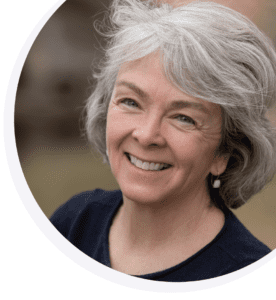
End of Life Doula, Podcaster, and founder of Best Life Best Death.