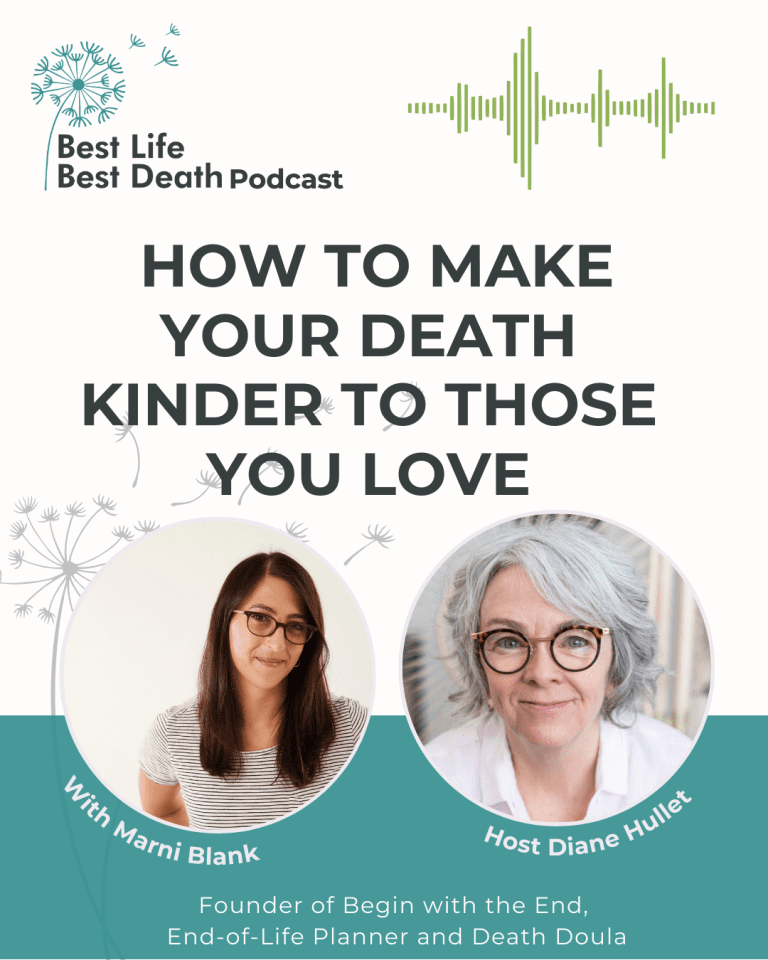
My guest this week will nudge you to think about what you’ve already taken care of – and what’s still unfinished – when it comes to end-of-life planning. Marni Blank and I dive into some of the most fascinating (and often avoided) questions: What gets in the way of getting things done? What superstitions keep us from filling out the paperwork? Does talking about death somehow invite it in? (Spoiler: no.) Why is having your paperwork in order actually a profound gift to the people you love? And perhaps most importantly, when it comes to something you can do today: what are the “Big 3 Passwords” that will make life and death a lot easier if they have been shared?
For more information on Best Life Best Death please visit our website at www.bestlifebestdeath.com
Follow us on our social channels to receive pertinent and helpful resources on death, grieving, and more at:
Facebook: www.facebook.com/bestlifebestdeath
Instagram: www.instagram.com/bestlifebestdeath
Transcript:
Diane Hullet: [00:00:00] Hi, I am Diane Hullet, and you’re listening to the Best Life Best Death podcast, and I’m here today with a guest from New York City, Brooklyn to be precise. Marni blank. Hi, Marni. Welcome.
Marni Blank: Hi, Diane.
Diane Hullet: So Marni and I crossed paths at Doula Palooza recently in New Orleans in 2025, which was just an incredible gathering of about 300 people who work in the end of life field.
And to get those people together in New Orleans was just quite something and quite fabulous. And Marni did a presentation there, and she’s an end of life after loss consultant. And after the conference I reached out to you and I said. Marni, I think we have some things to talk about that people need to hear.
So glad you’re here. And tell us a little bit about how you got into this end of life work.
Marni Blank: Yeah I always love talking to other doulas and, we were talking about this sort of before we were rolling, but that there’s all these different niches and people that are in this profession and it’s really amazing to get to learn from other people.
And that’s why Doula Palooza, for [00:01:00] me, was such an amazing experience. So for me, I I am a lawyer by background and I transferred into becoming an entrepreneur. I started a business with my sister and we ran it for about eight years. And during that time I was at a work event at our studio and got a call from a hospital in Massachusetts that our mother had been in a serious car accident.
And the first things I thought other than, is she okay, were, oh my gosh, I have a lot of her paperwork sitting on my desk that I was supposed to get signed and notarized that I had not done. And I am smart. I am an attorney. I know how important these things are. And there had been a mental block around.
Completing paperwork that had to do with my mom’s incapacitation or death, and I hadn’t done it. And before getting to the hospital, I had to scramble and do this. And then I will, fast forward to say that my mom ended up surviving and thriving, but figuring out how to run a business [00:02:00] while caregiving a seriously injured person in another state was entirely overwhelming.
And it really pointed out the conversations that we had not had in our family that we really needed to have. How unprepared, even though our family. Some people who prepare, we, there were so many gaps that I didn’t know. And specifically when she was at the hospital she was able to help us get into a lot of her online accounts that, we needed, like her insurance information and all of the utility things that we needed to run the house.
And she had gotten a kitten the week before and, had a dog and we had to figure out everything. But had she been. Had she been in a coma or had she died, I didn’t have any of that information, her passwords, any of those sort of things, and we would’ve just been at a, an entirely different level of overwhelm, having to figure all of those things out.
And I got really curious, through this whole [00:03:00] process and all the things that I felt like I needed to figure out. I’m the eldest daughter. My sister is incredibly involved and very helpful in everything. But all, a lot of the practical, logistical things fall onto to me as the researcher in the family.
And I wish that I had someone there to support me. And so I got curious and. I didn’t wanna be I wasn’t practicing as a lawyer. I wanted to figure out how to use my skills, but also the empath in me. And I came across, what an end of life doula was. And so I ended up going to training in 2020, to get just more of a sense of what all of this means.
Death and dying and grief. So that I felt prepared for my family, but also I’m in my forties. All of my friends and peers are, struggling with, aging parents or death of a loved one, serious illness ourselves, and that is how begin with the end began. And while I have end of life doula training and I do work with the actively dying, most [00:04:00] of what I’m helping people with now are helping people of all ages start having these conversations, facilitating conversations between parents and adult children to figure out roles and responsibilities.
How can people of my generation get prepared and plan ahead so that we have this information for ourselves? Which is a gift to everyone, and that we’re having these, important conversations and then it starts to feel more comfortable. And then I help people after a death figuring out how to go through the process of all the paperwork and logistics that fall on executors and families after a loved one dies.
And that’s where I come to you at right now.
Diane Hullet: So good. Marni. So good. Geez, my head is just popping with questions. It, the first thing was. Just how interesting it is that, people who quote unquote know better. This happened to my husband and I as well. It’s just there’s something about signing papers.
There’s something about stepping into it that’s just a real challenge. And two personal stories [00:05:00] would be that when my husband and I. Got married, decided, oh, we really ought to redo our papers now we’re 30 something. We tried to figure out which lawyer to use. It was complicated enough.
We needed a lawyer. We couldn’t just DIY. It. And I just fretted about whether we had the right person. Finally on the way to sign the paperwork, there was a huge accident on the highway and I thought this is why we’re doing this. And it doesn’t have to be perfect. It has to be good enough for right now.
So that was big. My mother-in-law signed a change to her will right at the end of her life, right at the very end, and she was absolutely mentally competent to do that, but she made some changes that were really important and the fact that she got those signed. Wow. What a big difference if she had died, just, a day or two sooner than that and not had those changes made.
Just for listeners who have piles of paper on their desk that need to be signed and notarized, just a reminder of how important that is. And most of us know better [00:06:00] but what, what in your experience gets in the way for people? Let’s just kinda start there. What are the blocks of not doing it or getting it or making it happen?
Marni Blank: And your stories really point to it, that, people should be thinking about these things in their thirties and forties when they’re starting families or getting married, getting divorced when there’s, all of these milestones getting, purchasing your first house.
These are all things where we need to be thinking about, getting our important paperwork in order and and then, it can change through one’s life, and that is okay. These can always be altered. You start somewhere and then you work through it as your life changes and milestones change.
A big mental block for people is really just the idea of this paperwork means that I’m going to die one day, or that I’m going to need someone to help me, with the healthcare proxy or a power of attorney that’s saying at some point I’m gonna need support and I’m not gonna be able to do something for myself.
And that’s, there’s something very scary in the [00:07:00] unknown of what will that look like? I don’t want to get to that point. So if I don’t fill out paperwork. It means that maybe it won’t happen. There’s a lot of superstition also around, if you. If you sign the will, if you fill out this paperwork, if you’re thinking about death or dying, that somehow you’re gonna invite it in.
And the reality is that it’s the one thing that binds us all together. As humans, we will die one day and we are not guaranteed along life. Many of us do. I had a great aunt who was 103 and my grandmother was 102. And that’s amazing. Hopefully I get those genes or not. I don’t know. I have had clients who have passed away in their thirties and forties, and that is a reality that we just don’t know.
And so it’s important to get your paperwork in order because it really is a gift to loved ones to be able to say this, these are my wishes, these are my values. This is where I want my things to go. And not leave it for someone else to have, to [00:08:00] make all the decisions and worry about doing the right thing.
When, a conversation can give people clarity. You were talking before that your, one of your kids is gonna be going off to college. They need to have a healthcare proxy in place every 18-year-old and above. It’s important to be thinking about that as parents to make sure that you are able to be there with a child if something happens to them too.
And a lot of people don’t think about that. So yeah.
Diane Hullet: So true. No, so true. Both our kids went in and signed things when they turned 18, and when I had some friends ask me like wait, are you gonna do your kids? I read this article about paperwork. Is that a thing? I said, it’s absolutely a thing. And for that age group, I do think it’s primarily the accident piece and HIPAA laws being what they’re, and all this stuff, especially if there’s a divorce.
Who is speaking for that child who’s now in a coma from an accident. It’s really important that’s laid out. I think. Oh gosh. I was struck too by what you said early [00:09:00] on about the digital assets. I almost wanna call them or like the digital
Marni Blank: Yeah.
Diane Hullet: Access and this is. So big, and I think we’re so swimming in that world right now where we have portals and passwords and all these accounts.
And gosh, if you don’t know how to get to those accounts, it is, as you said really complex and makes everything so much harder. Even the password on a phone. I know one person whose daughter died. She knew that she had the password somewhere, but it took her probably six months to find it and it, she’d written it on the corner of a paper calendar and she was like, what are those six digits?
Oh, I think it’s her password. And so she was able to get back in, but oh my gosh. We can save ourselves a lot of grief by having access to those.
Marni Blank: It’s, that is that example is just so like a heartfelt and so sad and, caused probably so much more extra grief than needed [00:10:00] to be on top of already a horrible situation.
But you’re right. In days past, information was more centralized. You had that, your paperwork in a filing cabinet and you knew where it was. And in best case scenario, most people don’t have everything buttoned up. And I do still think that everyone should have physical copies of your important paperwork too.
But, most of our information now lives spread out all over the internet. You have, your airline miles. You have your Venmo or your PayPal where money is being kept se separately you have investment accounts and bank accounts and your utility accounts. There’s so much information and having a, a digital password manager is great.
A digital vault is great, a lot of people, are not sticking to that. An example in my own family, it was my father, bless his heart. Had sent my sister in the mail, snail mail, handwritten, all of his usernames. And then to me, he sent in the mail all of his passwords, but like [00:11:00] some of them were Xed out and he was like, you’ll know what they, you’ll know what they mean and together they create your usernames and passwords.
And that was so sweet. He was trying to do us, a favor by giving us that information, but that is not necessarily the best way to go about it. And we have since gotten him set up with a password manager, which he’s still annoyed about. We’re like, this will be helpful. Us, and and thank you in advance for your service of setting this up.
But it really is important and to your point about someone’s email, the big three things that you know, you really need someone to know about or to be able to find to. Is, access your password to your phone, to your computer, and to your email. If you do not have that Gmail password, Google will not give it to you.
Same with Apple. These are huge companies that are, privacy laws are very strict and they will not give it to you and think about all of the things that you have. On your computer or on your phone, all of those videos and all of [00:12:00] those photos, those are, those are the things that you’re going to miss or be devastated by if you don’t have access to them.
And so setting up simple things like. In, if you have an iPhone having your legacy contact set up, it takes five minutes to complete and it allows someone to have legal access after you’ve died to be able to get into your Apple account. Same with an inactive account manager on Google. If you set this up, it gives someone the ability to do it not while you’re alive.
After you’ve died. And these are just simple things that if someone didn’t have access to your password or lost it for some reason or couldn’t find it they would be able to get in and all of that information wouldn’t be lost.
Diane Hullet: So much of what you’re talking about is, and I thought of this in your opening kind of thing too, is it goes against our kind of independence and our privacy, right?
And so those are like such core. I’m gonna call ’em American Values that are like, I’m independent. I don’t wanna have to [00:13:00] admit that there could come a time. I need help and I’m private. Why should I let anybody get into my stuff? Or maybe you really do have stuff on there. You don’t want people to see, I don’t know.
You might have to get a burner phone or something. People ’cause. Your kids need to be able to get into these things. I’m also reminded of there’s a great article, which listeners, you can literally just type this into Google and you’ll get it, how to make your Death Kinder to those you love.
It’s such a good, simple article, and I love the title because that’s what Marni and I are talking about here is really at the root of it, is how to make your death kinder to those you love, because these things make such a huge difference. It’s funny, we’re talking about getting prepared for everyone.
But we’re almost like talking about it at this really big picture level. Like in the digital world we live in. It matters so much that people have access to each other’s material. And what do you do if you’re a solo agent? If you don’t have kids, you don’t have simple next of [00:14:00] kin. How do you handle that?
Marni Blank: Yeah. And before I say that, I just wanna say one thing on your burner phone joke, which is, it is really not, a lot of people are very concerned about, privacy and not wanting certain things. And the great thing about planning ahead. Is that you can make your wishes known in that, if you have a letter of instruction or some sort of high level, saying, here’s where everything is.
You can say, I would like my friend so and so to come into my apartment and do a once over before my family comes, or I want this person to have access, or I do not want you to go through my personal. Emails, please respect that. You, I would, if you need to access my utility bills or find other, important information, but thank you for respecting my privacy.
So there are, you are trusting someone else to respect your wishes, but it, by planning in advance or writing thing these things down, I have a friend who I’ve said, please come into my home and just make sure everything’s tidy and, whatever before someone [00:15:00] else, who might.
Be grieving at a deeper level comes into my apartment. But I always try to keep my apartment slightly clean for that reason. Also,
Diane Hullet: just in case,
It’s like wearing clean underwear for the firemen. For the
Marni Blank: em. Exactly. Exactly. But you know what the solo aging question is a real thing. And there might be people who, for whatever reason are aging solo.
A lot of people it’s by choice. It could also be by circumstance, because. Of divorce because of estranged family or children because of widowhood. There are so many reasons why people are aging solo and in a vast amount of, the aging population is, a lot of people my age are as well.
I’m. In my forties and I’m currently aging solo. That might change. But I am planning with that in mind because I think everyone should be planning with that in mind. Because even if you Life changes.
Diane Hullet: Yeah. Even if you have a long-term partner, that could change, so how the plan is though, we’re all solo aging.
Marni Blank: Yes. [00:16:00] And for me it really is about thinking about sort of your circles of support. And a lot of people may say, oh, I have no one to be my healthcare proxy. And that can be a very scary thing to feel like you don’t necessarily have that. And when I work with people, we really get granular about, who are those people in your life that you know?
I ca call them like my couch people, the people, my friends who are so comfortable that we can just sit, eat takeout on the couch and watch tv. We don’t necessarily need to be in constant communication. There’s just a level of comfort. And hopefully there are some people that come to mind that are those people for you?
They don’t need to live close to you. It’s just that feeling that invokes. And then there’s more of, that next circle of care the neighbors, that you might check in on or say hello to or may have that extra set of your cues for whatever reason. It could be people within a religious organization that you belong to, people that you are checking in on your exercise buddies, things like that, that you know what’s [00:17:00] going on and can be a support to you.
And then, like the outer circle, maybe those are professionals that are part of your life. The attorneys, the financial advisors, the money, daily money managers, the therapists. And it really is thinking about how am I creating the support I need where I am now and thinking ahead to where I wanna be and really being intentional about it.
Aging solo is not something to be scared of or worry about. There’s no shame in that. It allows you to intentionally choose the people that are going to be part of your support network. And as we know. There are people in many different family dynamics where their family is not. Showing up the way they would want them to, or family dynamics are challenging.
So it really is getting to choose who are your people and being able to rely on them for support
Diane Hullet: and Marni, I think it you can, in terms of a healthcare proxy, aren’t there also people, depending on where you live, what your [00:18:00] region is, you can hire an advocate to play that role, isn’t that right?
And carry out your advanced directive. How does that work?
Marni Blank: Yeah for a power of attorney, so more of the financial role who would be making me, financial decisions for you if you’re unable, there are, people, fiduciaries, basically people who they, that is their job and it is legally required to do what’s best for you in those roles.
And yes, you can definitely hire those daily money managers are great resources and. Oftentimes they’re able to do that. And there are other people that you can hire in, in those roles for healthcare proxies. There are advocates out there. It really is state dependent and specific of, who would serve in those roles.
It’s not something that you can charge someone for typically because there would be a conflict of interest. So it’s really, it’s it is harder. To find someone to step in those roles. It really depends. But it really is there, there are people in [00:19:00] your life that really just, it comes down to taking the time.
And if there is not someone that immediately comes to mind, it’s important to think, okay, maybe it’s time to start cultivating my relationships in a different way and gives you the opportunity to see where the gaps are. In your social circle, because that’s really important as everyone ages to have that support and and to be thinking about that more intentionally.
Diane Hullet: I love that you’re almost putting our relationships at the center and paperwork secondary. I don’t know if we could separate, which was more important because they’re both really important. So often I find I don’t, maybe you find this. Too, especially with your background as an attorney. But people often think that end of life is all about do I have my paperwork done?
And I think it’s that getting prepared is so much more than just the paperwork, but the paperwork is really important. There’s getting your paperwork in order and then you’re really talking about kind of an assessment of your. Social world [00:20:00] and how that will support you either as you’re aging or at the end of life, no matter your age.
And are there those two components which we could delve into a little bit more, are there also other components that you think people should consider and they’re getting prepared?
Marni Blank: Y Yeah, I think they’re all related, right? I really do think it takes a village to raise kids, but also for getting older.
And it I really do think that creating your social support circles is incredibly important for loneliness, for, knowing that someone is there if you need them. And at any age, honestly. I like to tell the story that, recently I was making coffee in the kitchen and I felt something sharp, go into my toe, and I, all of a sudden was bleeding everywhere and there was just a little shard of glass, a little baby shard, but was causing, I couldn’t walk.
And it was that time of the morning that I needed to take my dog out for a walk and I had to sit and panic for a second of, I, I need to go to urgent [00:21:00] care and I need someone to take care of my animal. And it in that, in a moment, I was like. I felt that like I am, there’s no one here. And then I immediately was like, okay.
I need to call someone. And who, who’s that first person that I’m gonna call for me? It’s my sister. And she picked up and she said, do not worry. I will take care of this. And I took myself to urgent care knowing that someone was gonna take care of Penny. That can happen in any age, any, where there’s something that comes up that you need someone.
So it really is starting early. It is not something when you’re just aging and, thinking about it’s all the time who can show up when you need it. But I think that it is important to also see what the resources are around you as you’re aging and really take inventory of that.
If I wanna age in place. What does it cost in my area to have someone to come in and help whether it’s part-time or full-time, depending on what’s going on. If, I think that I will do better in a social [00:22:00] situation where I can play pickleball and, have the activities all the time.
Maybe I’m starting to look at what is around that would be good in that environment. What are the costs and thinking about, okay, if that is something that I want. What are my finances looking like? And do I need to talk to enough financial advisor to say, am I on track so that I can get this when I need it?
And if not, what should I be thinking about and doing? And the earlier planning and thinking about this, the more you know. More useful it will be when the time comes. And so really thinking about, what is important to me? Is it aging in place? Is it moving somewhere within my community?
Is it moving somewhere closer to family, but getting to do your own detective work? What resources are around. What is going to be important for me to make sure that I feel supported as I age?
Diane Hullet: I’m thinking too how much these conversations matter because they, it isn’t one [00:23:00] conversation, it isn’t one decision point for most people, right?
It’s thinking about what makes sense. It’s thinking, what do I want? It’s thinking how will this work financially and logistically and all those things. But the people that I see who seem to be happiest with their choices. Are making those choices. Yes. They are proactively making those choices rather than being thrust into circumstances.
And yet I say that as though it’s simple. It’s not simple to do. And sometimes we miss the window of opportunity to make a proactive choice and then we just are where we are.
Marni Blank: Yeah. It can be, it can lead to a lot of resentment or anger or frustration within a family unit if, the parents have been told or moved without really their consent or they really weren’t part of the decision making process and having those conversations earlier.
Understanding. It gives exactly what are the finances what’s most important? Do I need to be near my family? [00:24:00] Do I need that extra care? What is going on here? And taking an intentional approach to what it is that you want can alleviate some of that family tension later on. I’ve talked to many, elders who feel.
You know that they didn’t have a choice in the matter, and it really has put a damper on what can otherwise be a continuing, loving relationship, and maybe that same choice would’ve been made. But had they felt like empowered to make that choice themselves or had the autonomy to make some certain choices, it would’ve felt different.
Diane Hullet: Yeah. And the resentment can go either way, right? Yes. The resentment can be like, why did you make me move? Or why didn’t you make a move? It’s just, it’s really complex.
Marni Blank: Yes.
Diane Hullet: Jumping, jumping back to just general estate planning how often is it important to review paperwork?
Marni Blank: I often say if nothing’s going on and things are steady and even, and there’s no real life [00:25:00] changes, I would say every three to five years just checking in.
Especially when it comes to things like your TODs, your transfer on desks, who is the beneficiary of your account. So on every, bank account or investment account, there are, there’s a way in which to, name someone who will be the beneficiary of your assets.
And that, that avoids probate. And so that’s a really important thing to do. It’s a much easier process and much quicker process to give money to those who you love after. So checking in, making sure they still, make sense. I worked with someone who’s. We, I asked, when was the last time you checked on these?
They went and checked and they still had their ex-fiance listed on several of their accounts that had they died, this money would’ve gone and it was a significant amount of money would’ve gone to someone they did not want. Really important to be checking on those. But if so three to five years, I would say at a minimum, but at any sort of life change, it’s important to be [00:26:00] looking at them.
So if you have, kids. Grandkids getting married, getting divorced if a, if someone, a spouse dies, these are times to be reviewing and making sure that everything still makes sense or if you have to make different choices for who are, in your important roles or who’s going to be getting.
Your things after you have died.
Diane Hullet: Yeah. I like naming that with what did you call them? Like life markers, like milestones. Yeah. I like naming that as adjusting at milestones. I think that makes a lot of sense. It could be an even interesting to tie it to your birthday listeners, be like, okay, I am turning 35, I’m turning 40, I’m turning 45.
Or like you said, anything significantly. A change, a marriage, a divorce, a child, a grandchild, a retirement. All of these are reasons to say, oh, I should revisit all that. You on your website. You have a wonderful end of life checklist. Does that seem like it fits in this conversation or shall we save that for our second conversation?
’cause [00:27:00] Marni and I are gonna talk next week too.
Marni Blank: It fits in both places. I’m happy to mention it now. I just created sort of a list of your important information that you should be collecting, if at all possible. And so I have one list of your important paperwork. So things like your social security card, your birth certificate a marriage certificate or divorce certificate, your insurance information, all those things, the big things and making sure that you know where those items are.
Organizing them and ideally putting them in a digital vault as well. Things like what happened with the wildfires in California. There are climate disasters that you really need to be thinking about. It’s great to have a physical copy. I suggest it, but also. That’s not the thing that you’re gonna take when you’re fleeing a house.
You’re gonna take those photo albums, you’re gonna take the pets. That’s not gonna be first on your list. Thinking about having it both ways. And then the second page is more your digital assets, things to be thinking about to again. [00:28:00] Organize or just create an inventory of, it could just be a simple spreadsheet in Google Sheets or Excel where you’re saying, I have, a lot of people have a million miles on an airline.
Those are worth something. Write it down. Where are your subscriptions? Do you have, many people have streaming services and these are important things to think about. And honestly, if you are taking inventory that maybe you have. Five streaming services, maybe you only are watching three and you can save yourself a few hundred dollars along the way.
So it is good to just be looking through. So I have that, it’s free on my website. And just good to check off and say, oh, I know where all these things are, or, oh, maybe I should spend an afternoon kind of getting things in order.
Diane Hullet: So good taking inventory. That’s a great way to put it. I’ll end with one final story, which was someone whose uncle went into their home after he had died and Oh, wonderful.
He’s got like a Susie Orman box, like it’s, oh, everything’s gonna be in this [00:29:00] box. And this person very carefully carried the box all the way back to their home so they could find out what was in it. What the uncle had carefully put away in it. And there was nothing inside. So we can have great intentions to get organized and if we don’t take the next step and actually do it’s just an empty box, which is not helpful to those you leave behind.
And I don’t think anybody intends to be unkind or disorganized. As we said at the beginning I think it’s just that these things mean facing your mortality, and that’s a big commitment you and I have is how to create conversations, how to create openness, how to say it’s okay to talk about this, and Yep.
Looking at this box means that you are facing the fact that one day you’ll be gone. And it’s hard. It’s hard for all of us.
Marni Blank: Totally and just progress over perfection. Just starting somewhere, making a little progress. That’s all step by step. You don’t have to do this all. [00:30:00] One in one sitting, or in one season.
It’s just doing a little bit.
Diane Hullet: Oh, I think you totally named it. Progress over perfection. That definitely is what gets in my way. I am like, if I can’t do it all, I won’t do any of it. Yeah. Not all of us.
Marni Blank: All of us do that.
Diane Hullet: Thanks so much for joining me today, Marty, and we’re gonna talk more next week in order to talk about what do we need to do after death, and there’s so much there to discuss.
So thanks again for joining me. How can people find out more about the work you do?
Marni Blank: Yeah, so my business is, begin with the end, and you can find me on Instagram at begin with, underscore the end. I’m on LinkedIn and my website is begin with the end. Do co not com, but co
Diane Hullet: not.com. I think we should also add that you consult with people, you are a one-on-one consultant, and people can reach out to you and book a session and find out what your expertise has to shed light on their situation, which I think is so [00:31:00] valuable.
Marni Blank: Thank you for pointing that out. I work with people across the country and I always offer a 20 minute free consultation just to understand what’s going on and where I can potentially help support. So thank you for that, Diane.
Diane Hullet: Fantastic. It’s a part of getting prepared. I, for me personally, I often a part of taking a step is taking a baby step. So let me have one conversation and see if I can dip my toe in the water and get started. As always, you can find out more about the work I do at bestlifebestdeath.com. Thanks so much for listening.
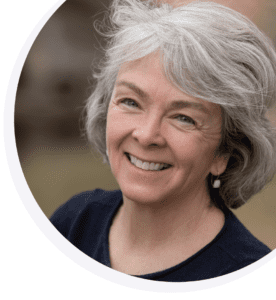
End of Life Doula, Podcaster, and founder of Best Life Best Death.