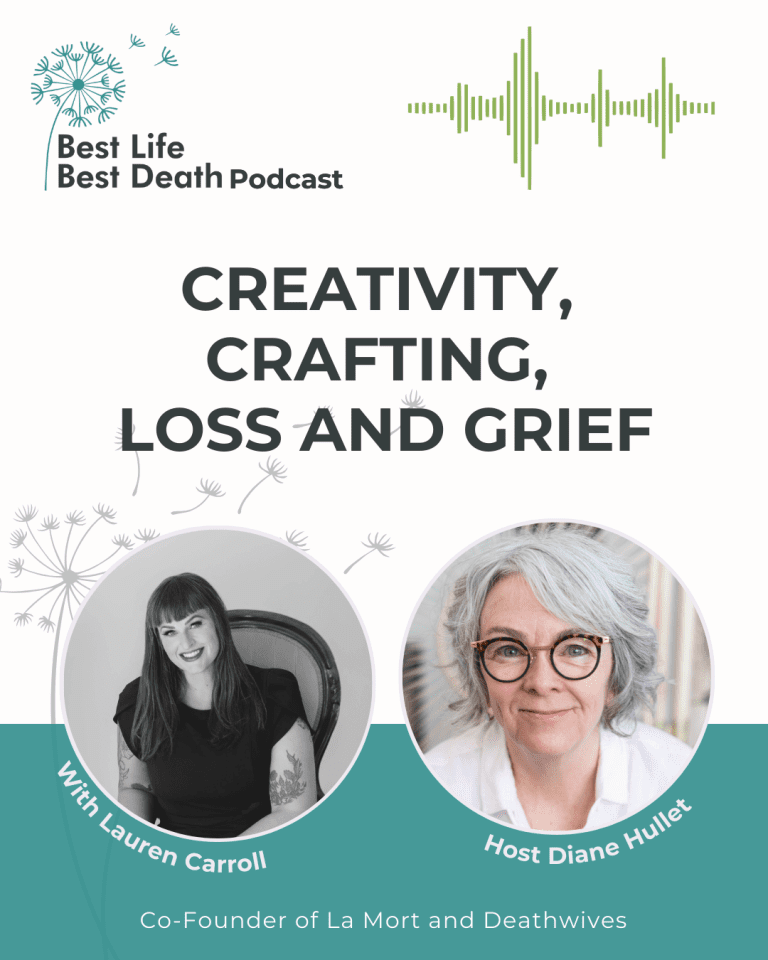
Starting in her twenties—and quickly shaped by an experience of profound love and loss—Lauren Carroll has devoted her life to the funeral profession and the wider end-of-life field. In guiding people through loss and grief, she’s found that creativity can offer the action our hearts instinctively seek. Whether you set up an altar, create a collage, connect with nature, make space to remember, dance, shout, sing, or write… we crave actions that help move and shape our grief. And when creativity is paired with community, it creates a space—both within and around us—where loss can soften, even if just a little. At one point in our conversation, I read a line from The Art of Grieving: How the Arts and Art Making Help Us Grieve and Live Our Best Lives by Sheila Collins: “To what life is this loss calling us?” (Listen in for the full, beautiful story behind that question.) www.lamort.org
For more information on Best Life Best Death please visit our website at www.bestlifebestdeath.com.
Follow us on our social channels to receive pertinent and helpful resources on death, grieving, and more at:
Facebook: www.facebook.com/bestlifebestdeath
Instagram: www.instagram.com/bestlifebestdeath
Transcript:
Diane Hullet: [00:00:00] Hi, I am Diane Hullett, and you’re listening to the Best Life Best Death podcast. And today I am here with a fellow educator and creativity goddess, and all things La Mort. Lauren Carroll. Welcome Lauren.
Lauren Carroll: Hi. Thank you so much for having me. I’m so glad we can finally do this. Yeah. We’ve known each other for years.
Yeah. We’re both in Colorado, so this is kind of long
Diane Hullet: overdue. Tell us you know, tell us about you, the work you do, LA Mort, how you got into this. Give us a little backstory.
Lauren Carroll: Yeah. So now for half my life, I turned 41. I started working in the funeral business when I was 20, typing death certificates on a typewriter.
That’s how we had to do it 20 years ago. And actually had quite a fear of death, which people always find so confusing since that is now my life. But I feel like I was the typical person where I had a really tragic loss when I was a teenager. Didn’t know how to deal with the grief. [00:01:00] I was the gothic girl.
So of course everyone assumed that I love death. And I had my boyfriend who was death. He ended up working at a funeral home, of course, invited me to work there and I said, no, I’m terrified. I don’t wanna see dead people. And lo and behold, long story short, I had to go pick up a baby from the hospital.
Absolutely terrified. And he was full term. Brought a blanket. He was wrapped up and I just carried him outta the hospital, shaking of course, and put him in my passenger seat and buckled him in and just kind of sat there, still shaking. But then I felt this overwhelming feeling of just like love, like when you go to a wedding and you could feel that that’s what I felt coming from him.
And this was like, as Oprah says, my aha moment of. What an honor that I am taking care of him right now. Somebody who has been so [00:02:00] loved and cherished and full of dreams and all of this, and it literally was like, whew. All my fear was gone and my whole relationship with death completely changed. And so I went on, moved to Colorado, became a funeral director.
I saw the film of family undertaking, which was my second aha moment in life. I was working at a corporately owned funeral home at that time, and then I learned about home funerals and family led death care, and I said, that’s it. This is literally how it’s supposed to be. What are we doing? And so I came home.
I came home, I came back to the funeral home and. Was like, oh, we shouldn’t embalm people and we should do all this. And I lasted about four more months after that. And then at that point I started learning about home funerals. I studied under Karen Van Veen, who I love, and started telling everybody teaching workshops.
I started my first workshop 14 years [00:03:00] ago. Did that while also working, and then. I think it was about 10 years ago, I was doing a home funeral workshop and Erin came and she was like, we need to teach this on a larger scale. People need to know. And so for like four years we talked back and forth of how do we do this?
What do we do? And then six years ago we founded Death Wives where, I mean, I don’t wanna say COVID, I was the catalyst, but when people were really thinking about death for the first time and had no idea. Like what it was, it really opened people’s eyes. People started learning about death, doulas, and kind of being curious of like.
Our overall relationship with death. So we did well, taught hundreds of students. And then last year, me and my best friend since sixth grade, who was also our designer at Death Wives, we started another business called La Mort which is, I don’t wanna say it’s [00:04:00] a lot different than Death Wives, but it definitely has a different flavor.
We do a lot of. I don’t know the filling of the gaps of death work, I guess I would say. We do a lot of arts and crafts. We do a lot of embodiment work. A lot of grief work, especially for death workers. And really just look at things a little bit deeper, like what happens to a dying body if they have this disease or this disease, or this disease.
So I feel like I’ve been a forever learner. Learning, learning, learning and teaching more things all the time.
Diane Hullet: Incredible. And then what I see with some of the offerings of Le Mor is that they, they really weave in creativity. And that’s where you and I were like, oh, let’s talk about creativity and grief and loss and death and why.
What is creativity and why does it matter with these really big feelings in life? So I don’t know if [00:05:00] you wanna. You know, ruminate on those big levels, or even just kind of name some of the workshops you’ve held, because I think people would find those really interesting.
Lauren Carroll: Yeah, I mean, for me, the reason that we do these craftings is sometimes it’s hard to talk.
When we’re in grief, we don’t have words, and so we can have these physical things, we can create things, and so some of the classes we’ve had are creating altars for our pets that have died, and then showing those off and then telling our pet stories. It’s, there’s something different about. Just presenting, this is my grief, versus look at what I created with my grief, and now I can share it with you.
I really like that crafting can be done in community too, and so I. We can invite all sorts of people. We’ve had ancestor alters, we’ve done psycho pumps to help us connect. And I’m trying to think. We’ve done so many. I know we have [00:06:00] another ancestor one coming up. We have another PET one coming up as well.
I mean, it’s endless.
Diane Hullet: So beautiful. I mean, altars are so interesting and, and I have off and on, had an altar set up and it’s interesting. My altar most recently got a lot bigger, which really surprised me. Like it usually was like a little space on a shelf with some candles and some things on it. And recently this fall when I kind of reset it.
I was using this piece of black fabric that has stars on it, and I kept reshaping the fabric and finally I just used the whole piece of fabric. So I’ve got this altar right now on a big shelf that’s probably like three by four feet, and it was so, I don’t know. It’s so satisfying. Do people resonate with that kind?
Work and, and I think for listeners who don’t even know what they, that means, I mean, I think an altar is simply kind of a sacred space that you set aside with some objects on it that are meaningful to you. And in the case of ancestors or pets, it might be a photo of [00:07:00] that being, or it might be some objects that represent them.
And it’s kind of just a way to connect and honor. That’s my super simple definition. What would you say?
Lauren Carroll: Yeah, no, I think that that’s so true, and the act of making an altar is just as meaningful as the altar itself. I think. On my altar, I have all of my ancestors, and then I have a second altar underneath that has all my friends that have died.
And then on the other side of my altar, separated by a few things, some saints and crystals I have. My kids and pictures of me with my family to kind of remember all of these people had to exist and love each other and live and survive for everything that I have now. And so for me it’s just this kind of reminder constantly of look at how amazing these humans are.
And someday I’ll be one of them and my picture will be on this side and what will continue after me. So [00:08:00] I, there’s so many different kinds of altars you can make. You can make an altar for yourself. I’ve worked with clients who are dying and that can be something really meaningful of. What was your story?
What are these precious things to you? Let’s build an altar to, to yourself or, my animal altar is so big that it doesn’t fit in my office. I have had, I’m trying to think. I’ve had three dogs cremated. Four cats. I have multiple chickens. I have my pig. Lots of animals. So they have their own space, but it’s really, it’s a place to pause and it’s a place to slow down.
So once I build my altar, which always feels really fun to look at their pictures, to decide where I wanna put them. Then I just have, yeah, a quiet space where I can be present with them, with my grief, whatever it is. But it’s just this, like you said, it’s just this allotted space [00:09:00] that is a sacred space.
Diane Hullet: I love this.
This phrase, a place to pause. I think that’s really beautiful. There’s, there’s so much right now in kind. Secular world that doesn’t give us places to pause and, and stating the obvious here. You know, most people don’t have a lot of ritual in their lives, so there’s something about a place to pause in your house and a place to have a simple ritual as simple as light a candle and sit for a few minutes.
Or as simple as remember them on anniversaries or death anniversaries, right? Or birthdays. There’s something about that that I think we, we crave and. Yet, I find people are sometimes a little embarrassed by it, almost. Like they’re like, oh, well I kind of have this urge to put up a picture and do something.
But I don’t know. And I, I encourage people, I, I think it’s a very rich way to remember both those who’ve died in those who are alive, as you said. And if, you know, if alter’s not a word you like to use, come up with another word. But it’s this place to [00:10:00] pause and, and. I, I love that we kind of just, you know, segued into this, talking about alters, because to me they’re a very creative act, like setting it up and choosing the pieces and you know, which rock represents what it in and of itself is a creative act.
I don’t know, I think of creativity is like a transmutation or a transformation in some way.
Lauren Carroll: Yeah, and I would say too, that creativity is. Also you pausing, you being present in that moment. And the thing I love about creativity, crafting, anyone can do it. There’s no wrong or right way to do it. One of my favorite things to do is just have magazines and say, rip out pages, rip out the pictures, have it be rough.
And then we’re gonna create a collage of. What does your grief look like now? And so there’s these physical acts of like, oh, I’m tearing these papers. And then there’s kind of switching be between that left and right [00:11:00] brain of, oh, I like this and this might go together here. And I’m not really thinking about it.
It’s just kind of flowing. And that’s an interesting thing about grief is when we grieve different parts of our brain kind of shut off. It’s a protection mechanism. It’s also just hormonal overload and all these things. And so when we have space to get crafty and use our hands, we’re kind of bringing those places back to life too.
So people kind of get surprised at the end of like, I thought this was gonna be really sad, and I’m kind of feeling happy. And I’m like, because you sparked those little parts of your brain and you didn’t even think you were doing anything. But
Diane Hullet: you did. Yeah. It’s like giving it a, a channel for which these big feelings can flow.
I, I’m so struck by how isolated people feel in grief and, and how, how common it is. I mean, we can talk about grief and loss around death, but it’s really, it’s so much more than that. I mean, I’m, I’m sure you have people who come to [00:12:00] your workshops who are grieving because of a death, but then I think they can also realize how grief permeates right now.
Lauren Carroll: Oh yeah. I was just gonna say we have we started a grief writing group called Grief Cabaret, specifically for that, because we are all carrying so much grief. I’m like, if you’re not grieving right now, are you alive? Because it, it doesn’t matter who you are in this world, like. We are grieving, we are feeling everything that is happening every single day.
So what do you do with that? I mean, we talk, I talk about Martine Protel all the time, but he talks about like, grief is fluid and if you don’t move it through, you becomes this hard stone within you, which can turn into a sickness or cancer or addiction. And so I feel like creativity is this like. Easier pathway that people don’t really even understand always how they’re physically [00:13:00] moving their grief through their body doing these activities.
And they can be as simple as, here’s a question. Whatever comes to you right now that may not seem like a creative pro or you know, thing, act, but it is. They’re having to switch those parts of their brain and just flow that grief out of their body onto the page or whatever it might be. Even going out in nature, I think is an act of creativity.
I go, go out in nature and find something beautiful, then sit with it and go, why do I find this beautiful? What about it? And then people were like, how is that a grief exercise? And I was like, well, was your grief present? They’re like, well, it’s always present. I was like, yes. But were you able to move and connect with other things and start.
Doing that meaning making too, right? Whatever our grief is in this world, it’s like nature and earth can hold you while you’re processing it, but I also feel like it [00:14:00] gives people space of like. Remembering, I will be this one day too. And grief doesn’t last forever and this world won’t last forever. And I’m part of it right now.
Diane Hullet: I love that it goes like macro and micro for me. Like it, it’s so, it’s so the, the range of what grief and loss hit on and the range of our response to it. And I, I really appreciate that you say it’s something that needs to move. ’cause I think that’s really accurate. It’s like, it’s a. Grief is a feeling, but it’s a feeling that requires action to move through us and with us, and for us to move with it.
And if we don’t have a way to like stimulate that movement, we, we can get very stuck with it. And it’s not that it dissipates and goes away, but it needs to move. And I, I agree with you. I mean, I think creativity is one of the biggest ways to move these big feelings. It’s interesting, I, I’m a person who sort of always has some kinda little project [00:15:00] going on, and so I don’t watch very much tv.
Not that that can’t be a wonderful way to relax, but for me, I’m like, I got, I got stuff to make. I got things to do. I got, you know, I got things to draw or paint or sew or moving things on the altar or some kind of clay work. Anything that’s like getting the crafty hands moving. Is such a way for me of finding out where I am and who I am and moving the feelings, like getting back in the river and out of the eddies, if that makes sense.
Lauren Carroll: Yeah, I love that. And creativity can be found in so many things can be found in dancing and movement. It can be found in singing or screaming. Or doing actual art or having clay and just pounding it and seeing what forms, I mean, there’s so many ways for us to be creative. I think most people think, oh, I have to be an artist and draw.
But creativity is so much more than that. It’s just, again, it’s another [00:16:00] action that maybe we don’t even control that much, just like our grief. And maybe that’s why it feels easier to play in that space. Because we don’t have to have control when we already feel like we don’t have a lot of control in how our emotions are going.
And I just wanna add, like you were saying, how with grief we don’t move it, but think about our other emotions. When we feel joy, we’re like, yes. When we feel sadness, we kind of, Ugh. When we all these other things, we do have to have a physical reaction. It’s like literally. Built into us. And so when our grief doesn’t have a physical reaction, you literally are causing yourself harm.
I always say crying is one of the healthiest things that we can do. That could be a creative thing. Put art on something and like cry over it. See what your tears do to the paper. That can be a craft where you’re also able to release your grief. I mean, ugh, there’s so many things. That’s what I love. [00:17:00] It’s endless.
Diane Hullet: There’s so many, and I wanna go back to something you said earlier too about community. There’s something about crafting in community that I think. It sort of hearkens back to a different time and I think it’s so valuable right now where people are very isolated and on a ton of screens. Incidentally, I read a really interesting article yesterday that kind of said you’re trying to limit your screen time.
Like give it up. Everything is on a screen. It was very provocative article because I do think of it as like, oh, I gotta get off my screen. And it said, the article said, really, how are you using your screen? How passive are you being versus how active are you being? Because they’re everywhere. Right?
They’re pervasive. It’s not just phones, it’s our laptop, it’s our work, it’s our cars, it’s our entertainment, it’s everything. So anyway, screens, but there’s something about coming together in person with people. Where everyone’s creating that is just like a different, it’s just a different channel. [00:18:00]
Lauren Carroll: And again, you don’t have to talk to people, right?
Like you’re not there necessarily to have to tell your story or share your grief with everyone. You’re just sharing this space together and if conversations happen, then fine. Or it could just be fun and you can do your own thing, but you’re sitting next to someone, I think it’s preschool or kindergarten.
They talk about that’s one of the most important human developments, is learning how to play next to each other. And so when we return to it. We’re not only just like returning to self, but we’re returning to times of joy too. That childhood part of us. I did a retreat once that I was like, I’m gonna do this in a totally different way.
And so I brought things to make dolls. I brought things to make collages and journals. I brought flowers to make flower crowns. And at the end of the weekend, one of the girls came up to me and she said, I had never had a slumber party in my life. I did not know [00:19:00] what I was missing out on and how fun it is just to be with each other and be silly and not really know what you’re doing, but just doing it.
She’s like, I think this was the most healing thing I’ve ever done for my grief. And I was like, yeah, play creativity. It just brings us back to safety too sometimes for people.
Diane Hullet: I love though that you’re also, you’re holding it in a container of going back to your story of this stillborn baby. You’re holding these kinds of craft workshops, right?
In a container that says Death is a part of life. And I’m holding that big space of love, which not everybody wants to dance with. So I think there’s something about when an educator like yourself or myself holds that really big container that says, we’re not afraid to stand in this water with you.
That’s. Very different. It’s just different than somebody who’s maybe holding a creative [00:20:00] workshop, but for a totally different reason. Right. Yeah. So I I love that, Lauren. It’s really, it’s really moving to me.
Lauren Carroll: Thank you and I, I mean, I hold death in such reverence, but I tell people nothing would matter if there wasn’t death.
We honestly wouldn’t be in this space together if we weren’t grieving some sort of loss. Whether it’s a job or a pet or a person. We have to have endings to have meaning. And when we can be in that space, you kind of can change your relationship with death and shift it into something beautiful and meaningful and crafty or whatever that is for you.
I forgot last night we’re doing, we’re creating tombstones. Perfect for this time of year. I have this book that has all the different icons and symbols that are on old headstones, and the reason that they use symbols is because. People didn’t know how to read back then, so they needed [00:21:00] these images to tell the story of.
Who were they in life? Who’s grieving them? All of those things. And so I just remind people like, we don’t have to always use language. We didn’t use language. We can use symbols and icons. One of the other crafts we did was make your own sigil for your grief. Like, what does that look like? Where can we put that?
Diane Hullet: What’s a sigil? How did you what? How did you spell that?
Lauren Carroll: S-I-G-I-L. They’re old, so like a king would have their own SIL of like, I am the ruler of this place. Or in old, like in voodoo, they have those different symbols. And so it’s really just what is my symbol for my group? A
Diane Hullet: sigil is a symbol. Oh, very cool.
I was thinking of it as like a concrete three dimensional thing. I’ve been having this urge lately. I’m, I’m gonna do some clay work in, in November. And I’ve had this urge to make like little, I don’t know how to describe [00:22:00] it, like little tiny pots with lids and I don’t know what that’s about. I’m just sort of following the impulse.
It’s like some little tiny. It feels like it holds something, I don’t know if it holds grief or it holds love or something, but, you know, I, I think it’s so interesting to follow our impulses individually as creators and then as teachers, like what do you have the impulse to bring people to do with you?
Lauren Carroll: Yeah, I mean, I, I love dancing. I always tell people ecstatic dance is probably the best thing to move anything through you, so you don’t have to do that in community. You can play your favorite rage song on hard days or your favorite song like Adele, if you just need to cry it out while moving your body, whatever it is.
That’s a really easy one for me to do, and it’s so fun and community because we’re not judging each other. We’re just moving our bodies and like getting it out. But back to like the screens, right? I, I was, I didn’t even have a cell phone [00:23:00] until eight years ago because I was. So anti-technology. I’ve now had three laptops since then ’cause I dunno how to use technology very well, but it has connected us in such a way that I didn’t think was possible.
I didn’t think that we could have this connection at that conference that we were just at. I knew everybody through online, but then when we saw each other it was like, oh, I’ve known you forever. Like, we’re best friends still. And so crafting and community. But also being in your own home has brought so many more people to Leor and to this area because, you know, there’s some people who have chronic illnesses and they want to be able to craft and they can’t leave their home, or they live in the middle of nowhere and don’t have their people where they are, which I find a lot.
And so we’re creating that space of your people. And so just showing up sometimes I can see. This healing happening with [00:24:00] people because they’re in this shared space when they haven’t been, maybe for years after COVID. I mean, COVID really isolated people in a way. I don’t think we were expecting to have it last so long term.
And there is COVID still out there, so some people just don’t wanna go out. And so I can appreciate Zoom, I can appreciate these screens in this setting because it really does offer a space for connection that’s not available. Like in a lot of places still.
Diane Hullet: I agree. I found it really stunning. I’m teaching a lot over Zoom right now and, and the fact that people, you know, we’re working with a class with Sarah Kerr.
We’ve got people from Australia, Britain, Canada, the US and Mexico. I mean, how, how else could you do that in a, in a cost effective way and yet. Done. Well, it can be surprisingly connected, and I can absolutely imagine a workshop where you’re making something and crafting and talking through screens and, and we never would’ve [00:25:00] thought that was possible without COVID throwing us into that.
I think that’s really, really true. So are some of your things online and some in person a.
Lauren Carroll: It’s a mix. So next week I’ll be doing something here in Manitou Springs, but most of the time they are online. And the reason I hold them online is because of that accessibility. And again, to bring in people that.
I wouldn’t get to meet here in Colorado. Like you said, I had someone in India once and I was like, I love this. This is amazing. Bring, bring everyone together because this is what we need now more than ever, is just spaces for grief. And maybe those spaces just look a little bit more fun and creative and loving and community.
So combining those two things is not only fun for me, of course, ’cause I love crafting and having an excuse to do it, but just getting to see people hear their stories. Hear other people’s stories, witness each [00:26:00] other in ways that wouldn’t be possible if it wasn’t for Zoom.
Diane Hullet: Yeah. Yeah. So true. Lauren and I were talking about, there’s a new book called Semi-New book called The Art of Grieving, how the Arts and Art Making Help Us Grieve and Live Our Best Lives.
And it’s by Sheila Collins. And I’ve been, I’ve been really appreciating it and I just wanna read. One part that she says as we kind of come to a close here she talks about how she was working with some nuns. She was talking to this group of nuns. And she writes, one of the sisters shared a community ritual that they had been using recently whenever a significant loss was about to be experienced by the community, whether the loss is expected or unanticipated, gradual, or sudden, small or mammoth, they ask this same question out loud in community and repeat it quietly to themselves.
They follow it with a meditation to listen for its answers, and the question is. To what life is [00:27:00] this loss calling us? I’ll just repeat it to what life is this loss calling us? And I, I think that’s such a stunning kind of question to ask at the, at the Center of Grief and Loss, and that sometimes we find the answer to that question by using sort of alternative creative ways to access, finding out what life we’re being called to by this loss.
Lauren Carroll: Yeah, like that creativity, shifting those parts of your brain making new neural pathways. We need to create the meaning of the loss. But then what’s the life after the loss? And sometimes again, there’s no words if we overthink it. If I overthink it, I’m like, there is no future. Like this is it forever. But when I give myself that space, right, that time to just slow down and breathe and do whatever my brain and body are gonna tell me to do.
All of a sudden I’m like, oh, there’s [00:28:00] this flicker. Oh, I remember, oh, I wanna do this craft with my other friends that are grieving right now. Like you can see past this stuckness that we stay in, in grief. And so it’s, again, it is like that backdoor therapy that people don’t even realize sometimes is opening and moving their grief.
They just think, oh, this might be fun. And it is, but it also is, has a little science behind it and has a little magic behind it. And those are my two favorite things. Mystery, magic, science. Bring it all together.
Diane Hullet: That’s, that’s so great. Bring it all together and it’s LaMorte.
Lauren Carroll: Yep. Lauren, how can people find out more about the work you do?
Yeah. So la mort.org, L-A-M-O-R-T, which. Means death. Of course. It’s also the name of my cat Mort who worked at the funeral home with me. So of course my grief lives in through my work. But yeah, we always have tons of little workshops. [00:29:00] We have free community events, bigger three month programs for people who really wanna dive into this.
So. So many little things over at Lamore and we love the collective aspect. I always have guest teachers and new people coming out. So yeah, the community keeps growing.
Diane Hullet: Fantastic. Well, I am so grateful that you’re here in Colorado and I’m so grateful that we at last, had this important conversation and I hope listeners take away a few little tidbits or you know, kind of a taste of maybe there’s something tempting about using creativity in some way to.
Help throw them into the big river from an Eddy if they’ve been in an Eddy, or just find their little trickle of what has meaning through creativity for them in the midst of loss and grief.
Lauren Carroll: Yep. Even that trickle counts even. That helps. Thank you so much for having me. This has been great, and again, I’m glad that we finally got to connect.
Diane Hullet: Yeah, same as always. You can find out about the [00:30:00] work I do at bestlifebestdeath.com. Thanks so much for listening.
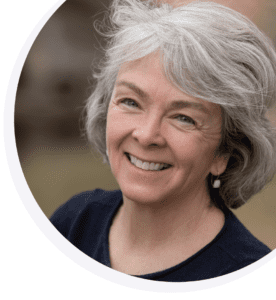
End of Life Doula, Podcaster, and founder of Best Life Best Death.